You love each other.
You get on well, and the sex has faded. Esther Perel wrote her book for couples in that spot.
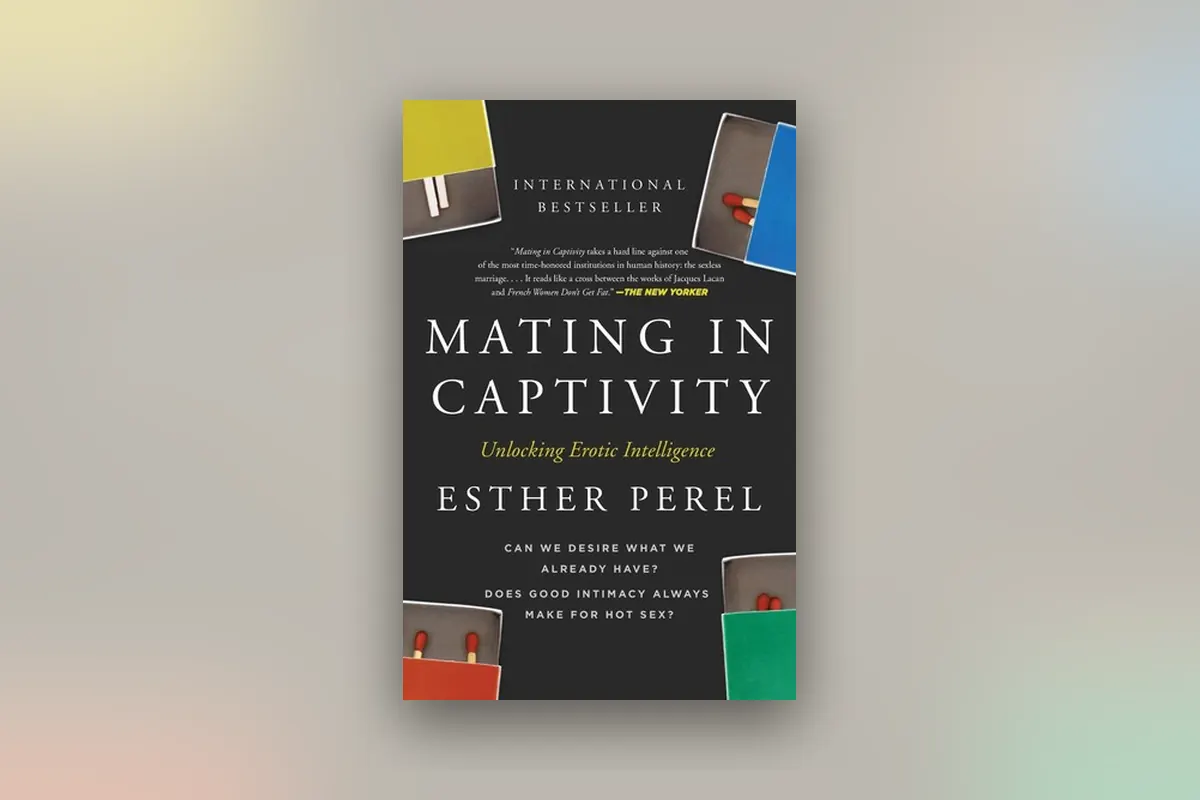
In this Mating in Captivity review I’ll tell you what she argues, where I agree and where I think she leaves couples short.
In one line: it helps you understand why closeness and desire pull in different directions, so you can stop blaming yourselves and bring some aliveness back.
It’s a book of ideas more than instructions. I think that’s both its strength and its weakness.
What the book is about
Mating in Captivity was first published in 2006.
Esther Perel is a psychotherapist who works with couples, and the current paperback runs to about 270 pages.
Her argument is that the things we want from a committed relationship, such as security and predictability, are the same things that dampen desire.
We now ask one person to give us what a whole community used to provide, and then we expect that person to stay exciting. Habit and certainty are good for love. They’re hard on sex.
She makes her case through stories of couples she has worked with: straight and gay, younger and older, with children and without.
The main ideas
- Security versus desire. Love wants closeness and knowing everything about your partner. Desire needs some distance and some mystery.
- Separateness helps. Having your own friends, interests and inner life gives your partner someone to be curious about.
- Erotic imagination. Eroticism is broader than sex. Perel wants couples to bring back play, fantasy and curiosity.
- Power and surrender. She writes openly about control and letting go in desire, and about wanting freely in bed without shame or guilt.
- Parenthood and sex. She looks at why children are so hard on a couple’s sex life, and argues that tiredness is only part of it.
- Cultural scripts. Our ideas about monogamy and gender shape what we expect from a partner, often without our noticing.

What I like about it as a couples therapist
As a couples therapist, what I like about this book is that it removes the shame.
Couples who are close friends and rarely have sex often think something is wrong with them. Perel shows how the fading can come from the closeness itself.
Does this sound like the two of you?
Her point about separateness is a good one.
Mark and I trained with David Deida, whose work on polarity says something similar: attraction needs difference between you.
I’ve written about why passion fades in long-term relationships if you’d like more on that.
I also like that she treats desire as something you take part in. She doesn’t treat it as a feeling that simply arrives or doesn’t.
That’s a hopeful message for a couple who think the spark has gone for good.
Where I’d add something is on safety.
I’m trained in Emotionally Focused Therapy (EFT), and from that point of view security doesn’t kill desire.
Many people can’t play, take a risk or ask for what they want until they feel safe with their partner.
You need both.
What other readers and reviewers say
For this Mating in Captivity review I looked at one trade review and two by clinicians.
Publishers Weekly reviewed it in 2006 and called her thesis “as revelatory as it is straightforward”. The reviewer liked how accessible it is and the wide range of couples in the case studies.
Le Shepard, a counsellor writing at The Therapist’s Bookshelf, calls it an honest book on a hard subject and a great read for therapists.
Her warning is blunt: “Couples wanting a how-to manual will be sorely disappointed.”
Dr T Srinivas Rajkumar, a psychiatrist, reviewed it on his own site. He praises the case studies and the non-judgmental tone.
He also notes that some readers with more traditional views will find the focus on eroticism challenging, and that the book sometimes lacks structured steps for daily life.
What it doesn’t do
All three reviewers land on the same limit, and I agree.
You’ll finish it understanding your situation much better and still not know what to do on Tuesday night.
It also doesn’t deal with the practical reasons desire drops, such as hormones, pain, resentment, or old hurt between you. If one of you wants sex far more than the other, start with my post on mismatched libido.
And a caution.
A partner who already keeps their distance can read this book as permission to keep more of it.
Perel is arguing for two whole people who still turn toward each other, which is a different thing.

Who should read it
Read it if you’re good companions and your sex life has gone flat. Read it if you’ve been telling yourselves that this is just what happens after ten or twenty years.
It’s best read by both of you, a chapter at a time, with a conversation after each one.
If you’d like steps as well as ideas, I’ve written about how to feel desired again in a long-term relationship.
Couples therapy is where those steps get tailored to the two of you.
My Mating in Captivity review in short: read it for the understanding, then get practical help for the rest.
Where to buy it
You can find Mating in Captivity in most bookshops and libraries. Here are three places to buy it:
- Mighty Ape (New Zealand)
- Paper Plus (New Zealand)
- Amazon
Prefer to listen? Look for the audiobook on Audible or Spotify.
Want support with this in your own relationship? Start with a free discovery call and we’ll talk about what would help the two of you most.