The two of you keep having the same fight.
If you can’t work out why, this is the first book I’d hand you.
In this Hold Me Tight review I’ll tell you what Sue Johnson’s book says, where it helps and where it stops.
In one line: it shows you the pattern underneath your arguments and gives you seven conversations to change it.
I should be upfront.
I’m trained in Emotionally Focused Therapy (EFT), the approach Sue Johnson developed, so I read this book as someone who works this way.
What the book is about
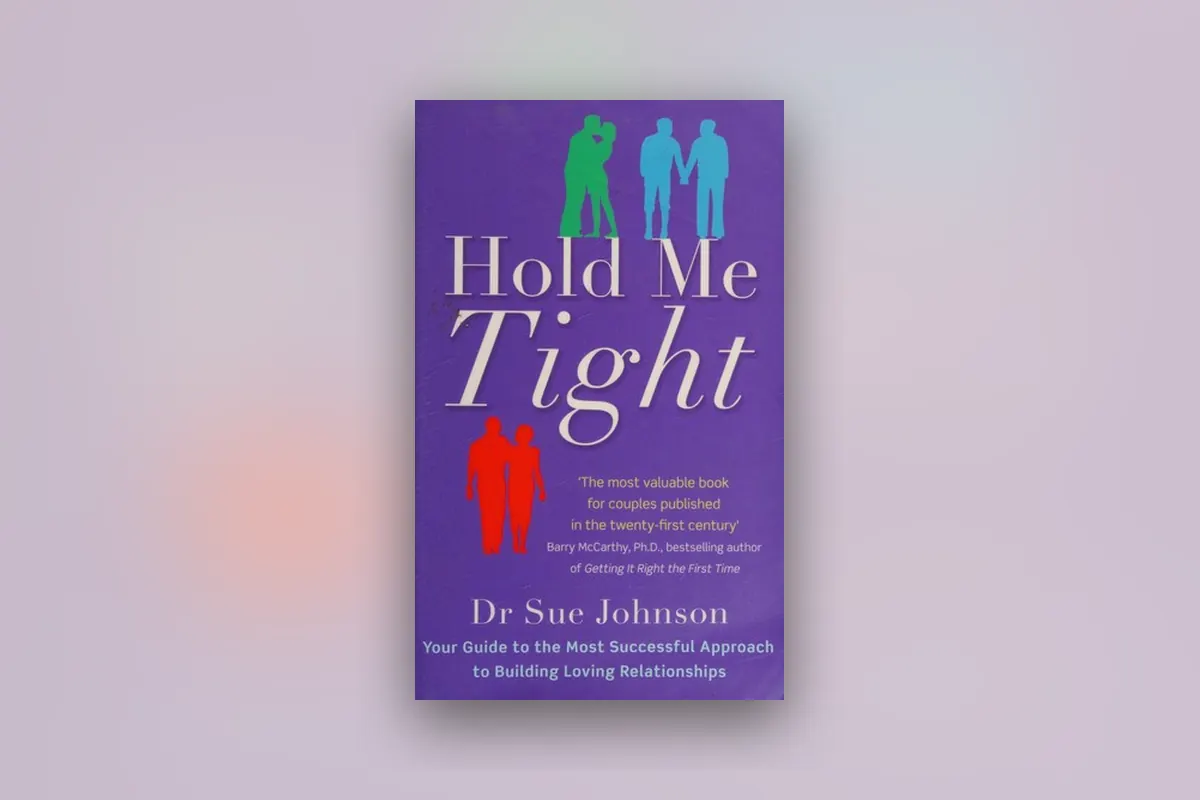
Hold Me Tight: Seven Conversations for a Lifetime of Love came out in 2008.
It was the first time Dr Sue Johnson, a Canadian psychologist, presented EFT to the general public. The UK paperback from Piatkus runs to about 310 pages.
Her main idea is simple to say.
Adult love is an attachment bond, the same kind of bond a child has with a parent.
We need to know our partner is there for us, and when we’re not sure, we either protest or shut down.
So most fights come back to one question. Are you there for me?
The book has three parts.
- The first explains the thinking behind EFT.
- The second takes you through the seven conversations.
- The third looks at keeping a strong bond over the years.
The chapters end with exercises to do together.
The main ideas
- Love is attachment. Needing your partner is normal and healthy in adults. Johnson treats that need as part of how we’re built.
- Demon Dialogues. Her name for the loops couples get stuck in. In the most common one, one partner criticises or pushes to get a response and the other pulls away.
- Raw spots. The sensitive places in each of you that set the loop off.
- Hold Me Tight. The conversation at the centre of the book. Each of you says what you’re most afraid of and what you need, plainly and without blame.
- Forgiving injuries. A way to repair a hurt that still sits between you. The hurt partner says how it affected them, and the other takes it in and owns it.
- Sex and touch. Johnson sees a good sex life as growing out of emotional safety, and gives it a conversation of its own.

What I like about it as a couples therapist
As a couples therapist, what I like about this book is that it takes the blame out of your arguments. The problem is the loop you’re both caught in, and neither of you is the villain.
When you can both see that loop, you stop reading each other so harshly.
The partner who pushes is reaching for closeness. The partner who goes silent is trying to stop things getting worse.
Does this sound like the two of you?
I’ve written more about this in the anxious and avoidant dance that most long term couples get caught in.
I also like that Johnson doesn’t teach communication tricks.
She asks you to slow down and say the softer thing underneath the anger, which might be I’m scared I’m losing you or I feel like I keep failing you.
That’s much harder than a script, and it’s what changes how your partner hears you.
The approach also has strong outcome research behind it. If you’d like the fuller picture, read my guide to Emotionally Focused Therapy for couples.
What other readers and reviewers say
For this Hold Me Tight review I also read what other people have said about the book.
In the Globe and Mail’s obituary for Johnson, who died in April 2024, Alan Freeman reports that the book has sold more than a million copies and been translated into 30 languages.
He quotes Boston University psychologist David Barlow, who said “she shifted the focus back to the all important, underlying emotional life of couples” and credited her with doing the hard work of testing her approach.
Sylwia Latacz, a psychologist writing for Psychotherapy Lisbon, recommends it as warm and readable, with one caveat.
Reading about a pattern is different from changing it in the middle of an argument, especially after an affair or years of distance.
In her words, “A book can start the work”.
Diana Brummer, a psychotherapist who reviewed it for Good Mental Health, found the ideas enormously helpful but the writing a bit disorganised and hard to follow.
She suggests pairing it with a workbook so you practise what you read.
What it doesn’t do
I agree with both therapists.
The seven conversations look simple on the page, and they’re hard to do alone when you’re hurt and defensive.
It’s easy to stall when one of you shuts down and there’s no one to slow things down.
It also won’t do much if only one of you reads it.
The conversations need both of you willing to try.
And it’s the wrong starting point if there’s violence in your relationship, or if one of you is afraid of the other.
That needs specialist help first.

Who should read it
Read it if you love each other and keep ending up in the same argument or the same silence. It’s a good book to read before or alongside therapy, because you’ll arrive already able to name your pattern.
If there’s been an affair or a long stretch of distance, read it and get support as well. In couples therapy you have someone to guide the conversation while you learn it.
So that’s my Hold Me Tight review in short. It’s the book I’d start with, and it works best when you read it together.
Where to buy it
You can find Hold Me Tight in most bookshops and libraries. Here are three places to buy it:
- Mighty Ape (New Zealand)
- Paper Plus (New Zealand)
- Amazon
Prefer to listen? Look for the audiobook on Audible or Spotify.
Want support with this in your own relationship? Start with a free discovery call and we’ll talk about what would help the two of you most.