
You probably know the scene.
It’s 10.30 pm, the dishes are done, the kids or the work emails are finally out of the way, and one of you says, “We need to talk.”
Within minutes you’re having the same argument you’ve had for years. One of you presses for contact. The other goes blank, gets defensive or practical, or heads for the spare room.
You both end up feeling bruised and unseen.
This is where Emotionally Focused Therapy can help.
Emotionally Focused Therapy (EFT) is a form of couples therapy based on attachment science. It helps the two of you see the negative cycle you get caught in, understand the feelings and needs underneath it, and turn towards each other again in a way that feels safe.
It was developed by Dr Sue Johnson and Dr Les Greenberg in the 1980s, and it’s one of the most researched forms of couples therapy there is.
One quick note: EFT here is not EFT tapping. They share the same three letters but they’re completely different things. I explain the difference in this post on EFCT and EFT tapping.
What I see with couples is that they can usually communicate perfectly well. What trips them up is the emotional dance that takes over when connection feels uncertain.
EFT helps couples see that dance clearly, slow it down, and create a safer way back to each other.
For long term partners who’ve become excellent co-managers of life but feel less certain how to be lovers, EFT can be a powerful turning point.
It builds the kind of emotional security where affection, play and desire can come back, and where you can be honest without having to agree on everything.
What is Emotionally Focused Therapy?
EFT is an evidence based approach to couples therapy developed from attachment science.
Attachment goes well beyond childhood, and it’s more than therapy jargon.
It’s the deeply human need to know: when I reach for you, will you be there? Do I still count? Am I safe to show you the tender, messy parts of myself?
When the answer feels uncertain, couples protect themselves.
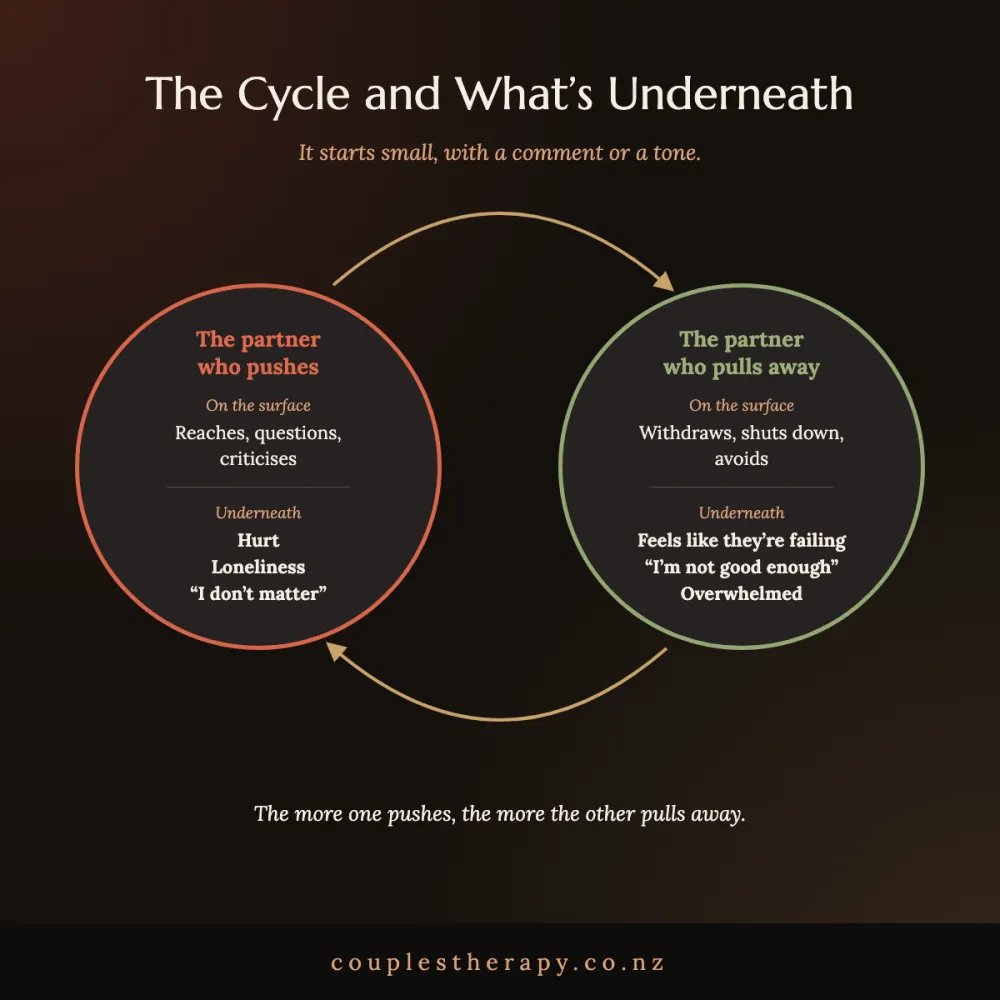
One person might criticise, pursue, explain, demand, or bring the issue up again at breakfast. The other might withdraw, shut down, get sharp, disappear into work, or offer solutions when their partner wants comfort.
From the outside, it can look like one partner is the problem. In Emotionally Focused Therapy, the cycle is the problem.
That shift can feel like a bloody relief.
You stop asking, “Why are you so cold?” or “Why are you always on my back?”, and you begin asking, “What happens to us when we lose each other?”
The answer is often far more vulnerable than either of you expects.
The pursuer may be carrying the terror of feeling unimportant.
The withdrawing partner may be carrying the shame of never getting it right, or the fear that any emotional conversation will end with them being blamed.
Beneath the protest and the retreat are two people trying, in clumsy and protective ways, to avoid getting hurt.
How Emotionally Focused Therapy works: the three stages
EFT doesn’t give you a script for conflict.
A skilled therapist listens for the pattern underneath the fight.
The argument might have begun with money, sex, the in laws, the dishwasher or a late text. What the therapist cares about most is what that moment stirred between you.
Early in the process, you map the negative cycle.
Maybe one of you raises the lack of intimacy, and your partner hears failure and retreats. You feel abandoned and push harder, and then they retreat further.
Or maybe one of you asks for sex, and your partner senses pressure and freezes. You feel rejected and become distant, and they feel even less desired as a whole person.
The details differ from couple to couple, but the loop is easy to recognise once you’ve seen it.
Can you see yours?
Once you can name the loop, you can begin to interrupt it.
Where one of you used to say, “You never want me,” you might learn to say, “When you turn away, I tell myself I don’t matter to you. I get angry because I’m scared of how much I miss you.”
There’s nothing magic about that sentence.
It’s a risk to say it, and intimacy gets built through risks that are received with care.
In the middle stage, therapy helps each of you reach and share the feelings beneath your automatic defences.
This is where the work can become deeply moving.
The person who has spent a decade appearing composed might finally say, “I pull away because I’m frightened you’ll see how inadequate I feel.”
The partner who has carried the emotional labour of the relationship might say, “I get loud because I don’t know how else to reach you.”
The final phase is about practising a new bond.
You learn to bring your needs, hurts, boundaries and attempts at repair to each other with more openness.
You also build confidence that a fight doesn’t have to turn into three days of distance.
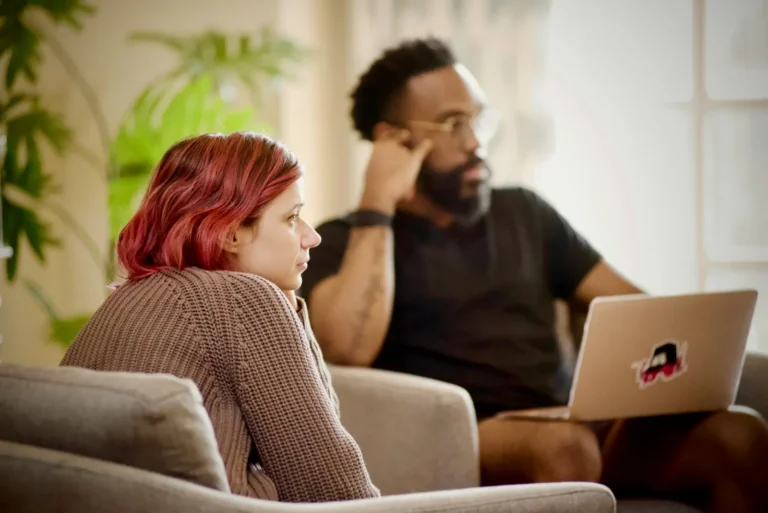
What an Emotionally Focused Therapy (EFT) session can feel like
A good EFT session is active and focused, and it feels emotionally alive.
Your therapist might slow a fast conversation right down and ask what happened inside you at a particular moment. They might help you turn towards your partner and say the truer thing in place of the familiar thing.
That can feel exposing.
Couples often arrive hoping the therapist will tell the other person to pull their weight.
What happens is that you both get invited to understand how the behaviour you dislike is a way of protecting yourselves.
Understanding it doesn’t excuse cruelty, betrayal, coercion or chronic disregard.
It lets you work with what’s actually driving the pattern, which is far more useful than arguing about the behaviour itself.
Sessions can include tears, anger, long silences and startling softness.
They can also include laughter, because sometimes you suddenly see how faithfully you’ve both danced the same ridiculous choreography. “I chase, you hide, I chase harder, you become a possum in headlights.”
Once you can name the pattern together, you start to have a choice about what you do next.
Does Emotionally Focused Therapy work?
Yes. The research on EFT is strong and consistent.
A 2022 review of 20 studies with 332 couples found that about 70% of couples were free of relationship distress by the end of therapy. The gains held up when couples were checked again later, up to two years on.
The same review found that couples did better when their therapist followed the EFT model closely. That’s one reason I trained formally in EFT and keep training.
An earlier review, by Sue Johnson and colleagues in 1999, found much the same.
And a 2019 review of 33 trials compared EFT with behavioural couples therapy. Both helped couples, and EFT’s results were still there six months later.
Does that mean it works for everyone?
No therapy does. But if you’re both willing to look at your cycle, the odds are very much on your side.
If you’re wondering how EFT compares with other approaches, I’ve written about that in What Is the Most Effective Couples Therapy?
How long does Emotionally Focused Therapy take?
In the research studies, EFT usually runs for 8 to 20 sessions.
In real life it depends on how long the cycle has been running, how much hurt there is, and whether there’s been a betrayal like an affair.
Some couples feel a clear shift in the first few sessions, once they can see the pattern. Others need longer to build enough trust to show the softer feelings underneath.
If you’d like to move faster, a two or three day private intensive gives you 12 to 18 hours of therapy, about the equivalent of six months of weekly sessions.
Emotionally Focused Therapy (EFT) and intimacy: security isn’t the same as sexual spark
For couples who miss desire and passion, Emotionally Focused Therapy is often the foundation, but it isn’t always enough on its own.
Emotional security supports desire.
It’s easier to relax, receive touch and risk asking for what you want when you don’t feel perpetually rejected, criticised or unsafe.
But a secure bond doesn’t automatically create a thrilling sex life.
Long term desire also needs attention, novelty, permission, embodiment, and honest conversations about turn ons and turn offs. It needs room for each of you to be more than a parent, provider or household operations manager.
This is where integrating EFT with sex therapy and embodied work can be potent.
- EFT helps you feel emotionally close again.
- Sex therapy helps you talk about sexual patterns without getting stuck in shame.
- Somatic and polarity based practices invite you out of your heads and back into breath, sensation, play and presence.
In my work with couples, I work with both: your emotional bond and your sexual connection.
The deepest love is still ahead of you when you’re willing to meet each other with courage, even when staying comfortable would be easier.
When Emotionally Focused Therapy (EFT) may be a strong fit
Emotionally Focused Therapy is particularly helpful when you keep circling the same conflict, feel lonely inside the relationship, struggle to recover after fights, or have lost the feeling that your partner is emotionally available.
It can also support couples rebuilding after breaches of trust, though the pace and structure need to fit what happened.
EFT takes time, so don’t expect a quick fix, and it won’t suit every circumstance.
Where there’s ongoing abuse, coercive control, active violence or fear of retaliation, joint therapy may not be safe. Individual support and a safety plan may need to come first.
If there’s an active affair, addiction or major mental health crisis, EFT can still be useful, but the therapist may need to address stabilisation, transparency or additional care alongside the couples work.
The fit also depends on readiness.
You don’t both need to arrive enthusiastic. Frankly, most couples don’t.
But you do need enough willingness to look at the dance you create together, and to put down the case you’ve been building against your partner.
How to get more from the work
Progress often happens between sessions.
After a hard moment, try identifying the cycle before you debate the facts.
You might say, “I think our pursue and withdraw pattern is here again. I don’t want to fight you. I want to find you.”
It may feel awkward at first. That’s fine. New things usually feel awkward until you’ve practised them.
Make small bids for connection that are realistic enough to keep.
- Sit together for ten unrushed minutes on the couch.
- Put a hand on your partner’s back as you pass in the kitchen.
- Ask a question that has nothing to do with logistics.
- Ask directly for comfort, and skip the test your partner can’t possibly pass.
None of these replaces therapy, but each one helps you both feel that closeness is possible again.
Please don’t use Emotionally Focused Therapy language as a weapon, either.
“You’re activating my attachment wound” won’t get you out of being accountable. The point is to become more tender and more responsible with each other, and getting fluent in therapy speak won’t do that for you.
Your relationship doesn’t need to stay a flat, functional arrangement simply because you’ve been together a long time.
You can learn to find each other after the fight, say what you feel underneath your defences, and bring more warmth into the ordinary hours of your life.
Want support with this in your own relationship? Find out about couples therapy with Tarisha, a private retreat for two, or our retreats for couples: the Valentine’s Retreat and The Wanaka Adventure. Or start with a free discovery call.






One Comment
Comments are closed.