
The Gottman Method suits couples who want clear tools.
You get a structured plan too. If you like knowing what you’re working on each week and why, this approach will probably feel comfortable.
I’ve trained in the Gottman Method and I use parts of it.
My main way of working is Emotionally Focused Therapy (EFT), so I’ll explain both and show you where they differ.
Which one would help the two of you more?
What is the Gottman Method?
Drs John and Julie Gottman developed it.
John Gottman began studying couples in the 1970s. He filmed them talking through a disagreement, then checked years later to see who had stayed together.
The core idea is that couples who last do specific things differently. They respond when their partner reaches for attention, and they repair quickly after a fight.
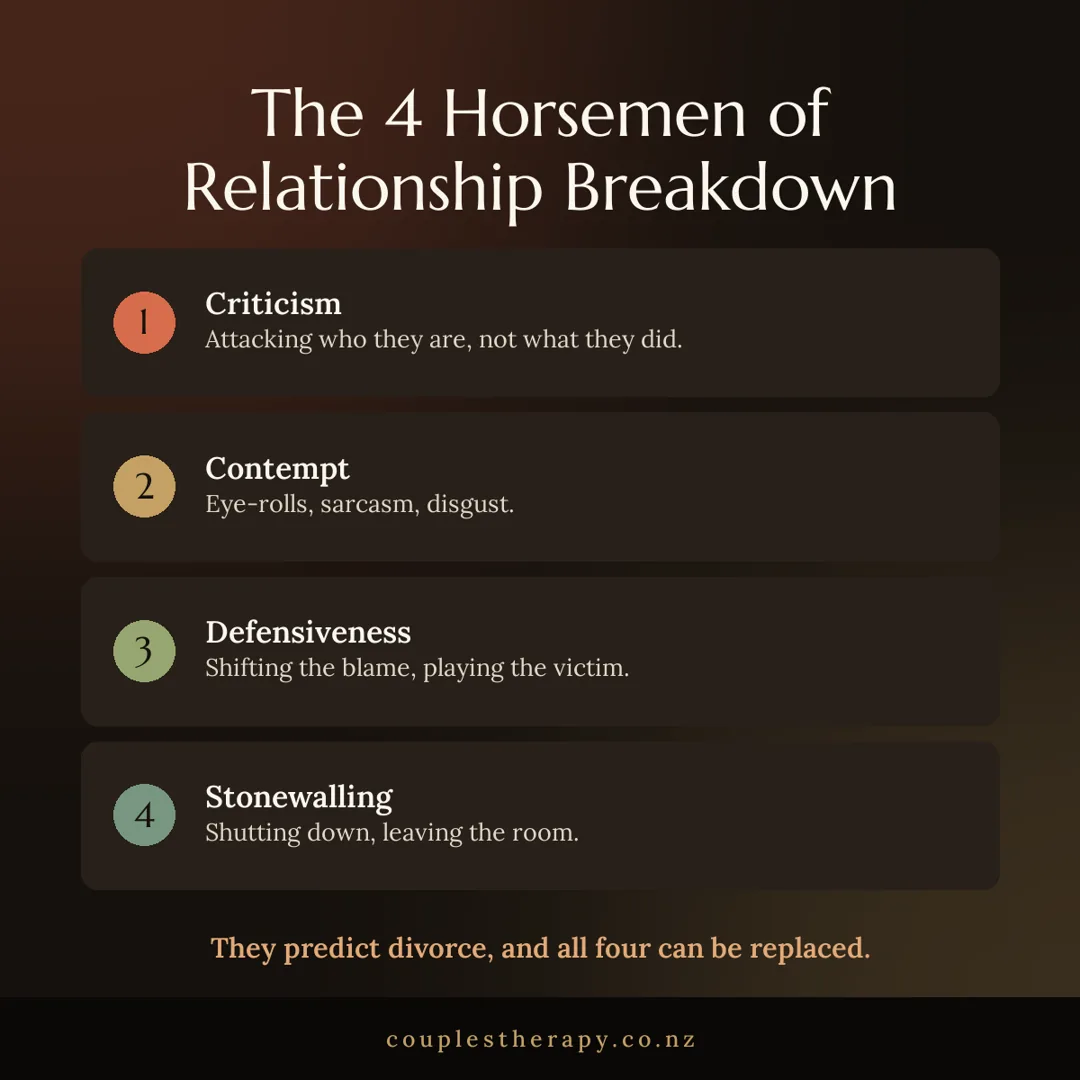
The method also names four habits that wear a relationship down:
- Criticism
- Contempt
- Defensiveness
- Stonewalling
Gottman calls them the Four Horsemen.
If you’ve read my post on what to do when you feel flooded in an argument, you’ve already met one of his ideas.
What happens in a session
It starts with an assessment.
You have a session together and then each of you meets the therapist alone. You both fill in questionnaires as well.
Then the therapist gives you feedback on what’s strong between you and what needs work.
After that, sessions are practical.
You might practise raising a complaint without blame, or learn to call a break when your heart is racing.
There are usually exercises for home.
There’s no fixed length.
The Gottman Institute says you and your therapist decide how often you meet and for how long. In the published studies, couples had about ten or eleven sessions.
What the research says
There are two kinds of research here, and they’re easy to mix up.
The first is Gottman’s observational research on what happy and unhappy couples do. It’s large, and it has shaped the whole field of couples therapy.
The second asks whether the therapy itself works. That body of research is much smaller.
- A 2018 study in Iran randomly assigned 16 couples to ten sessions of Gottman therapy or to a control group. The therapy group improved in marital adjustment and intimacy, and the gains held at follow up.
- A 2017 study followed 106 gay and lesbian couples through about eleven sessions. Relationship satisfaction improved in both groups. There was no comparison group.
- A 2026 study of 35 couples who had Gottman Method therapy after infidelity found both partners improved from the start of therapy to the end.
These results are encouraging.
The studies are small, though, and most have no control group.
So the evidence for the therapy is thinner than the fame of the method suggests.
What other people say about the Gottman Method
Journalist Laurie Abraham looked closely at Gottman’s claim that he can predict divorce, in an article for Slate. She found his formulas were built after the researchers already knew which couples had divorced, and they weren’t then tested on new couples.
She was still fair to him: “Undeniably, Gottman has made enormous contributions to the study of marriage.”
Psychology lecturers Lisa Williams and Rebecca Pinkus made a similar point in The Conversation. They wrote that when prediction models like his are tested on new samples, the accuracy drops a lot.
Couples therapist Figs O’Sullivan, writing on his Empathi blog, praises the practical tools and the shared vocabulary they give couples.
His criticism is that the method often stays at the level of behaviour, and that it suits moderate distress better than a crisis.
In his words, “It can feel like a classroom.”
How the Gottman Method compares to Emotionally Focused Therapy
The two have a lot in common.
Both work with the two of you together, and both see the fight about the dishes as a sign of something underneath.
- Focus. Gottman teaches skills and habits. Emotionally Focused Therapy works with the emotions and attachment needs that drive the negative cycle between you.
- Style. Gottman sessions are structured, with exercises and homework. EFT sessions are slower and stay with what you’re feeling in the room.
- Evidence. EFT has more outcome research. A 2022 meta analysis of 20 studies and 332 couples found about 70% of couples were free of relationship distress at the end of therapy, with results holding up to two years. There’s more on the EFT research page.
Which one is right for you?
The Gottman Method may suit you if you’re both fairly steady and you want tools. It’s a good fit if you like structure and you’ll do the exercises at home.
EFT may suit you better if you already know the tools and still end up in the same fight.
That usually means something deeper is being touched, such as a fear that you’re not important to your partner.
You don’t have to choose only one.
In my own work, EFT is the base.
I bring in Gottman tools when a couple needs something practical to use between sessions.
You can read how I work on my couples therapy page, or start with my guide to Emotionally Focused Therapy.
Where to learn more
- Book: John Gottman and Nan Silver, The Seven Principles for Making Marriage Work (1999).
- Official site: The Gottman Institute, which also has a page on the method’s effectiveness research.
- Video: Making Marriage Work, a talk by Dr John Gottman on The Gottman Institute’s YouTube channel.

Where to buy the books
- The Seven Principles for Making Marriage Work by John Gottman and Nan Silver: Mighty Ape, Paper Plus or Amazon
- Eight Dates by John Gottman and Julie Schwartz Gottman: Mighty Ape, Paper Plus or Amazon
Not sure which approach is right for the two of you? Start with a free discovery call and we’ll talk about what would help you most.