It’s a question I get asked a lot.
Couples want to know they’re putting their time, money and hope into something that works.
So here is my honest answer. The two approaches with the strongest research are Emotionally Focused Therapy (EFT) and Integrative Behavioural Couple Therapy (IBCT). Other approaches can help too, and the therapist you choose is just as important as the method.
Let me explain what the research actually shows.
Does couples therapy work at all?
Yes, it does.
A 2020 review of 58 studies with more than 2,000 couples found that couples therapy has a large effect on how happy couples are together. It also improved communication, emotional intimacy and how partners treated each other.
Couples who were put on a waiting list instead didn’t improve.
That’s worth knowing if you’ve been hoping things will sort themselves out with time. Usually they don’t.
The same review found that couples who were more distressed at the start often made the biggest gains.
An earlier review by Jay Lebow, Sue Johnson, Andrew Christensen and colleagues put it simply: couples therapy helps about 70% of couples. That’s similar to individual therapy.
So if you think you’ve left it too late, you may be surprised.
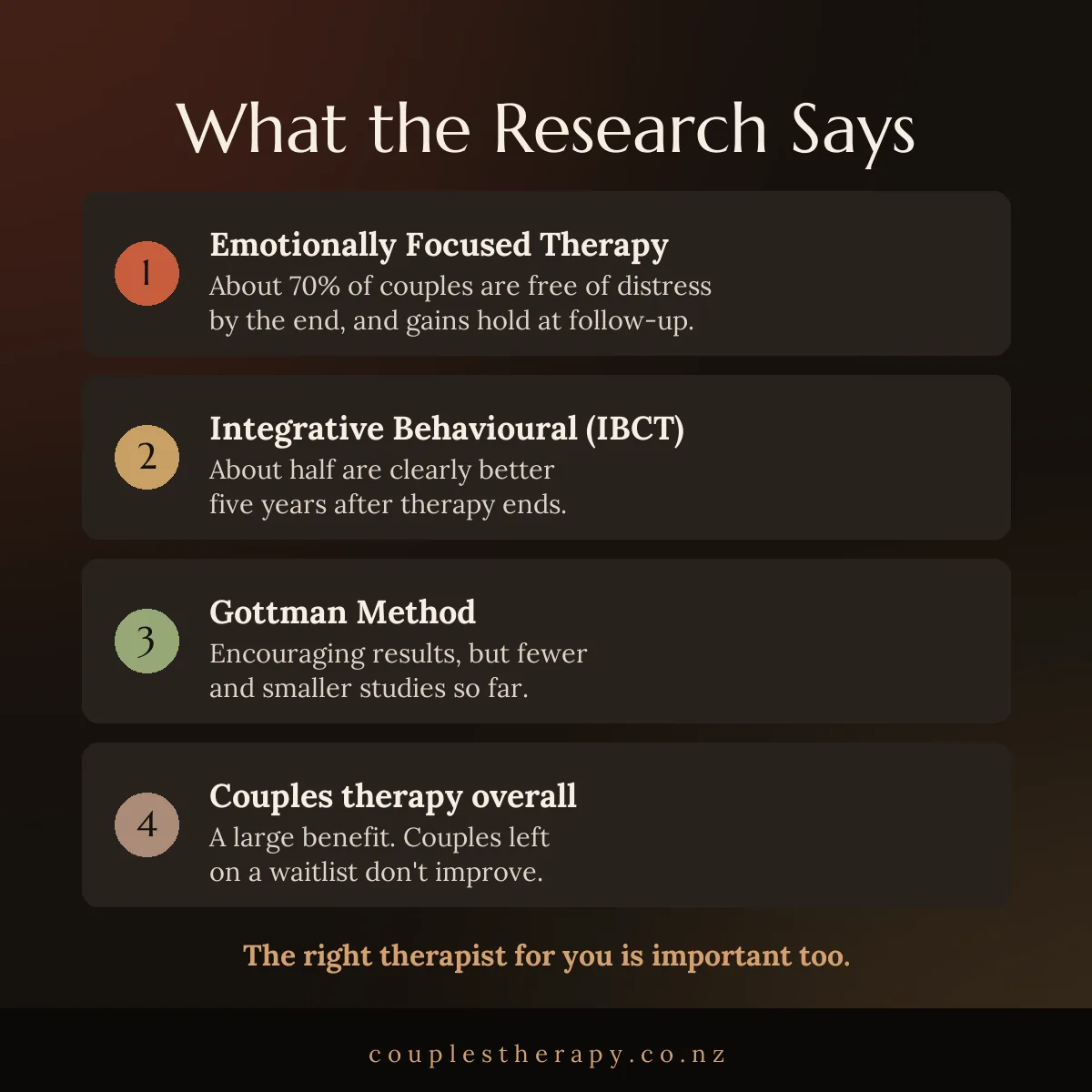
The approaches with the strongest research
Emotionally Focused Therapy (EFT)
This is the approach I use as my base.
Emotionally Focused Therapy helps you see the negative cycle you get stuck in, like one of you pursuing and the other withdrawing. Then it helps you reach the feelings underneath, such as the fear of not being important to your partner, and share them in a way that brings you closer.
A 2022 review of 20 studies found that about 70% of couples were free of relationship distress by the end of EFT, and the gains held at follow up.
You can read more in my guide to Emotionally Focused Therapy.
Integrative Behavioural Couple Therapy (IBCT)
IBCT was developed by Andrew Christensen and Neil Jacobson.
It combines practical skills, like communication and problem solving, with acceptance. The idea is that some differences between you won’t change, and learning to accept them can bring you closer.
It has one of the longest follow ups in couples research. In a large trial, about half of the couples were clearly better five years after therapy ended. About a quarter had separated.
When a 2019 review of 33 trials compared EFT with behavioural couples therapy, both worked and neither clearly beat the other.
Other approaches you’ll hear about
Many other approaches are popular and can be very helpful. Their research is usually smaller, or still growing.
- The Gottman Method. Practical tools based on John Gottman’s research on what happy couples do. The research behind the ideas is large, but there are fewer studies of the therapy itself.
- Imago Relationship Therapy. Structured dialogues that link your conflicts to childhood. I compare it with EFT in Emotionally Focused Therapy vs Imago.
- Somatic and body based therapy. Works with what happens in your body when you feel close or threatened. More in how somatic couples therapy can help.
- Sex therapy. Focuses on desire and your sex life. See sex therapy vs couples counselling.
- Relational Life Therapy, PACT and IFS. Newer approaches with growing followings. I’m writing about each of them in the coming weeks.
Does that mean these don’t work?
Not at all. It means we know less about them, so far.
What makes the biggest difference
The method is only part of it.
In the 2022 EFT review, couples did better when their therapist followed the model closely. Training and skill are important, whatever the approach.
Feeling safe with your therapist is important too. You both need to feel that they’re on your side as a couple, and not taking one partner’s side against the other.
And timing helps. The longer a negative cycle runs, the more hurt builds up and the longer it takes to soften.
Try this: when you look for a couples therapist, ask them three things. What approach do you use? What training do you have in it? How do you make sure both of us feel heard?
I go through more questions in How to Choose a Couples Therapist.
One important exception. If there’s violence, threats or coercive control in your relationship, couples therapy may not be safe. Individual support needs to come first.
How I work with couples

Emotionally Focused Therapy is my base, because the research is strong and because I see it work with couples every week.
I also bring in Gottman tools when a couple needs something practical to use at home, body based work from my Hakomi training, and sex therapy when desire has faded.
Most couples I see want two things. They want to stop having the same fight, and they want to feel like lovers again.
That usually needs both the emotional work and the physical side.
You can read more about how I work on my couples therapy page. If you’d like to make faster progress, I also offer a private retreat for two.
Where to learn more
- Roddy and colleagues (2020), Meta analysis of couple therapy, Journal of Consulting and Clinical Psychology.
- Spengler and colleagues (2022), A comprehensive meta analysis on the efficacy of emotionally focused couple therapy.
- Rathgeber and colleagues (2019), The efficacy of Emotionally Focused Couples Therapy and Behavioral Couples Therapy.
- Christensen and colleagues (2010), five year follow up of IBCT, summarised by ScienceDaily.
- Book: Sue Johnson, Hold Me Tight. Read my review of Hold Me Tight.
Not sure which approach is right for the two of you? Start with a free discovery call and we’ll talk about what would help you most.