It starts small.
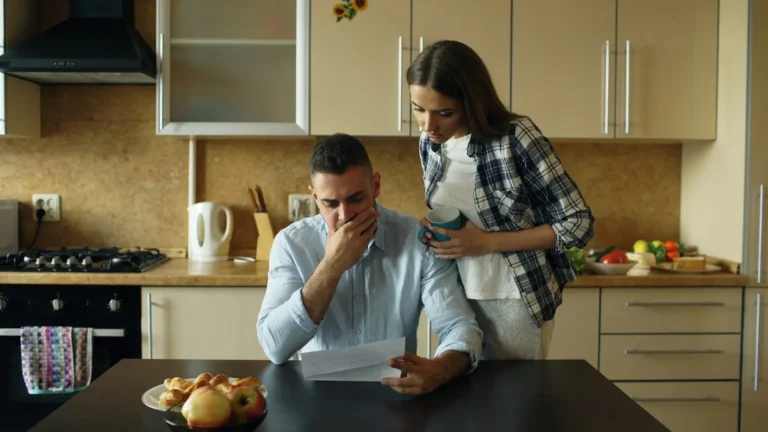
A distracted answer. A plan that got forgotten. A week where you’ve been passing each other in the hallway.
One of you says, “Can we talk?” The other says, “Not now.”
And somehow, ten minutes later, one of you is standing in the kitchen doorway raising your voice, and the other is reaching for the car keys.
If this feels familiar, you’re not a bad couple.
You’re doing a dance.
Almost every long term couple does some version of it. Most just don’t know it has a name.
The dance with two steps
In Emotionally Focused Therapy (EFT), developed by psychologist Sue Johnson, this is called the pursue and withdraw cycle.
It’s one of the most common patterns couples bring to therapy.
In EFT, the partner who reaches is called the pursuer, and the partner who retreats is called the withdrawer.
You may also have heard this described as anxious and avoidant partners.
It has two steps.
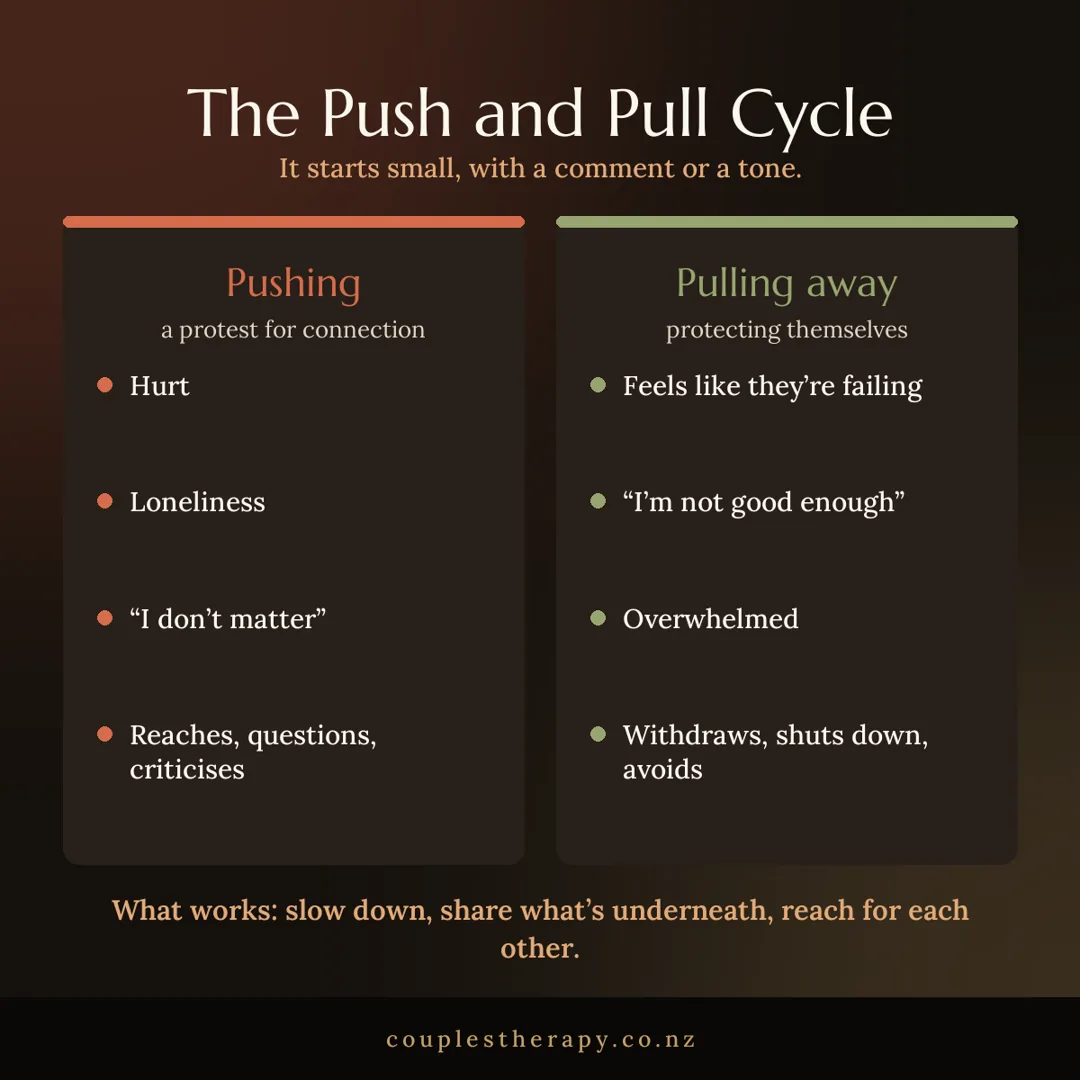
One partner feels disconnected and reaches to close the gap.
They ask questions, raise concerns, push for a conversation. If nothing changes, they push harder.
That’s the reaching partner, sometimes called the pursuer.
The other partner senses tension and steps back to stop it from getting worse.
They go silent, change the subject, leave the room, or try to fix it fast so it’ll end.
That’s the retreating partner, sometimes called the withdrawer.
Here’s the trap.
The more one reaches, the more the other retreats. The more one retreats, the more the other reaches.
Each person’s move is a reaction to the other’s.
Round and round it goes.
Try this: think about your last argument and notice who reached out and who pulled back, without judging either of you.
What’s going on for the reaching partner
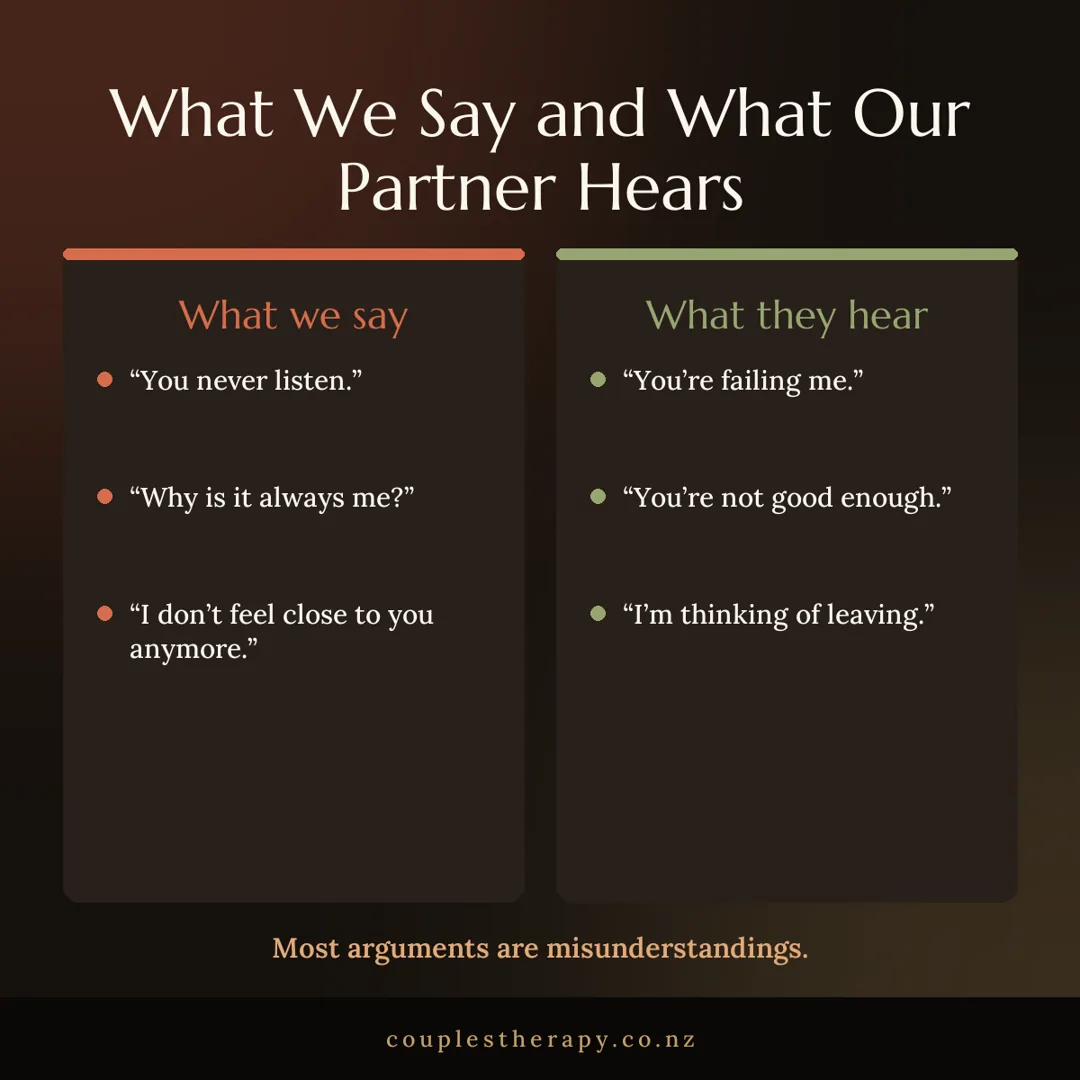
From the outside, the reaching partner can look demanding, critical, even angry.
- “You never listen.”
- “Why do I always have to bring things up?”
- “Do you even care?”
But listen underneath and there’s usually one message: come back to me.
The reaching partner’s body is sounding an alarm.
Something in them says, we’re drifting, I’m losing you, I’m on my own here. And when you feel that, staying calm is very hard.
The protest gets louder because the fear is getting louder.
Many reaching partners have learned that being nice doesn’t work. If they wait patiently, nothing changes.
So they push.
And pushing becomes the way they try to save the connection.
What’s going on for the retreating partner
From the outside, the retreating partner can look cold, uncaring, checked out.
- The silence.
- The shrug.
- The “I don’t know.”
- The disappearing into the shed.
But underneath there’s usually a very different message: I don’t want to make this worse.
The retreating partner often feels like they’re failing.
Whatever they say seems to be wrong. The criticism lands like a judgement.
So their body does what it knows to protect the relationship and themselves: it shuts down.
Some people describe it as their mind going blank.
Others feel flooded, heart racing, unable to think.
Withdrawing isn’t the same as not caring. Often it’s what caring looks like when you’re overwhelmed.
Try this: if you’re the one who goes silent, notice what happens in your body just before you do. Maybe your chest tightens, your heart races or your mind goes blank. That’s useful information, and it’s worth sharing.
Why it keeps getting faster
In a new relationship, the dance might happen occasionally. After twenty years, it can happen in seconds.
It can start with a sigh, a look or “we need to talk”.
Do you know that moment?
That’s because both of you have rehearsed your steps hundreds of times. Your nervous systems know the music. The moment it starts, you’re both already halfway into your moves.
This is also why long term couples sometimes say, “We fight about nothing.” The dishwasher, the dog, the directions. It’s never about those things.
It’s about the dance.
Nobody is the bad guy
This is the most important idea in this whole post.
The reaching partner isn’t needy or nagging. The retreating partner isn’t cold or uncaring.
Both of you are trying to protect the relationship. One by reaching for it. One by trying not to damage it.
The tragedy is that your protective moves trigger each other.
So the problem isn’t your partner. The problem is the cycle.
And once you can both see the cycle, you’re on the same side. It becomes the two of you against the pattern, not against each other.
Even good couples dance
Many couples who say “we’re good together” still do this dance, just with less noise.
Instead of shouting, there’s a sigh and a silence. Instead of slammed doors, there’s an early night and a back turned in bed.
That silent version is easy to miss, but it does its work over time. The reaching partner gradually gives up and goes silent too.
And then both of you are lonely in a house that looks perfectly fine.
Does this sound familiar?
How to step out of the dance
You can’t stop the alarms going off. But you can change what you do next.
Name it together. Give your cycle a name: “the chase”, “the storm”, “our dance”. When it starts, either of you can say, “We’re doing it again.” That one sentence can stop a two hour fight.
Slow it down. The cycle runs on speed. Take a breath, lower your voice, and sit down if you’re standing.
Say the softer thing. Underneath the anger there’s usually something softer: hurt, fear, loneliness.
The reaching partner might say, “I’m not trying to attack you. I miss you and I’m scared we’re drifting.” The retreating partner might say, “I go silent because I’m scared of getting it wrong.”
Take a break with a promise. If you need to step away, say when you’ll be back. “I need twenty minutes. I’m not leaving you. I’ll come and find you.” Then come back.
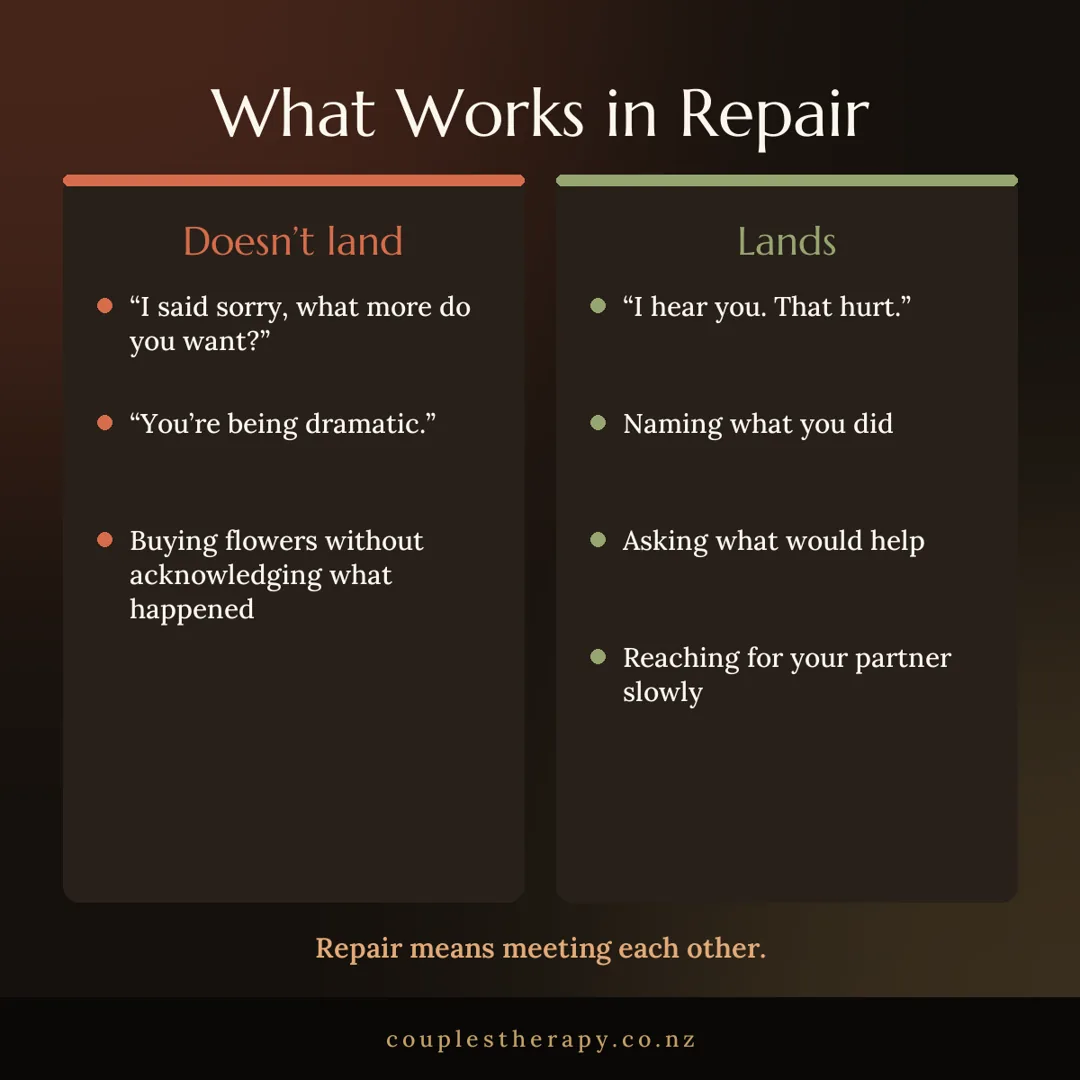
Repair afterwards. When things are calm, talk about what happened. Not to win, but to understand.
What to do during the break
A break works best when you’ve agreed on it beforehand.
The reaching partner agrees not to chase or send a string of texts during the break. You both use the time to settle yourselves, and neither of you uses it to build a better argument.
You calm down through your body as well as your head.
- Walk around the block.
- Feel your feet on the ground.
- Breathe more slowly than you think you need to.
- Put cold water on your face, or stretch your shoulders.
When you return, begin with connection before content.
A hand held across the couch, eye contact, or simply, “I’m back and I want to understand,” can change the whole mood of the conversation.
Some people find touch calming during conflict and others find it invasive, so ask first.
Practise when things are calm
The pattern won’t change only in the heated moments.
Build small, repeatable rituals when things are relatively calm. A ten minute daily check in can be enough if you both mean it.
Ask, “What’s one thing weighing on you?” and “What’s one thing you want more of from us this week?”
Listen without correcting, fixing or presenting evidence.
When the problem is practical too
Not every complaint is only about the cycle.
Sometimes there’s a genuine mismatch in workload, parenting, alcohol use, money or sexual desire, and practical change is needed.
Practical problems are far easier to solve, though, when neither of you is feeling under attack at the same time.
When to get some help
If the dance has been running for years, it can be hard to step out on your own. That’s not a failure. It’s just that patterns this old need some outside eyes.
A therapist trained in Emotionally Focused Therapy can help you see your cycle clearly and practise new steps.
So can a couples workshop or retreat where you learn it together.
Want to understand what’s happening between the two of you? Come to Reignite Your Love, a 3 hour workshop in Auckland about the emotional and sexual cycle and how to step out of it. Or start with a free discovery call.