
You can feel lonely beside your partner.
You can share a bed, a mortgage, a calendar full of obligations and decades of family history, and still feel strangely alone beside the person you chose.
The best ways to rebuild connection don’t start with a more efficient date night or a forced conversation over red wine. They start when you stop blaming one of you for the distance, and get curious about the pattern that keeps you apart.
For many long term couples, disconnection isn’t dramatic. It builds through small absences.
A bid for attention goes unanswered, a practical chat replaces a proper one, and the familiar fight ends with both of you retreating to opposite ends of the house.
Desire often goes missing here too.
That happens when emotional safety and curiosity get pushed aside by how busy daily life is, and it doesn’t mean either of you is broken.
The good news is that mature love doesn’t have to flatten with time.
If you’re both brave enough to pay attention to it, it can become richer and more honest than the love you had at the beginning, and hotter too.
1. Name the negative cycle and stop blaming each other
When couples are stuck, the fight is rarely about the dishes, the spending or who forgot to call Mum.
It’s usually one of you protesting that you don’t feel close any more.
One of you reaches with criticism, questions or intensity because you’re afraid you no longer matter. The other hears failure or pressure, and withdraws, goes blank or gets defensive.
Then the first one reaches harder, and you’re both caught in the same miserable dance.
Emotionally Focused Therapy (EFT) calls this the negative cycle, and seeing it clearly changes how you talk to each other.
Where you’d normally say, “You never care about me,” try, “When you turn away while we’re talking, I tell myself I’m on my own, and I get sharp because I want to feel close to you.”
Speaking this way gives your partner something they can respond to. In my experience, vulnerability brings a partner closer far more reliably than building a case against them.
A simple reset after conflict
When things heat up, pause before either of you says something hurtful.
Take twenty minutes apart if you need to, but agree on when you’ll come back.
During the pause, ask yourself what you’re protecting.
Is it hurt, or shame? Is it fear of being rejected or controlled, or the old belief that you have to handle everything alone?
Then come back and speak from that place.
You’re trying to find each other again, and winning the argument won’t get you there.
2. Create rituals that make your partner feel chosen
Good intentions aren’t enough to keep you connected.
Connection needs structure, especially in a full life where work, teenagers, ageing parents and endless admin can take up the whole week.
Choose one daily ritual that says, “I’m still here and I’m still interested in you.”
It might be a ten minute check in before phones come into the room, a walk after dinner, or a proper reunion when one of you gets home.
I don’t mean a distracted “How was your day?” while you unload the groceries.
I mean a moment where you look at each other, touch, and are fully there.
Ask questions that can’t be answered with “fine”.
- What felt heavy today?
- What gave you energy?
- Where did you feel most like yourself?
- What are you carrying that I might not see?
Then create a weekly ritual that stops the relationship turning into a project management meeting.
Spend part of it on logistics if you must, but leave room for laughter, daydreaming together and touch.
Your relationship needs fun and closeness as well as planning.
3. Repair early, before resentment builds
Every couple gets it wrong sometimes.
The couples who grow closer over time have ruptures too. What sets them apart from the couples who drift is that they know how to repair.
A proper repair is specific, so “Sorry you took it that way” doesn’t count.
Try something like, “I was dismissive when you were trying to tell me something important. I can see why that hurt. You deserved my attention.”
Don’t defend yourself, and don’t go straight to your own complaint.
If you’re the one who was hurt, be honest about what would help.
Maybe you need reassurance, a change in behaviour, or a conversation at a better time. Maybe you just need to be held while your nervous system settles.
Please don’t make your partner guess and then mark them down for failing the test.
Repair works best when it happens early.
Staying irritated for three weeks because you don’t want to make a fuss might look like keeping the peace, but what you’re building is resentment.
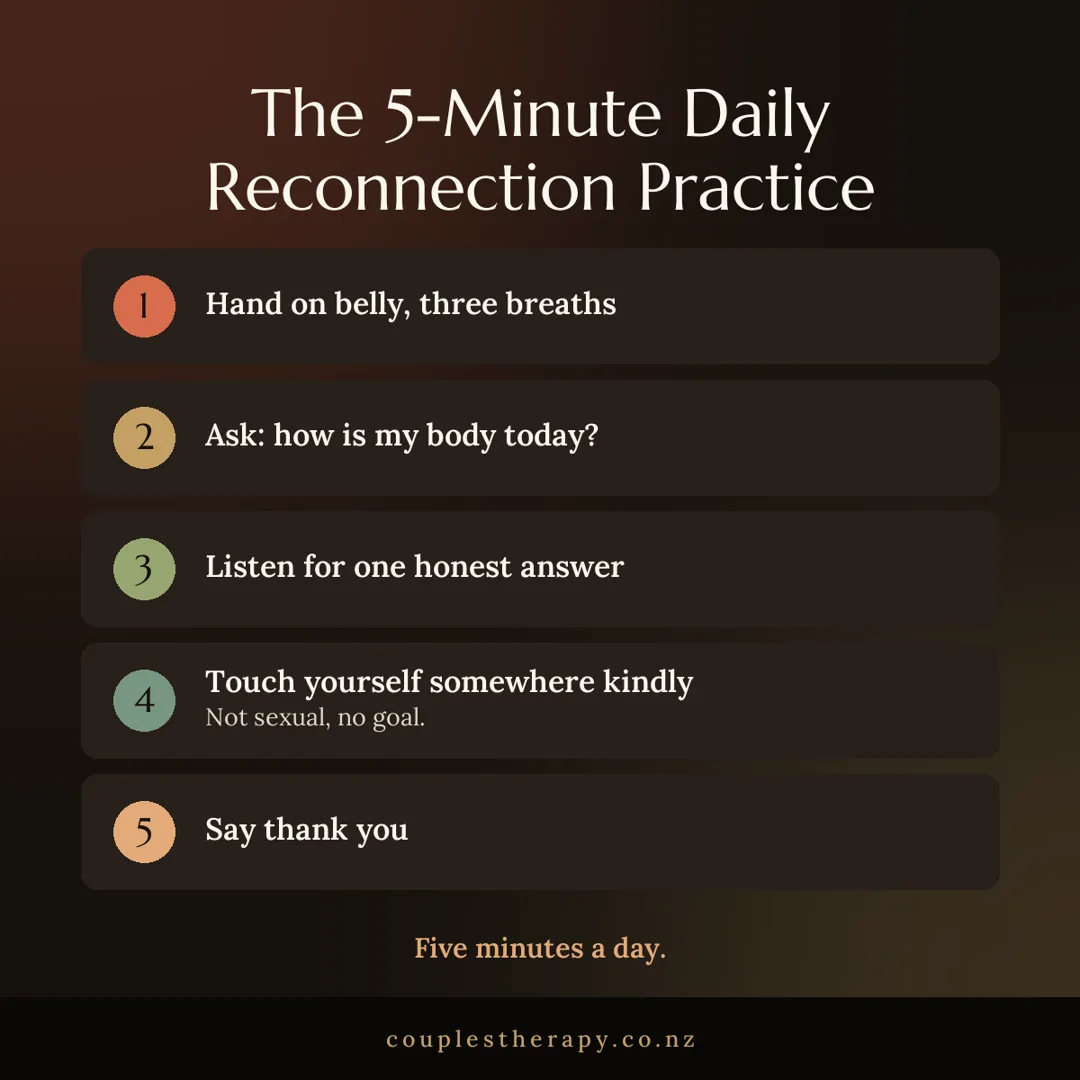
4. Bring the body back into the relationship
You can’t think your way into a fully alive partnership.
We feel connection in our bodies: through our breath, eye contact, tone of voice, and touch that isn’t automatically a lead up to sex.
Start with affection that has no agenda.
Sit with your legs touching. Hold each other for thirty seconds longer than feels normal.
Put a hand on your partner’s chest while you speak, and slow down enough to notice whether their body softens, braces or reaches back.
For couples whose sexual connection has faded, pressure rarely helps.
Scheduling sex helps some people protect time for intimacy, but it can feel like one more task if desire has become fraught.
Start with sensual contact and honest conversation.
- What kind of touch feels nourishing lately?
- What turns you off before anything even begins?
- What would make sex something you look forward to?
Erotic intimacy thrives on safety and on difference.
You need to feel accepted.
You also need to experience your partner as a separate, fascinating human being, and as more than your co-manager of life.
A little mystery doesn’t threaten closeness, and it can feed desire.
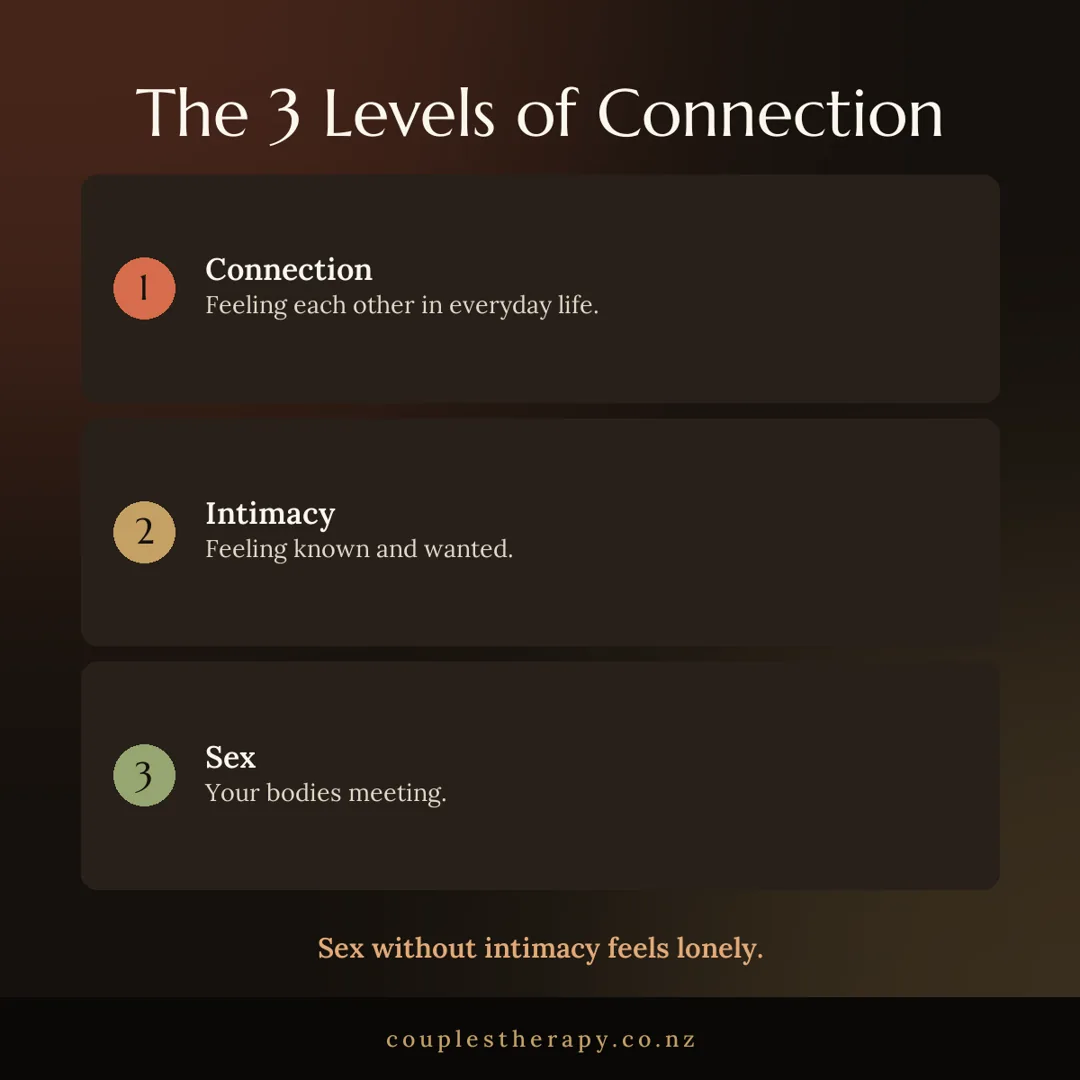
5. Talk honestly about desire, without judging each other
Many couples avoid talking about sex because the conversation feels loaded. The partner with less desire is afraid of being judged.
The partner with more desire feels rejected, and then either stops asking or pursues with growing frustration.
Both of you end up lonely.
Talk about desire outside the bedroom, at a time when neither of you is making a bid for sex.
Be direct and kind.
“I miss feeling wanted by you” lands differently from “You never want me.”
“I’ve been disconnected from my body lately” invites your partner to ask more, while “I’m just not interested” usually ends the conversation.
For many people, desire is responsive. It may arrive after relaxation, affection, novelty, emotional closeness or a sense of being seen.
It also depends on stress, hormones, medication, body image, unresolved hurt and how the work at home is shared. There’s no one size fits all solution, which is exactly why a curious conversation beats assumptions.
6. Do something that asks more of you than dinner out
A restaurant date has its place.
But if every attempt at reconnecting happens across a table while you talk about the children, the investment property or the bloke at work who drives everyone mad, you’ll keep getting the same result.
A shared challenge creates a different kind of closeness. Take a hike that makes your calves complain, or learn something awkward together.
Plan a weekend where neither of you is responsible for feeding everyone else. Go somewhere that interrupts your familiar roles and lets you meet each other with fresh eyes.
The point of adventure is to step outside the routines that have made you predictable to each other.
It doesn’t need to look impressive in photos.
You face something uncertain together, you laugh at the wrong turn, and you feel your bodies come alive.
That’s when you remember that you’re lovers and friends, as well as two people who run a household together.
7. Get skilled support before the gap feels permanent
There comes a point where repeating the same kitchen table conversation is just exhausting. If every discussion loops back to blame, shutdown or despair, more effort on your own may not change the pattern.
Skilled support can slow the cycle down and help you reach the emotions neither of you has felt safe enough to say out loud.
Look for support that works with both attachment and intimacy.
A relationship can become more peaceful and stay sexually flat. It can also become sexually adventurous while the emotional injuries go untreated.
Good couples therapy covers both: feeling secure with each other and feeling desire for each other.
At Couples Therapy & Retreats, I work with couples who want more than just getting along and are ready to find out what’s possible between them. That work might happen in therapy, in an intensive or on an immersive retreat.
Wherever it happens, the aim is a relationship that’s more honest and more passionate than the one you had before.
The deepest love may still be ahead of you, and you don’t need to be perfect to get there.
You do need to be present with each other.
Turn towards the conversation you’ve been avoiding. Reach for your partner’s hand before you reach for your phone.
Want support with this in your own relationship? Find out about couples therapy with Tarisha, a private retreat for two, or our retreats for couples: the Valentine’s Retreat and The Wanaka Adventure. Or start with a free discovery call.