
You may have talked about your problems for years.
If nothing has shifted, Hakomi therapy may be worth a look.
It suits people who are willing to slow down and notice what happens in their body, not only in their thoughts.
I’m a graduate of the two-year Hakomi training, so I know this approach from the inside. My main method with couples is Emotionally Focused Therapy (EFT), and I bring Hakomi skills into that work.
Here’s what Hakomi is, what the research does and doesn’t show, and how it sits next to EFT.
What is Hakomi therapy?
Hakomi is a body-centred, mindfulness-based psychotherapy.
The American therapist Ron Kurtz developed it in the 1970s with a group of colleagues, and the Hakomi Institute was founded in 1981.
The core idea is that your early experiences leave you with beliefs you don’t know you hold.
“I have to do everything alone” is one example. Hakomi calls this core material.
You can’t easily think your way to these beliefs.
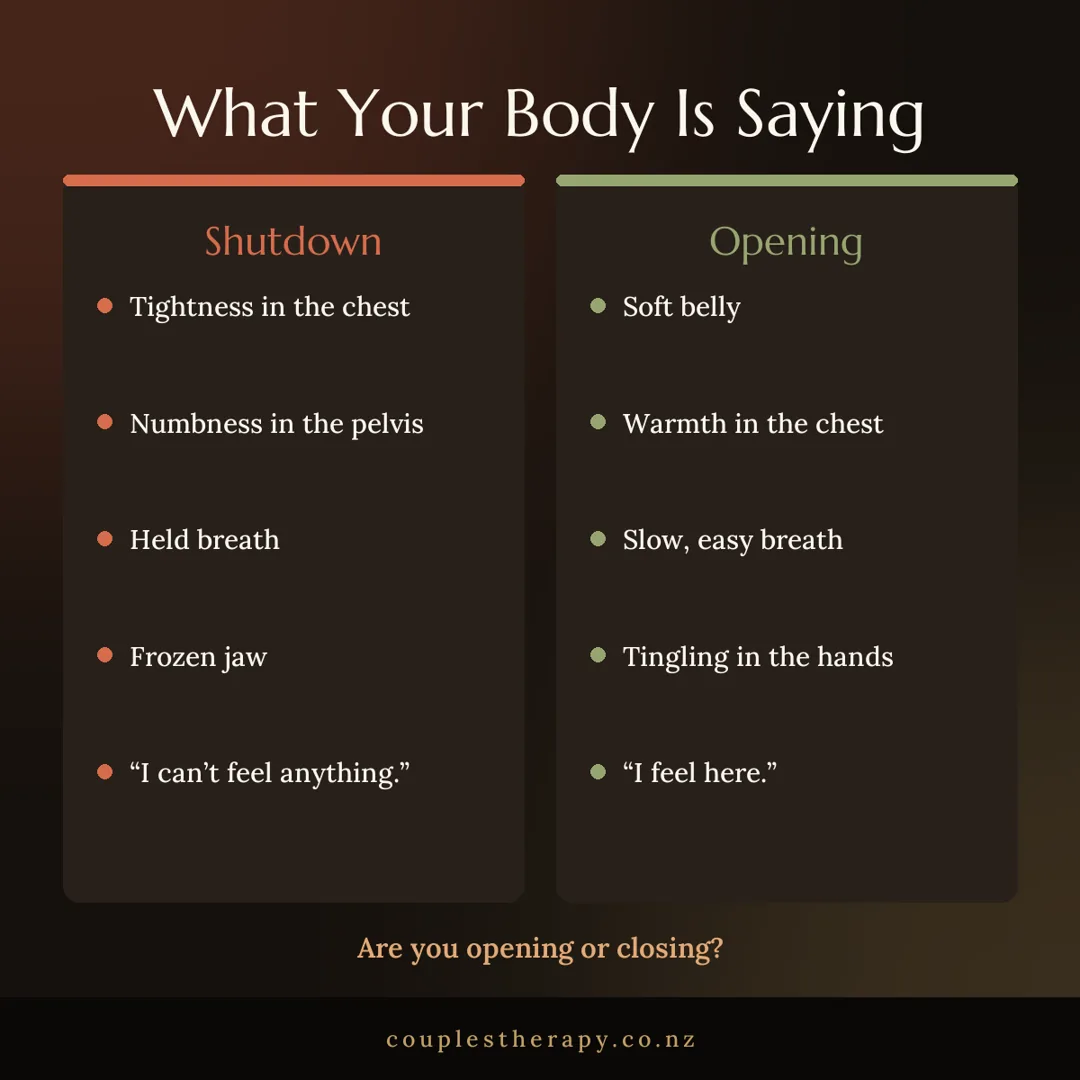
They show up in your body, in the way your shoulders lift or your breath stops when your partner raises their voice.
So Hakomi uses mindfulness.
You turn your attention inward and study what’s happening in you right now, with a therapist who is warm and unhurried.
What happens in a session
A session starts like an ordinary conversation. Then the therapist invites you to slow down and notice your present experience.
From there the therapist may offer a small experiment.
They might say a kind sentence and ask you to notice what happens inside when you hear it. A tightening in the chest or a sudden sadness tells you both something that an hour of talking wouldn’t.
The Hakomi Institute puts it plainly on its site: you study your present experience instead of talking about your history.
With couples, the experiments happen between the two of you.
One of you might reach a hand toward the other, slowly, while your partner notices what their body does.
Hakomi trainers describe this as helping partners turn inward instead of acting out on each other.
Hakomi is open-ended, so there’s no standard number of sessions.
What the research says
Here I have to be plain.
I couldn’t find a controlled outcome trial of Hakomi itself, with individuals or with couples.
Most of what’s written about Hakomi is theory and case material, much of it in the Hakomi Institute’s own journal.
The nearest evidence is about body psychotherapy as a wider family, which Hakomi belongs to. A 2021 meta-analysis pooled 18 randomised trials of body psychotherapy and found medium-sized improvements in psychological distress.
None of those trials tested Hakomi by name, and the authors asked for larger and better studies.
An earlier study in Germany and Switzerland followed 342 people having body psychotherapy in ordinary practice. They had improved after six months and more by the end of therapy.
There was no comparison group, so we can’t say the therapy caused the change.
That’s thin compared with the research on EFT, and you deserve to know it.
What other people say about Hakomi therapy
Rob Fisher is a Hakomi trainer who wrote a book on using it with couples.
In a piece published by Mindful magazine, he says mindfulness gives both client and therapist far more information than ordinary conversation does.
Amy Marco wrote about being a Hakomi client for her master’s thesis in counselling, later published in the Hakomi Forum. She found that staying with a body sensation sounded simple and often took effort.
She also describes feeling emotions she had rarely felt before.
The researchers behind the 2021 meta-analysis, Rosendahl, Sattel and Lahmann, are more cautious.
They write that body psychotherapy “appears not to be a well-established treatment option”, and they suggest the missing proof of effectiveness may be why.
How Hakomi compares to Emotionally Focused Therapy
These two sit close together.
Both work with what’s happening in the room right now, and both go slowly on purpose.
Both also take attachment seriously, meaning the deep need to know someone is there for you.
- Hakomi gives fine tools for the body and for one person’s hidden beliefs. It began as individual therapy, and couples work is an adaptation.
- EFT was built for couples. It follows the negative cycle between you and helps you reach for each other in a new way.
EFT also has far more research behind it.
A meta-analysis of Emotionally Focused Therapy covering 20 studies and 332 couples found about 70% of couples were free of relationship distress at the end of therapy, with results holding for up to two years.
The EFT research page lists the studies.
Which one is right for you?
Ask yourself this.
When things go wrong between you, do you know what you feel in your body?
If the honest answer is “no idea”, a body-based approach can help a lot. Many people go numb or go into their head during conflict, and talking alone doesn’t reach that.
If your main pain is the distance between you and your partner, I’d start with EFT, because it was designed for that and has been tested with couples.
In my own practice I don’t make you choose.
EFT gives us the direction, and my Hakomi training helps me slow things down and include your body. I’ve written more about this in how somatic couples therapy can help and in these somatic exercises for couples.
If old trauma is part of your story, you may also like my post on trauma-informed couples therapy.
You can see how I work on my couples therapy page.
Where to learn more
- Book: Ron Kurtz, Body-Centered Psychotherapy: The Hakomi Method (1990).
- Book: Rob Fisher, Experiential Psychotherapy with Couples: A Guide for the Creative Pragmatist (2002).
- Official site: Hakomi Institute.
- Video: Introduction to the Hakomi Method with Ron Kurtz.

Where to buy the books
- Body-Centered Psychotherapy: The Hakomi Method by Ron Kurtz: Mighty Ape, Paper Plus or Amazon
- Experiential Psychotherapy with Couples: A Guide for the Creative Pragmatist by Rob Fisher: Mighty Ape, Paper Plus or Amazon
Not sure which approach is right for the two of you? Start with a free discovery call and we’ll talk about what would help you most.