
You can talk about the same argument for three hours.
And you can still feel miles apart in bed that night.
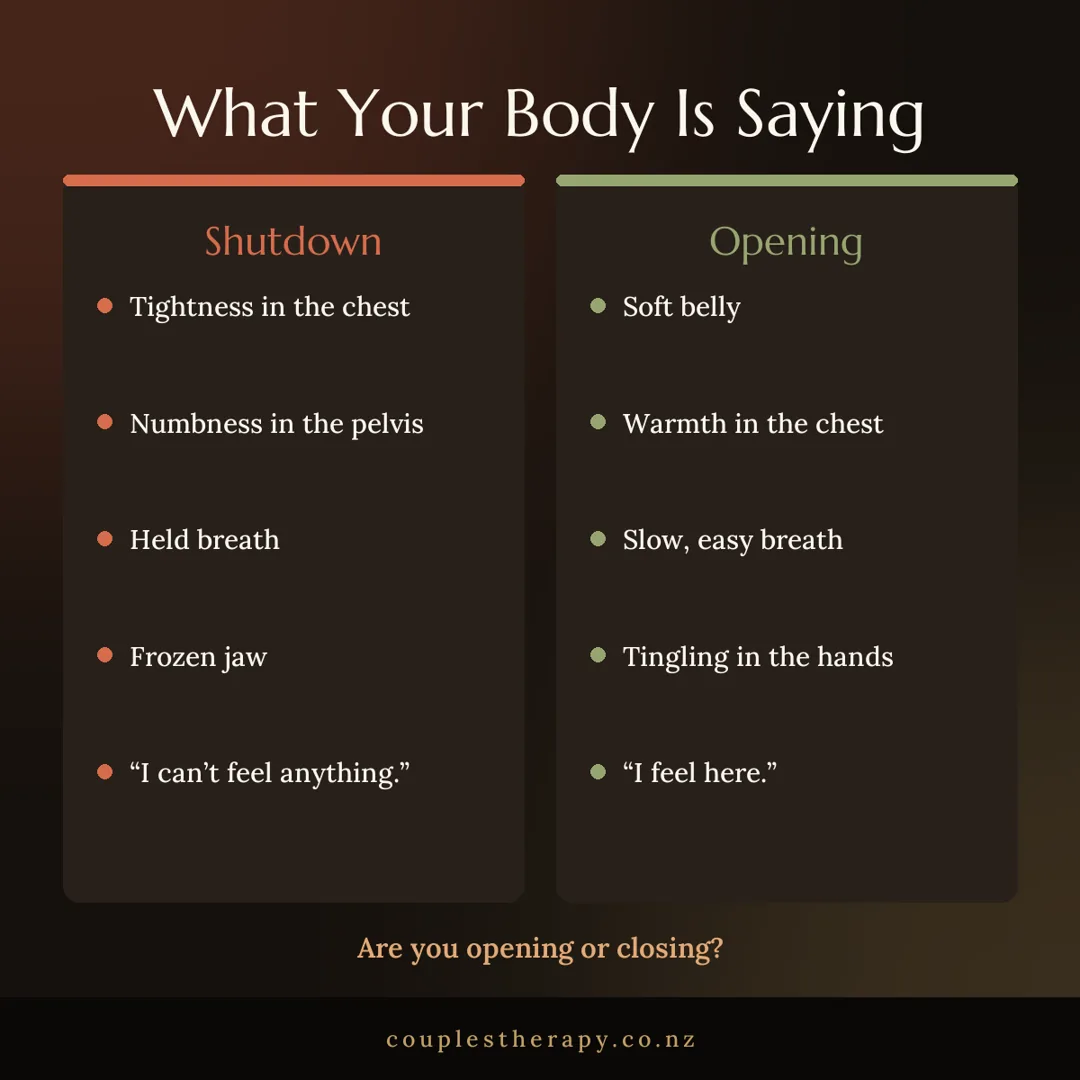
That’s because the problem is rarely only the words. It’s also in the tight jaw, the held breath, the body bracing for criticism and the hand that no longer reaches across.
Somatic couples exercises get you out of analysing your relationship and back into your body, where you can feel it.
For long term couples, this can be a turning point.
You may love each other fiercely and still run your days like co-managers of a household, with calendars, bills, children, ageing parents and the question of who takes the bins out.
Does this sound familiar?
Somatic practice interrupts that autopilot.
It means working with the body, and it helps you notice what’s happening underneath the words: your need for closeness, your desire, your defences and your tenderness.
Why the body belongs in relationship repair
When conflict flares, your nervous systems respond before your cleverest explanation arrives.
One of you might pursue harder, needing reassurance right now. The other might go blank, get defensive or turn strangely practical.
Neither response makes either of you the villain. They’re protective moves, and you often learned them long before this relationship began.
Talking can help you understand the cycle.
Working with the body gives you a chance to change it while it’s happening.
A slower breath, a softer gaze or a hand placed with permission on your partner’s chest can say, “I’m here. I’m not attacking you. We can face this together.”
That might sound like fluffy romance, but it’s repair at the level of the nervous system.
Somatic practice also has an erotic edge.
Desire doesn’t tend to flourish in a body that feels evaluated, rushed, ignored or obligated.
It grows where there’s safety, anticipation, choice and room to feel.
You don’t need to turn your lounge into a tantra studio with a suspicious amount of incense. You do need to be willing to get curious about sensation together.
Before you begin, agree on a simple rule: either of you can pause, change or stop an exercise at any time.
Consent is ongoing, including in a committed relationship.
If touch feels like too much, start with distance, voice and eye contact.
If either of you is dealing with trauma, severe conflict, betrayal or a history of coercion, guided support can make this work far safer and more productive.
7 somatic couples exercises for more connection
Choose one or two practices at a time.
Ten attentive minutes will do more than an ambitious hour spent checking the clock.
1. Arrive before you talk
Sit facing each other, feet on the floor, with enough space that neither of you feels crowded.
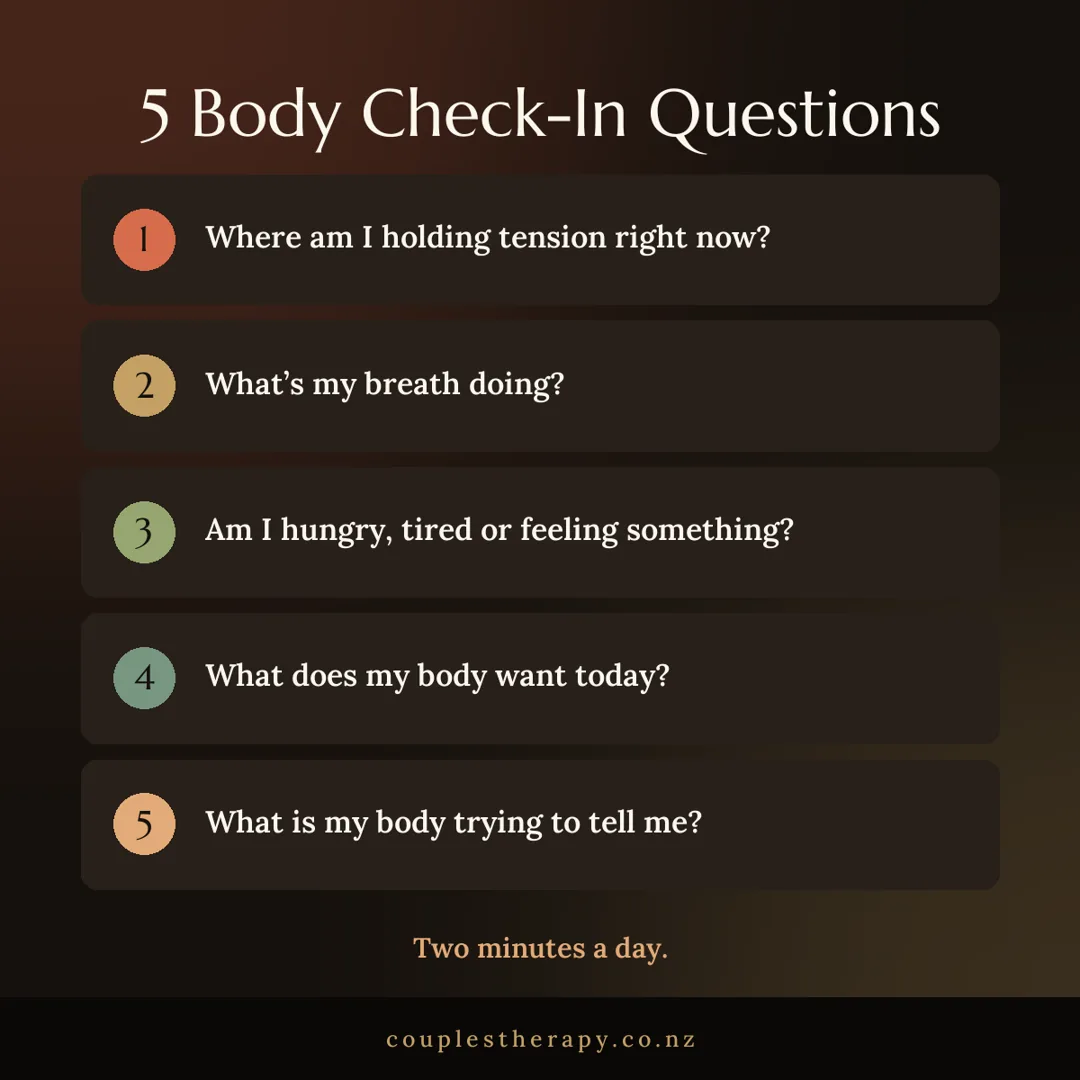
Take a minute to notice your own body first: the weight of your legs, your breath, the temperature of your hands.
Then look at your partner and say, “Right now, I notice…”
Finish the sentence with a sensation and leave out any accusation.
You might say “My chest feels tight,” “I feel warmth in my face,” or “My stomach is buzzing.”
You aren’t trying to solve anything here.
You’re practising being present before you get into the content.
This is especially useful before a difficult conversation, after a hectic day at work or when you can feel that old fight gathering pace.
2. Try the back to back breath reset
Sit back to back, fully supported, and let your spines touch lightly.
For two minutes, breathe at your own natural pace, without forcing yourselves to breathe in time. Just feel that another human being is there, breathing and leaning their weight against you.
After a minute or two, you may find your breathing settles into a shared rhythm, or it may not, and both are fine.
The practice is about calming down together (coregulation), which has nothing to do with putting on a show of intimacy.
If you find direct eye contact intense, this can be an easier first step.
3. Use hand contact as a conversation
One of you offers your hands, palms up, and the other rests their hands on top. Stay there for sixty seconds, then switch.
Notice the pressure, the temperature and any impulse to grip, pull away, stroke or stay still.
When you’re done, each of you shares one sentence: “When I received your hands, I felt…” You may be surprised by what comes up.
A partner who has felt sexually shut out may discover they’re starving for simple touch with no demand in it.
A partner carrying resentment may realise their body can’t relax until they feel more emotional safety.
That’s good, because now you have something to work with.
4. Practise a yes, no and maybe map
This exercise builds erotic honesty without making sex the immediate goal. Sitting clothed and facing each other, take turns naming a form of connection you might enjoy.
It could be:
- A longer kiss
- A shoulder massage
- Cuddling naked
- Dancing in the kitchen
- Being touched on the back
- Lying together without your phones
The listener answers from the body with yes, no or maybe.
Notice whether your body expands, contracts, warms, freezes or goes numb.
A maybe isn’t a failure and a no isn’t a rejection. Both are useful information. A yes only means something when you’re also free to say an honest no.
5. Let one person lead a two minute touch ritual
Set a timer for two minutes.
The receiver chooses a nonsexual area of the body, such as hands, scalp, feet, shoulders or arms, and gives clear instructions: firmer, slower, stay there, less pressure, stop.
The giver’s job is to follow without taking the feedback personally.
Then swap.
This can be humbling if you’re used to guessing, or silently hoping your partner will read the room.
It builds the erotic skill of asking, listening and responding, which is far sexier than pretending you have telepathy.
6. Move your body before you talk
When you’re upset or triggered, don’t force yourselves into a big relationship talk at the kitchen bench. Move your body first to let some of the tension out.
Stand apart and shake out your hands, arms and legs for thirty seconds.
You can also:
- Push your palms against a wall
- Stomp your feet
- Roll your shoulders
- Take a brisk walk around the block
Then come back and ask, “What’s happening in me beneath the anger?”
Anger might be carrying fear, grief, longing or the raw ache of not feeling chosen.
None of this excuses harmful behaviour.
It gives you enough space between the feeling and the reaction to choose a different move.
7. Look into each other’s eyes
Sit comfortably and look into each other’s eyes for one minute.
If that feels like too much, look at the forehead, cheek or collarbone. Keep breathing, and don’t turn it into a staring contest.
Afterwards, share what you saw or felt.
Perhaps you noticed tiredness, softness, guardedness, beauty, sadness or the familiar person underneath all the logistics. Couples often report that this exercise feels unexpectedly intimate because it asks for nothing except attention.
How to make somatic work part of your relationship
The best somatic couples exercises are the ones you’ll actually repeat.
Attach one to something you already do:
- Two minutes back to back after dinner
- Hand contact before sleep
- A yes, no and maybe check in before date night
Doing them regularly teaches your bodies that connection belongs to ordinary days too.
You don’t have to wait for an anniversary, a holiday or the moment something has gone badly wrong.
Keep your expectations realistic.
These practices won’t erase a decade of avoidance, sexual pain, unresolved betrayal or contempt in a week.
What they can do is create the conditions for more honest repair.
When your body feels safer, you can often say the thing underneath the complaint: “I miss you.” “I’m scared I don’t matter to you.” “I want to want you again.”
There’s a trade off too.
Somatic work can bring up emotion that has been buried under busyness, so tears, irritation, longing and awkwardness are all possible.
Discomfort doesn’t prove you’re doing it wrong.
When it comes up, slow down, come back to consent, and look for skilled guidance when the intensity is more than the two of you can manage on your own.
At Couples Therapy & Retreats, I work with couples who want more than keeping the peace.
The deepest love is still ahead of you when you’re willing to meet each other with courage, with skill and with your whole body present.
Your relationship can be a place where you feel chosen and alive.
Want support with this in your own relationship? Find out about couples therapy with Tarisha, a private retreat for two, or our retreats for couples: the Valentine’s Retreat and The Wanaka Adventure. Or start with a free discovery call.