
You’re fighting about the dishes.
By then, the fight has already started somewhere else. One of you felt dismissed and the other felt criticised.
Suddenly two intelligent adults are standing in the kitchen having the same brutal argument they promised never to have again. The benefits of somatic couples therapy become clear in moments like these.
It helps you work with the reaction happening in your bodies as well as the story each of you tells about it.
For long term couples, talking can start going in circles.
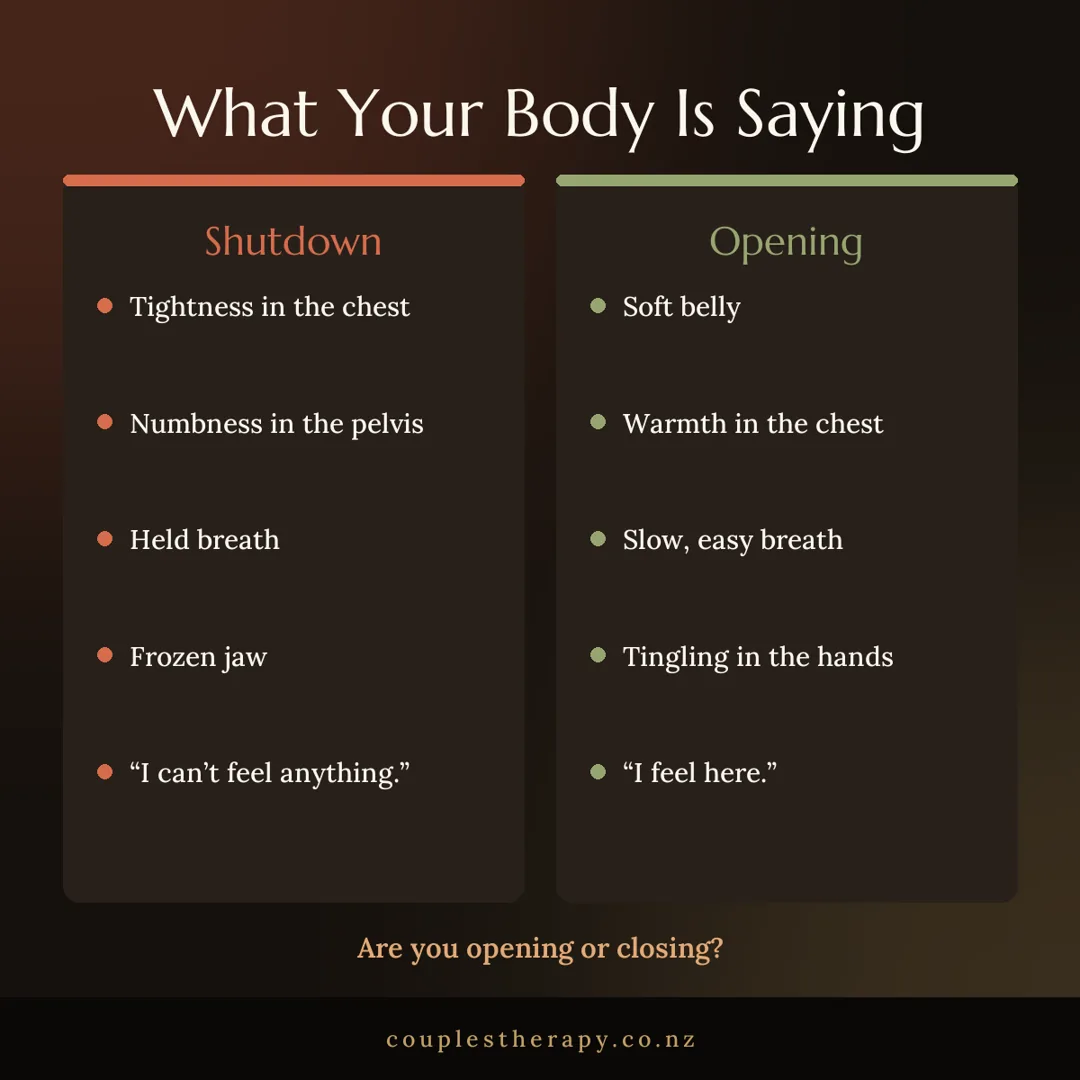
You understand the pattern, you can name your attachment styles, and you may even apologise beautifully. Yet when tension rises, your chest tightens, your jaw locks, your libido vanishes or you go cold.
Your bodies react before either of you has had the chance to choose a different response.
Does this sound familiar?
Somatic couples therapy includes the body, because understanding each other is only one part of intimacy.
Intimacy also happens through your breath, your eye contact, your tone, your posture, your touch and your pace, and through staying present when you feel vulnerable.
This work can help you become lovers again, with more honesty than you had in the early years.
What somatic couples therapy actually works with
Somatic therapy pays attention to what you’re physically experiencing, as it happens.
A therapist may ask what happens in your body when your partner turns away, raises their voice, reaches for you or says they want more sex.
You might notice:
- Heat in your face
- A knot in your stomach
- Numbness in your hands
- An urge to make a joke and change the subject
None of those reactions mean you’re broken.
They’re intelligent ways of protecting yourself, often built over years.
Your body has learned what closeness, conflict, rejection and desire have meant in this relationship and before it.
When the two of you can recognise these protective reactions together, the argument changes. You stop fighting each other and start working together on the pattern that keeps pulling you apart.
At its best, this work combines body awareness with sound clinical relationship therapy.
Emotionally Focused Therapy (EFT) can help you find the attachment need underneath the protest or the withdrawal.
Sex therapy can make room for desire, differences in arousal, pressure around sex and the sexual conversations you’ve both avoided.
Body based practices then help you feel those insights as well as understand them.
The somatic couples therapy benefits that change the pattern
The first benefit is that conflict stops feeling like a threat to the relationship itself.
You’ll still disagree, because healthy couples disagree over money, parenting, ageing parents, holidays and who has once again left wet towels on the bed.
When you learn to notice the tension rising in your own body, you can catch the escalation earlier.
Perhaps you notice your voice speeding up and ask for a pause before you say the cutting thing. Perhaps your partner feels their shoulders collapse and can say, “I’m starting to believe I don’t matter here.”
That’s a very different moment from storming off, or listing every failure since 2017.
A second benefit is more emotional safety.
By safety I mean feeling that you can share your fear, anger, longing or disappointment without being mocked, punished or abandoned.
You’ll still feel uncomfortable sometimes, and your partner won’t always agree with you.
For couples stuck in the pursuer withdrawer pattern, somatic work is especially useful.
The partner who pursues may discover that underneath the urgency there’s panic: “Please don’t leave me alone in this pain.”
The partner who withdraws may discover that underneath the silence there’s overwhelm: “I can’t get this right, so I need to disappear.”
Once you say these things to each other with care, you often soften towards each other. The problem is still there, but you can see each other again.
A third benefit is a more alive sexual connection.
You can’t schedule desire into existence, although a roster might stop the kids’ soccer from taking every free evening.
Desire needs attention, permission, and enough safety for your body to feel.
Many established couples confuse low desire with a lack of love. Sometimes that’s what it is.
More often, desire has been buried under:
- Resentment
- Exhaustion
- Body shame
- Routine
- Unresolved grief
- Years of touch that came with an expectation of sex
Somatic work gives you space to notice what’s true for each of you, with no pressure to get a particular result. You may learn that one of you needs slower transitions into intimacy.
The other may need more playful initiation and clear signs of being wanted.
This approach can also help you rebuild sensual contact without every touch becoming a question about sex.
Sitting close, breathing together, holding eye contact, practising a deliberate embrace or naming what feels good can all seem simple. For a couple used to working as co-managers, it can feel exposing, tender and surprisingly electric.
Why insight alone isn’t enough
I’ve seen couples who can explain their pattern with the precision of a university lecture, and then recreate it before they reach the car park.
Insight is valuable, because it gives you language for what hurts. But it doesn’t automatically teach your nervous system that a vulnerable conversation can end in connection.
The body learns through new experiences, repeated enough times to become believable.
When you stay connected through a hard conversation, take in your partner’s emotion without defending, or say no to sex without withdrawing affection, you learn something new.
You show each other that you can be honest and stay close.
That’s why a skilled therapist will often slow the conversation down.
Slowing down is how you notice the moment an old defence takes over, and how you practise a new response before the argument takes off.
What a session may feel like
Somatic couples therapy has no single fixed protocol, and it should never involve pressure to touch, disclose trauma or engage sexually in the therapy room.
Consent, choice and going at your own pace are central.
A well trained practitioner will make the work a collaboration and will never ask you to put on a show.
You may spend part of a session speaking face to face, instead of directing every word through the therapist.
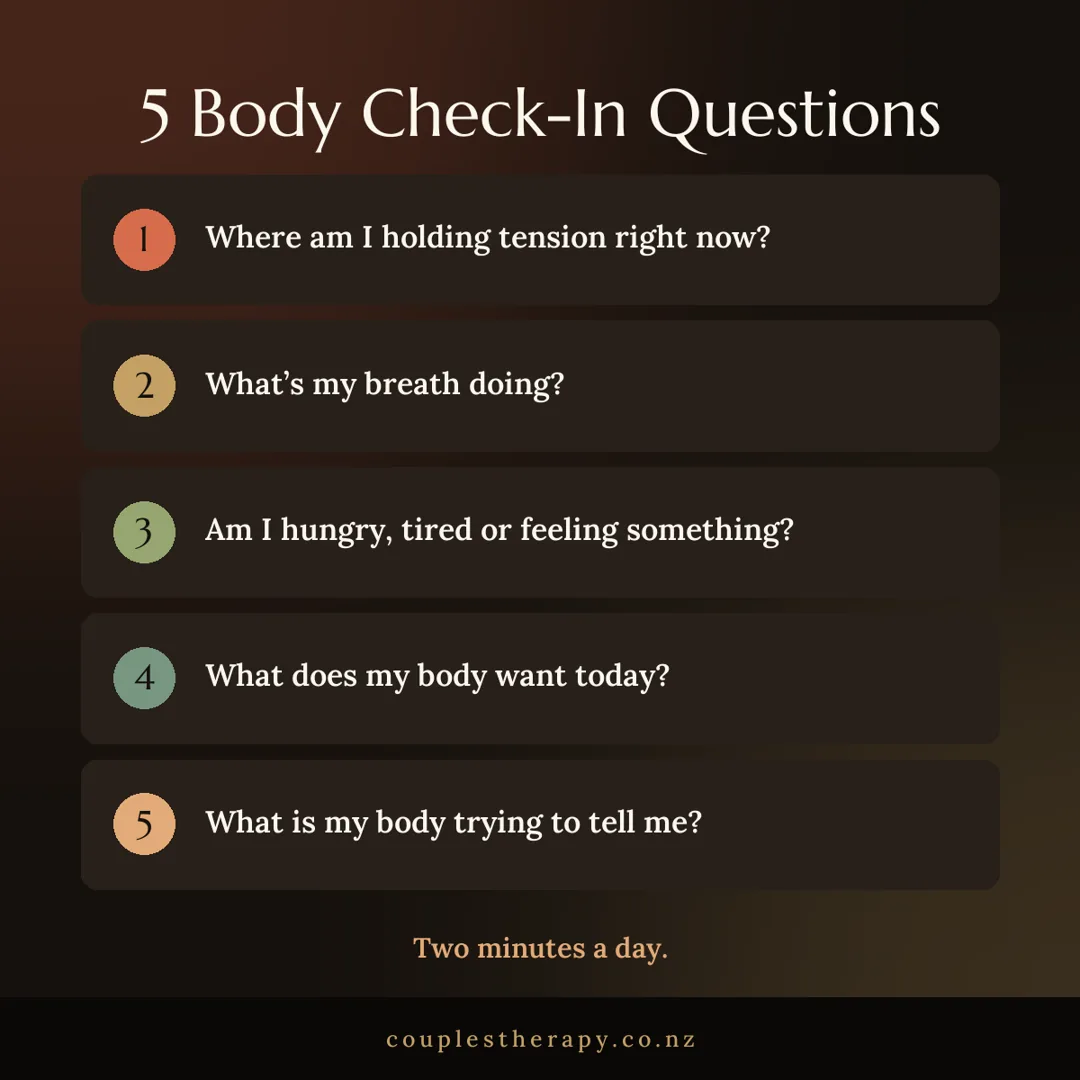
You could be invited to notice your breathing while your partner shares a hurt, or to place a hand over your own heart as you name a need.
At times, a therapist may guide a brief grounding exercise when either of you gets flooded.
If trauma, betrayal, coercion, addiction or ongoing abuse is part of the picture, the pace and structure need particular care.
Couples work isn’t appropriate in every circumstance, especially where one partner can’t speak freely or safely. Individual support, safety planning or specialist treatment may need to come first.
Good therapy doesn’t rush intimacy before safety is in place.
Is it the right fit for your relationship?
Somatic work tends to suit couples who are tired of analysing the same problem and want to actually feel different together.
It can be powerful when emotional distance and sexual disconnection are tangled together, or when one of you says, “I love you, but I don’t know how to reach you anymore.”
Is that where the two of you are?
It isn’t magic, and it won’t remove the need for accountability. If trust was damaged, repair takes consistent actions outside the therapy room.
If your schedules are brutal, you may need to protect time for each other with the same seriousness you give work and family.
A relationship will always challenge you.
This work helps you handle those challenges together.
You learn to come back to each other sooner, to speak from your vulnerability, and to practise intimacy regularly instead of hoping it comes back on its own.
The deepest love may still be ahead of you.
You can’t go back to who you were at the beginning, but you can get to know each other more deeply now.
Want support with this in your own relationship? Find out about couples therapy with Tarisha, a private retreat for two, or our retreats for couples: the Valentine’s Retreat and The Wanaka Adventure. Or start with a free discovery call.