You keep having the same fight.
Your partner says, “We need to talk,” and suddenly you’re both back in the same old fight.
One of you lays out the facts like a lawyer. The other gets defensive or goes blank. By the end neither of you feels heard, and you’re a little further apart.
Does this sound familiar?
The best questions for relationship repair take the conversation somewhere else.
They help you get underneath the criticism, the resentment about who does what, the stalemate around sex and the score keeping, to what’s more vulnerable: I miss you. I’m scared I don’t matter to you. I don’t know how to reach you anymore.
When you’ve been together a long time, you can’t go back to the early years.
You’ve lived too much life for that.
What you can do is build a partnership with more honesty and courage in it than the one you had before, and more spark.
How to use the best questions for relationship repair
These questions work best when neither of you is flooded.
Don’t try to dig into your feelings at 10.30 pm after a brutal day, between school pick up and dinner, or halfway through a fight about the dishwasher.
Choose a set time, put the mobiles away, and agree that you’re there to understand each other and nobody needs to win.
One of you asks and the other answers. Then you swap.
You don’t need to solve every answer straight away. Your job is to stay present long enough to hear what your partner is feeling.
If either of you gets overwhelmed, pause for twenty minutes or longer, and agree on a specific time to come back.
A pause with no return can feel like being abandoned.
1. What hurts you?
What I see with couples is that behind a complaint there’s very often hurt or grief.
“You never help around here” may mean, “I feel alone in this family.” “You’re always on your phone” may mean, “I don’t feel chosen.”
Ask this question when you’re stuck arguing about the surface issue.
Then listen for the softer feeling and let the sharpest words go past you.
You can say, “So when I don’t step in, it feels like you’re carrying us alone. Have I got that right?”
Checking like this is where repair begins.
2. When do you feel most distant from me?
Distance often arrives in tiny moments: a joke that lands badly, a rushed goodbye, or another evening spent side by side without really talking.
This question helps you find the patterns that make you feel far apart.
Be specific when you answer.
“I feel distant when we only talk about the kids and work for days” gives your partner something to respond to. “You’re never there for me” is too vague for them to answer.
3. What do you most need from me when we’re in conflict?
Some people need space before they can speak clearly. Others need a hand to hold, eye contact, or to hear that the conversation won’t end with you walking away.
Both are fine.
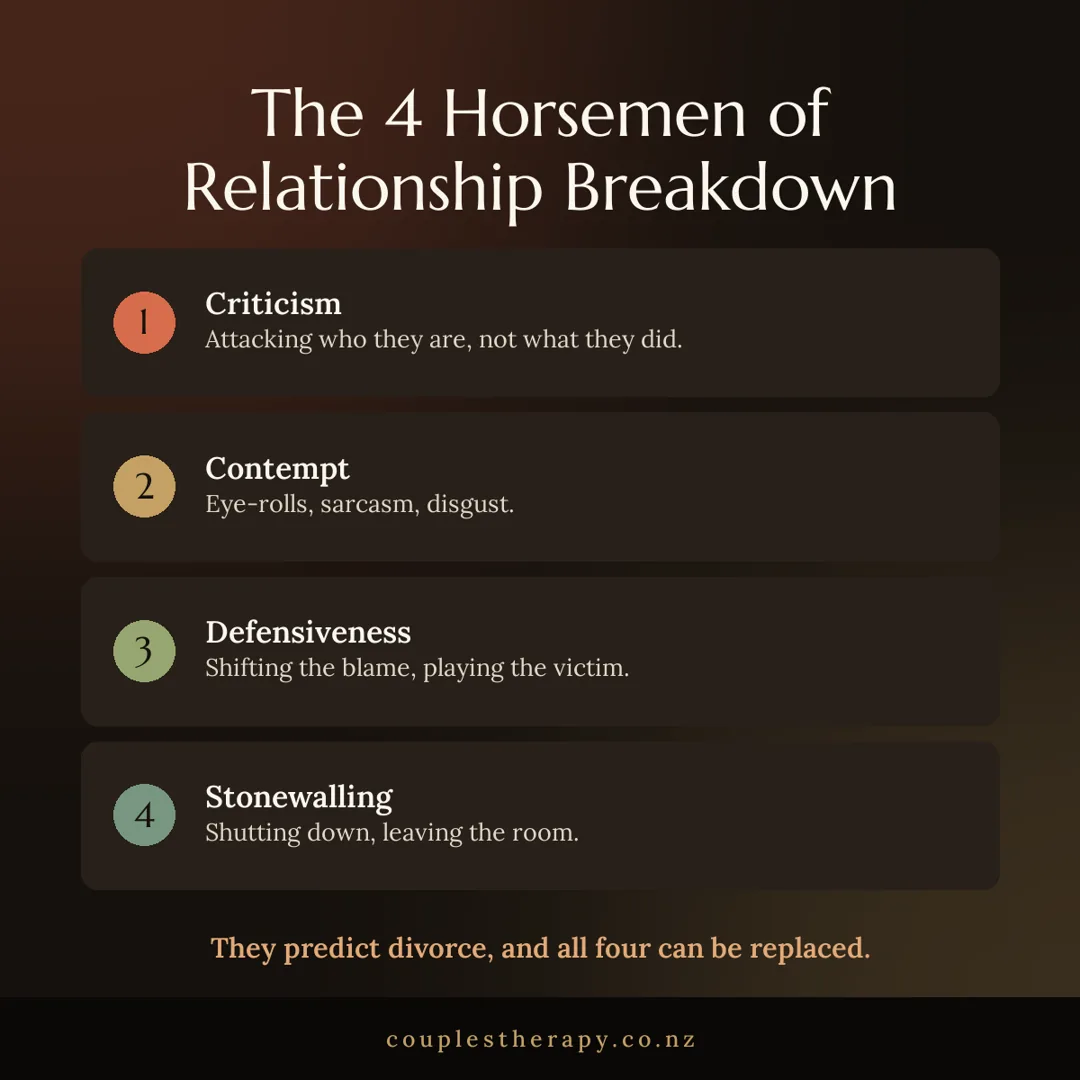
The trouble begins when one partner pursues and the other pulls away, and each of you sets off the other’s deepest fear.
Ask for what would help your body settle.
It might be, “Tell me you’re coming back to this,” or, “Please don’t follow me from room to room while I calm down.”
This is attachment work in everyday language.
4. What have I stopped being curious about in you?
In a long relationship it’s easy to stop being curious.
You know how your partner takes their coffee, what they think about politics, and their annoying habit of leaving one sip in the carton.
Yet the person beside you is still changing.
Ask about their inner life now.
- What are they worried about?
- What are they longing for?
- What aren’t they saying out loud about getting older, parenting, work, their health or who they are these days?
Knowing someone well can be deeply erotic when you keep finding new things in them.
5. What do you wish I understood about your experience?
This question is especially powerful after a hurt involving family pressure, money, parenting, betrayal, sex, or an unequal mental load. It makes space for a point of view you may not share but can still respect.
You can understand your partner without agreeing with every conclusion they’ve reached.
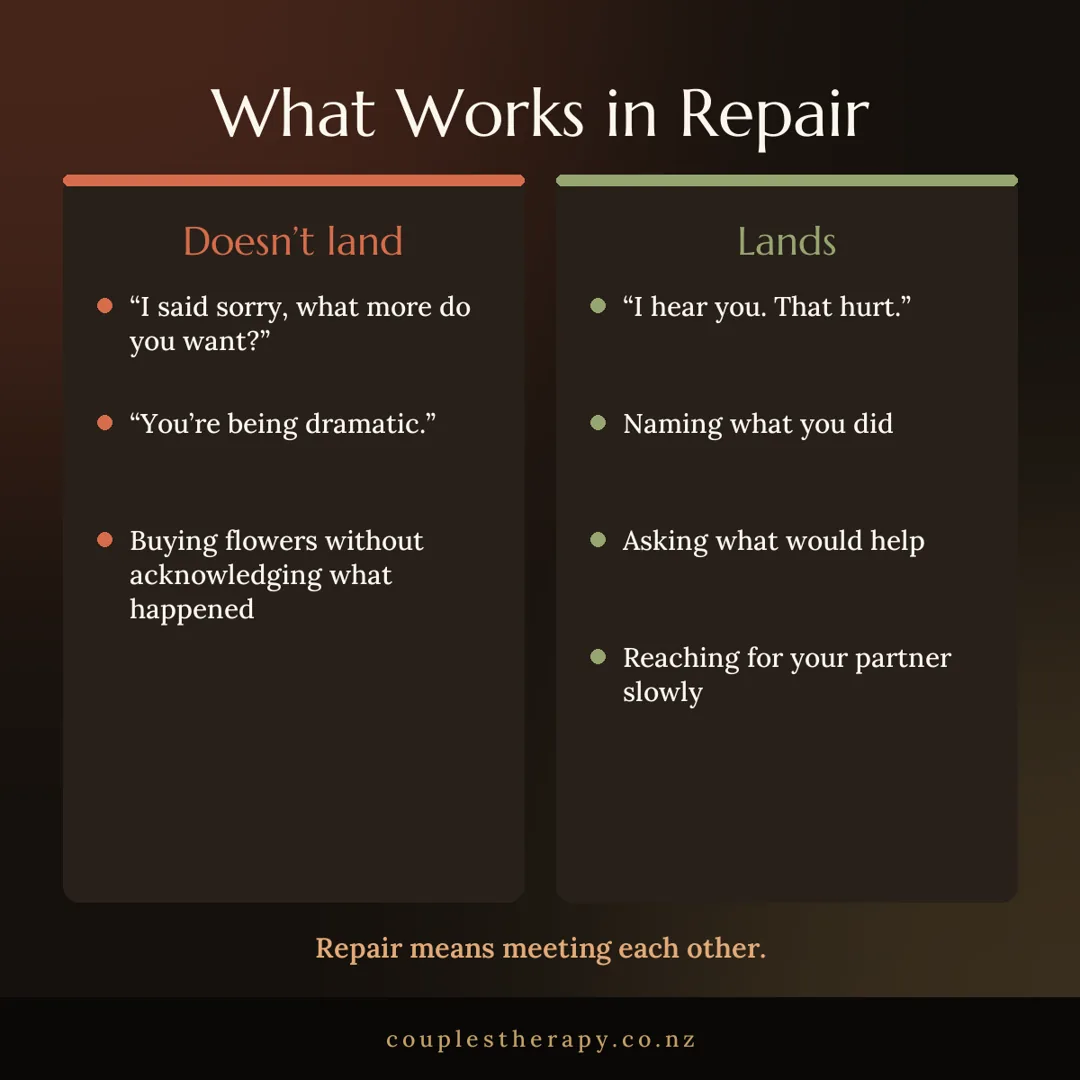
All it takes is being able to say, “I can see why you felt that way.” For many couples, hearing that sentence is a huge relief.
6. Where have I been protecting myself instead of reaching for you?
Defensiveness is usually a clumsy way of protecting yourself.
Sarcasm, silence, keeping busy, taking control and shutting down sexually can all be ways of trying to avoid rejection or shame.
This question lets each of you own your part without anyone becoming the villain.
You might realise that your cool detachment has been a way of avoiding the risk of asking to be held. Or you might see that your constant criticism comes from panic that you no longer count.
7. What would help you rebuild trust in me right now?
Trust comes back through behaviour your partner can see, repeated over time.
A grand speech and a weekend away won’t do it on their own, though a weekend away can be lovely.
That means being consistent, being open, doing what you said you’d do, and telling the truth before you’re cornered into it.
The answer may be practical: share passwords, come to therapy, stop contact with someone, come home when you say you will. Or it may be emotional: answer without contempt, make time to talk, stop dismissing the pain.
Be careful here.
Healthy repair asks for accountability. It doesn’t mean one of you monitoring the other all the time.
8. What has happened to desire between us?
For many established couples, this is the question you both think about and neither of you asks.
Desire rarely disappears for one simple reason.
Exhaustion, resentment, how you feel about your body, menopause, medication, unresolved conflict, routine, pressure to get it right and the loss of anything new can all play a part.
Ask with tenderness and leave the accusation out.
“What has made sex feel difficult, distant, or loaded?” is very different from, “Why don’t you want me?”
Leave frequency aside for now, and try to understand what each of you needs to feel safe, wanted and playful enough to be turned on.
9. When have you felt most desired by me?
You can’t keep an erotic connection going by guessing.
Your partner may feel desired when you flirt in the kitchen, when you plan a date, when you notice how capable they are, or when you take the pressure off intercourse and make room for touch without an agenda.
Their answer may surprise you.
Desire is personal, and it’s also shaped by what happens between the two of you.
It grows when you pay attention to each other, when there’s some freedom and polarity, and when you feel like lovers as well as co-managers of the household.
10. What are you grieving in our relationship?
There’s a loss inside many stuck relationships.
It might be the ease you once had, the body you used to live in, a dream that didn’t happen, the safety that a betrayal damaged, or the years that went into caring for everyone else.
When grief is ignored it often comes out as anger.
Let the answer be sad.
Don’t rush to silver linings or defend the past. Feeling the sadness together is part of the repair.
11. What’s still good between us that we’ve overlooked?
Repair shouldn’t turn into an audit of everything that has gone wrong.
Even couples in serious pain usually still have some affection and loyalty, a shared sense of humour, good memories of sex, teamwork, or a fierce commitment to their family.
Naming those things won’t erase the problems, but it gives you something good to build on.
Perhaps you still laugh in the car.
Perhaps you show up for each other in a crisis. Perhaps one look across a crowded room still says, “I know you.”
Tell each other about those moments.
12. What would an alive relationship look like for us next?
I don’t mean a perfect relationship, or one where you never fight and desire turns up on command.
In an alive relationship you keep growing together.
You repair honestly, you touch in ways that mean something, you each have room to be yourselves, and you’re willing to meet each other again and again.
Ask for details.
- Would it mean one night away each quarter?
- A weekly check in?
- Learning how to argue without contempt?
- More adventure, more affection, more direct conversations about sex?
This doesn’t need to be a formal plan. You’re deciding together what kind of relationship you want.
When questions aren’t enough
Questions are a good start, but they aren’t enough on their own when there has been ongoing betrayal, coercion, addiction, abuse, entrenched contempt, or repeated emotional abandonment.
In those situations, a skilled couples therapist can keep the conversation safe so that neither of you falls back into blame, shutdown, or apologies you don’t mean.
If your conversations keep ending in the same place, you may need more support. That could be couples therapy, a private retreat for two, or time away together on the Valentine’s Retreat or The Wanaka Adventure.
At Couples Therapy & Retreats, I work with the emotional bond and the erotic bond because they’re often tangled together.
When you feel secure, you can be vulnerable. When you feel desired, some life comes back.
You need both.
Start with one question this week.
Please don’t do all twelve in one long conversation that leaves you both exhausted.
Stay with the answer, and let it change how you see the person you chose and the relationship you can still choose from here.
Want support with this in your own relationship? Find out about couples therapy with Tarisha, a private retreat for two, or our retreats for couples: the Valentine’s Retreat and The Wanaka Adventure. Or start with a free discovery call.