
Resentment builds up slowly.
It’s in the sink full of dishes you didn’t touch, the school email one of you always answers, the sex that keeps getting postponed, and the conversation that ends with, “Fine, whatever.”
Before long you’re sharing a home, a calendar and maybe a bed, but the warmth has gone.
Resentment is deadly to love.
Healing resentful marriage dynamics begins when you see resentment as a sign that something important between you has been neglected for too long. It doesn’t mean your relationship is broken.
For long term couples, resentment can feel particularly cruel.
You’ve built a life together, and you know each other’s stories, habits and vulnerabilities. Yet you can feel very lonely when the person who’s meant to know you best doesn’t see you.
The good news is that resentment doesn’t always mean the end of desire or love.
Often it’s a protest.
It says, “I needed you, and I stopped believing you would come towards me.”
What resentment is trying to protect
Underneath resentment there’s usually pain, fear or grief.
The partner who constantly criticises may be terrified of not being important to you.
The partner who withdraws may feel they can never get it right, so why risk another failure? Neither response creates intimacy, but both make sense when you remember how much we need to feel secure with our partner.
This is where I see couples get stuck.
One says, “You never help.” The other hears, “You’re useless.” One goes cold, the other gets louder, and the original hurt gets lost in the fight about the fight.
None of us wants to be our partner’s enemy. Yet when we’re stressed and stretched, two good people can get very good at hurting each other where it’s most painful.
We also feel resentment in the body.
It can show up as a clenched jaw when you hear their key in the door, or a stomach that drops before another difficult conversation.
It can show up as a lack of sexual appetite that comes from emotional distance and has very little to do with libido.
You can’t reason your way out of every reaction when your body has learned that getting close means getting hurt.
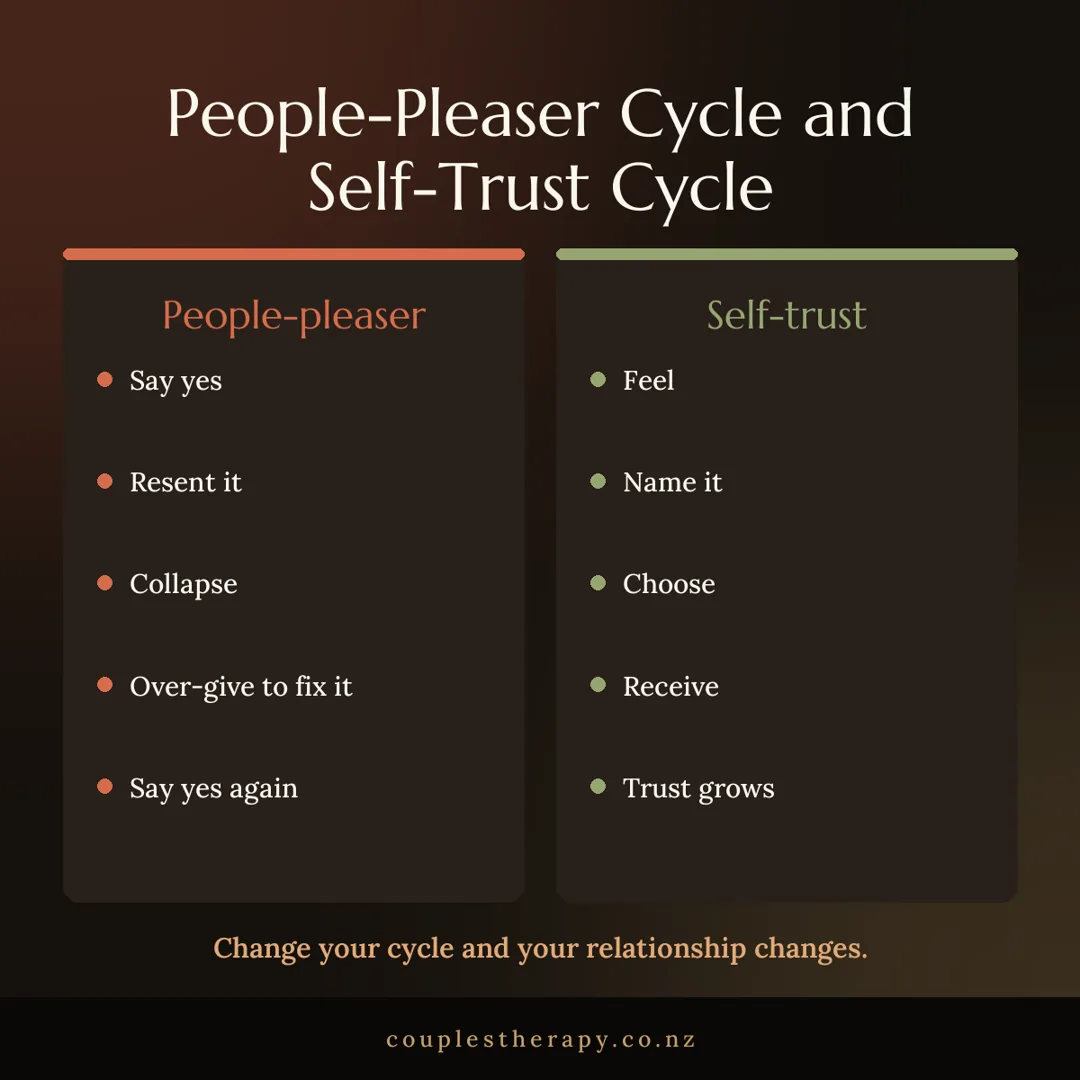
Healing resentful marriage dynamics starts with the cycle
What you’re up against is the pattern that takes over when you’re both triggered, and your partner is caught in it too.
In Emotionally Focused Therapy (EFT), I pay close attention to this cycle.
Maybe one of you pursues connection through questions, complaints and intensity, while the other protects themselves with silence, work, screens or a brisk change of subject.
The more one pursues, the more the other retreats, and the more the other retreats, the more urgent the pursuit becomes.
It’s exhausting, and you both end up accusing and defending. Does this sound familiar?
Naming the cycle changes the mood between you.
Instead of saying, “You shut down every time,” try: “When we get into this pattern, I feel like I’m reaching for you and losing you at the same time. Then I get sharp because I’m scared.”
This is honest and it doesn’t blame, so your partner can listen without having to defend themselves.
Your partner may not respond beautifully the first time.
Years of resentment don’t disappear after one good conversation. But naming the pattern gives you something to work on together.
You stop asking, “Who’s at fault?” and start asking, “What happens to us when we feel unsafe, unseen or overwhelmed?”
Talk about what’s hurting now
When we’re resentful, we keep a list of everything our partner has done wrong, going back years. But going through every past offence makes your partner defensive.
A more useful question is: what’s hurting now?
Speak from the vulnerable feeling beneath the accusation.
“I feel alone carrying this” is much easier to hear than “You never pull your weight.” “I miss feeling wanted by you” is easier to respond to than “You don’t care about sex.”
None of this excuses chronic neglect, dishonesty or cruelty. You’re simply speaking in a way that gives repair a chance.
If there has been betrayal, coercion, intimidation or ongoing emotional abuse, couples work needs careful professional support and clear safety boundaries.
Some resentments can’t be fixed with a date night and a bottle of wine.
Some injuries need accountability, transparency and sustained behavioural change before trust can begin to return.
Repair needs action as well as insight
A good conversation is a start, and consistent action is what makes the change last.
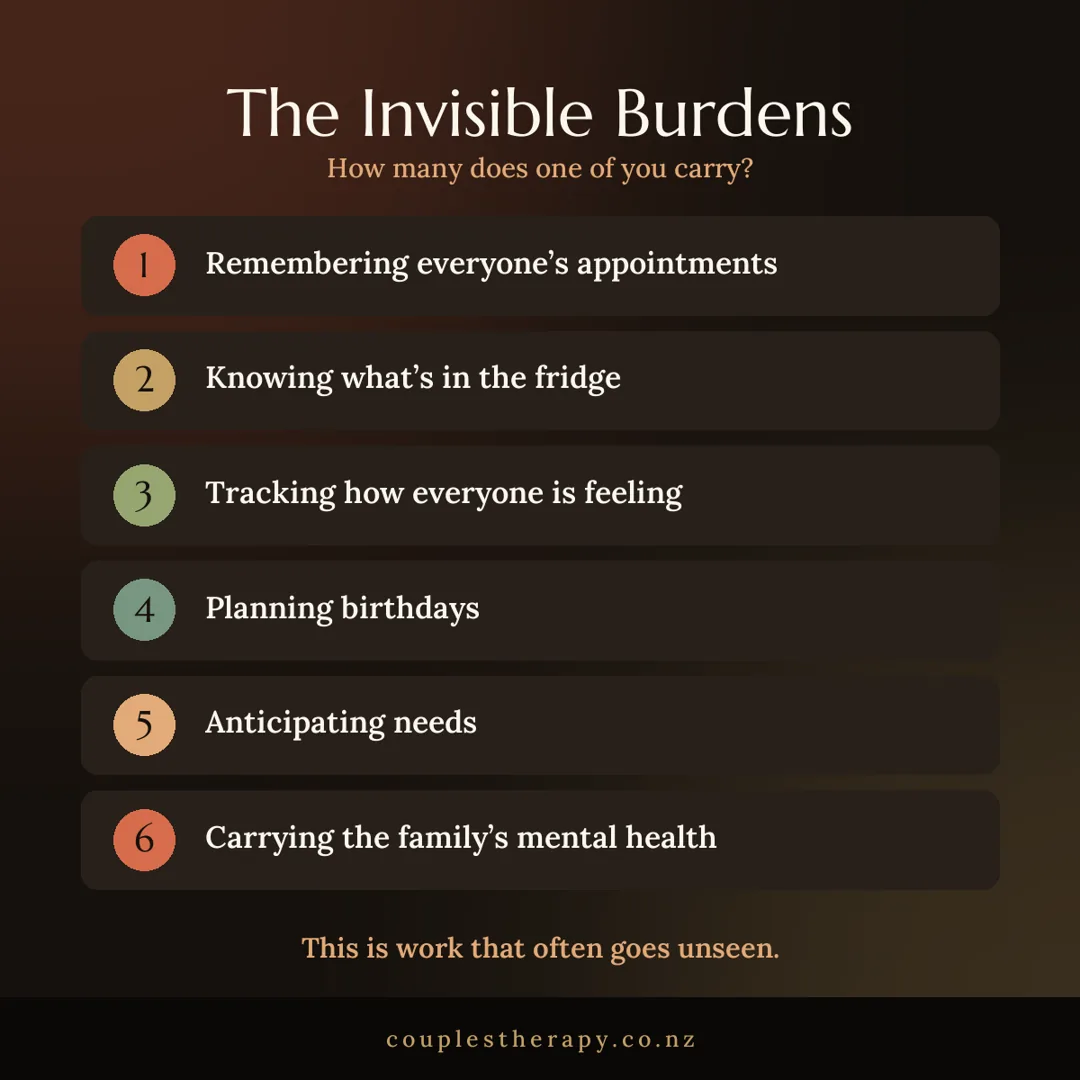
If resentment grew because one of you does more of the work, write down all the work that usually goes unnoticed. That means household management, caring responsibilities, finances, social planning, and the emotional work of remembering everyone’s birthday.
Then create agreements that are specific enough to act on.
“I’ll help more” sounds nice, but it’s too vague to act on. “I’ll manage school communications and Thursday dinners without being reminded” is a commitment you can both see being kept.
You don’t need to run your marriage like a business.
What you do need is to stop one of you carrying the mental load while the other believes they’re contributing because they took the bins out twice.
The same applies to emotional repair.
An apology is stronger when you own what you did, show you understand how it felt, and make a different choice.
For example: “I see that I dismissed you when you tried to tell me how overloaded you were. You shouldn’t have had to shout to get my attention.
Tonight I’m taking over dinner, and tomorrow I want to sit down and work out a fairer rhythm with you.”
Trust rebuilds through small things you do reliably.
- You respond when your partner reaches out.
- You send the message you said you’d send.
- You’re present for ten minutes without your phone in your hand.
These moments can seem almost too simple, but repeating them is what builds a secure relationship.
Don’t leave desire out of the repair
Many couples try to solve resentment by becoming better housemates. They divide tasks, schedule meetings and argue less, then wonder why desire hasn’t come back.
Stability is essential, but desire needs more.
It needs room for curiosity, separateness and play, and for the feeling that your partner is someone you’re still discovering.
When resentment is high, sex can become loaded.
One of you may feel rejected, while the other feels pressured, scrutinised or emotionally disconnected.
Pushing through that tension for the sake of “getting back to normal” usually makes things worse.
Begin with pressure free physical connection.
That could be a longer embrace, a massage with a clear agreement that it doesn’t need to lead anywhere, or lying together with your hands on each other’s chest or belly.
Paying attention to your body helps here because it takes you out of the argument and into what you’re feeling.
Ask yourselves: What helps me soften? What makes me brace? What kind of touch feels connecting, and what kind feels demanding?
These are important questions for any long term couple.
Your erotic relationship deserves the same attention you give the mortgage, the kids’ futures and the rest of the life you’ve worked so hard to build.
Long term love needs both closeness and space.
You need emotional safety, and you need enough individuality to see each other with fresh eyes.
Go climbing, take a solo weekend, learn something that makes you feel capable and alive, or do something mildly ridiculous together.
Doing something new won’t heal a deep hurt on its own, but a shared challenge can get you out of the roles you’ve both been stuck in.
Have the conversation before it blows up
Set aside a regular time to talk before resentment is boiling over.
Keep it short (perhaps 30 minutes) and begin with appreciation, as a way of remembering what’s still working.
Then each of you answers two questions: “Where did I feel close to you this week?” and “Where did I feel distance?”
When you’re the listener, hold off on rebutting, explaining or fixing.
Your job is to reflect back what you heard until the speaker feels understood.
That can feel painfully slow when you’re convinced your intentions have been misread. Still, how your words or actions affected your partner is important, whether you intended it or not.
If the conversation gets heated, pause with an agreement to return.
A pause stops feeling like abandonment when you say when you’ll come back: “I’m flooded and I want to do this well. Let’s take 20 minutes, then meet on the couch at 8.30.”
Then follow through.
Every time you come back when you said you would, you both learn that conflict doesn’t have to end in disconnection.
The deepest love may still be ahead of you, but you won’t build it by pretending nothing happened. You build it when the two of you give the pain between you your attention and your tenderness, and keep choosing each other.
Want support with this in your own relationship? Find out about couples therapy with Tarisha, a private retreat for two, or our retreats for couples: the Valentine’s Retreat and The Wanaka Adventure. Or start with a free discovery call.






One Comment
Comments are closed.