
A fight about the dishwasher is rarely about the dishwasher.
Underneath it there’s usually a painful question: “Do I matter to you when life gets hard?”
When couples compare Emotionally Focused Therapy vs imago, they’re usually looking for more than a better way to argue. They want to stop feeling like two people efficiently co-managing a household.
They want to feel chosen, safe and desired again.
Both approaches can create powerful shifts for long term couples. Both ask you to slow down the familiar fight and look at the tender feelings beneath it.
They take different routes to get there.
Emotionally Focused Therapy (EFT) focuses mainly on the bond between you and the pattern you get caught in.
Imago uses a highly structured dialogue, so each of you can be heard without the other defending or interrupting.
Which one is right for you?
It depends on where your relationship gets stuck and what kind of support helps you open.
It also depends on what needs attention first: emotional safety, a structure for communicating, or your erotic connection.
Emotionally Focused Therapy vs Imago: the core difference
EFT is a form of couples therapy developed by Dr Sue Johnson and colleagues. It’s based on attachment, our need to feel safe and close with our partner.
EFT sees your fights as a protest against losing that closeness, so they don’t prove your relationship is broken.
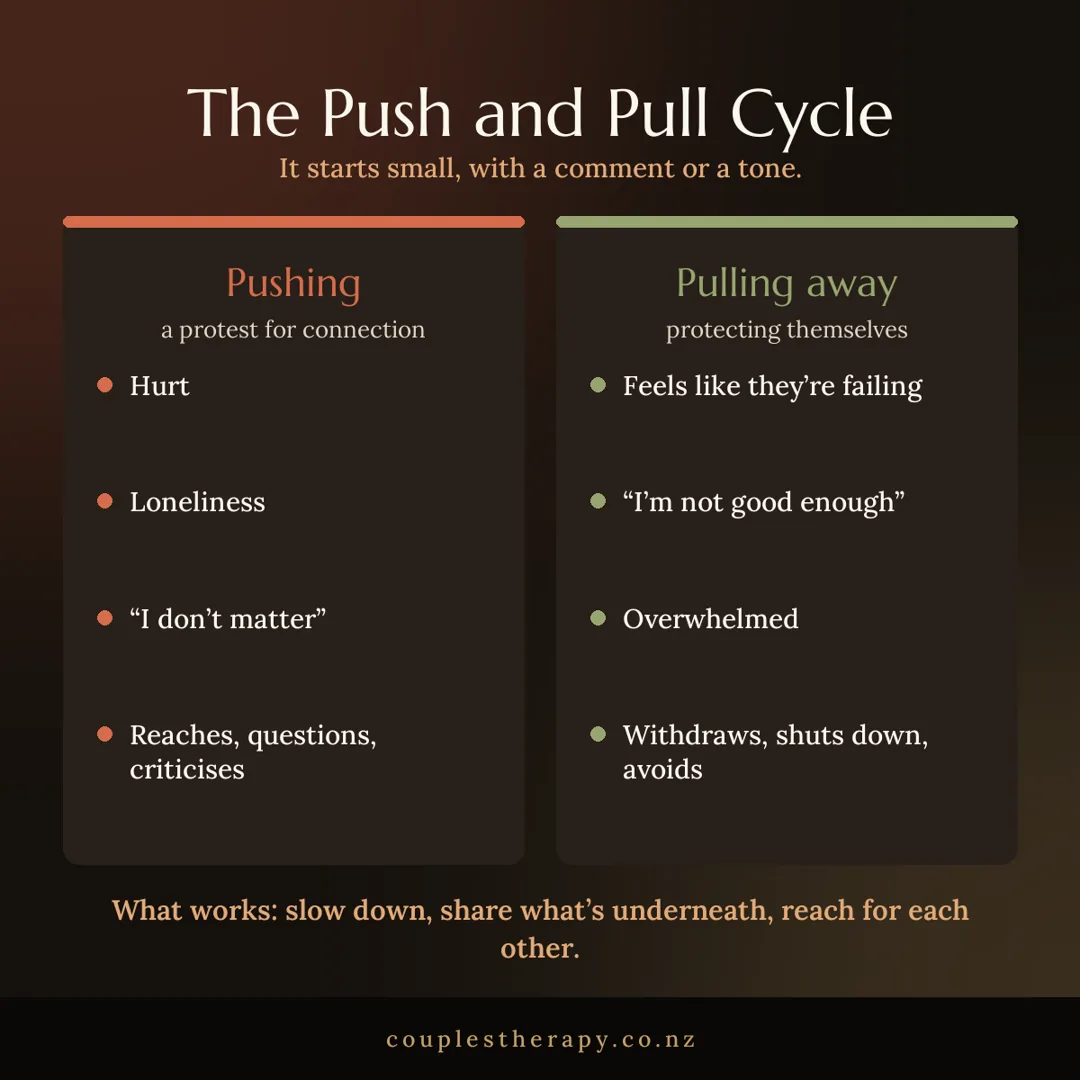
Say one partner pursues and criticises while the other withdraws and shuts down. EFT doesn’t ask who started it. It asks, “What happens to the bond between you when you’re both scared?”
An EFT therapist helps you see the cycle as the enemy, so you stop treating each other as the enemy.
Beneath the anger, numbness, defensiveness or sarcasm there are usually more vulnerable feelings.
It might be fear of rejection, or shame about not being enough. It might be grief over years of distance, or the ache of wanting your partner to reach for you.
Imago Relationship Therapy was developed by Harville Hendrix and Helen LaKelly Hunt.
It’s built around the idea that we’re often drawn to partners who stir both our longings and our unfinished childhood wounds.
Imago is best known for its dialogue process.
One person speaks, and the other mirrors back what they heard, validates the speaker’s experience and offers empathy.
Put simply, Emotionally Focused Therapy works with the emotional bond between you as it shows up in the session. Imago gives you a clear structure for talking, so a difficult conversation doesn’t turn into a shouting match.
How Emotionally Focused Therapy (EFT) changes the cycle
EFT is especially useful when your conflict has become repetitive, emotionally loaded and exhausting.
You may know the script by heart.
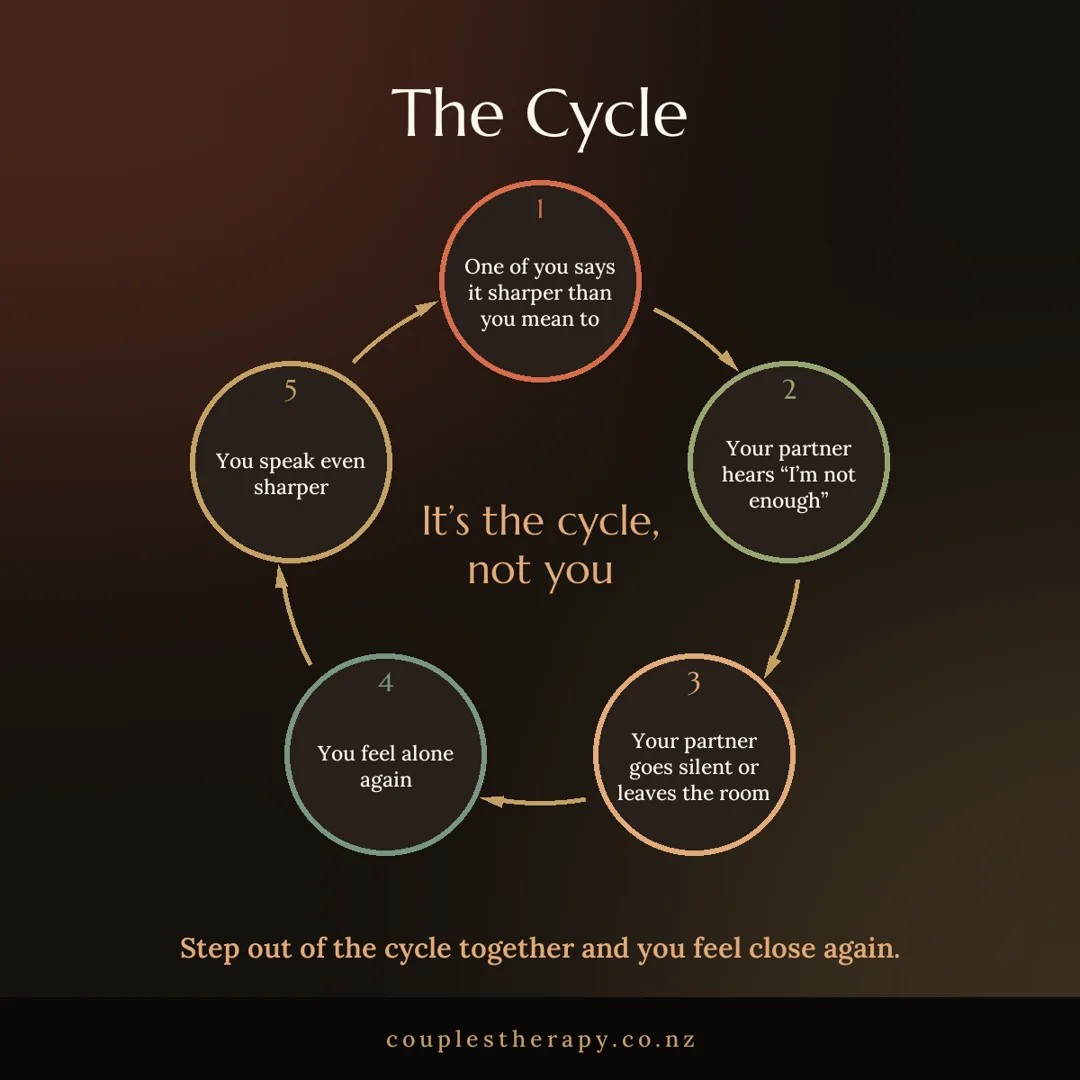
One of you raises an issue, perhaps about money, parenting, sex or the endless mental load. The other gets defensive, distant or practical. The first one pushes harder and the second retreats further.
Before long, you’re both wounded and neither of you feels understood.
Does this sound familiar?
EFT maps that pattern very exactly.
The therapist may help the pursuing partner move from “You never care about us” to something more vulnerable and honest: “When you turn away, I panic that I’m not important to you.”
They may help the withdrawing partner find words for what sits beneath the silence: “I shut down because I feel like I always fail you, and I don’t know how to stay close when I feel that exposed.”
There’s no magic trick in this.
It can feel confronting, particularly if you were raised to keep emotion tidy and private.
Yet when you can both say those deeper needs out loud and respond to each other with care, the fight has less power over you.
You can turn towards each other, and you no longer have to protect yourselves.
Emotionally Focused Therapy has a substantial and growing research base, particularly for relationship distress and attachment security. That doesn’t mean every EFT therapist is the right fit for you, or that attachment repair alone resolves every sexual concern.
For couples caught in pursue withdraw patterns, betrayal wounds or deep emotional distance, though, it can be transformative.
How Imago creates a new conversation
Imago often appeals to couples who say, “We can’t talk without it going sideways.” Its dialogue structure gives each of you a clear job.
The listener doesn’t:
- Rebut
- Correct details
- Prepare a counterargument
- Offer a solution nobody asked for
They mirror what they heard until the speaker feels accurately received. Then they validate how the speaker’s view makes sense, and they practise empathising with how it feels.
For some couples, that structure is a relief.
If one of you dominates while the other disappears, the dialogue slows the pace and gives you both equal time to speak.
It can teach two people who’ve spent years interrupting each other how to listen with discipline and generosity.
Imago also invites you to get curious about why particular behaviours upset you so much. When your partner forgets to call, it may be more than annoying. It may touch an old hurt of being overlooked.
When your partner asks for more affection, you may hear a demand you can never satisfy. They may simply want to feel loved and secure.
The trade off is that a structured dialogue can feel formal or scripted at first.
Some people love having clear steps.
Others find it hard to follow a script when they’re upset.
A skilled Imago therapist keeps the process warm and natural, so it doesn’t turn robotic.
Which approach is better for your relationship?
Neither approach wins by default. EFT may be the stronger fit if you feel trapped in emotional disconnection, escalation that keeps recurring, withdrawal or distrust.
It may also fit if every conflict seems to end with both of you alone on opposite sides of the bed.
EFT is designed to look past what the argument is about and repair the bond between you.
Imago may suit you if your conversations become chaotic fast, or if one or both of you struggle to listen without defending. It’s also a good choice if you want a repeatable dialogue practice to take home.
It can be particularly valuable when you’re both willing to slow down and practise giving each other a more generous hearing.
There’s plenty of room for overlap too.
An experienced couples therapist may draw on Emotionally Focused Therapy to identify the attachment wound, and use dialogue based practices to help you have a safer conversation at home.
You don’t have to pick only one.
What you do need is a therapist who can work with complicated situations.
If there’s been coercion, ongoing abuse, active addiction, unaddressed trauma or an affair that’s still unfolding, standard communication exercises may not be enough.
Safety, accountability and individual support may need to come first.
Where desire fits into the picture
This is where I find many couples therapy comparisons become too narrow.
You can repair the way you talk and still wonder why neither of you reaches across the bed. You can understand your attachment pattern beautifully and still feel more like flatmates than lovers.
Feeling emotionally safe and feeling desire affect each other, but they’re two different things. Having less conflict is often not enough to bring desire back.
It needs attention, novelty, play and honest sexual conversation.
It needs you to be present in your body, and it needs permission to become curious again. It may also need room for differences in libido, ageing bodies, stress, resentment, medical realities and the familiar ache of rejection.
At Couples Therapy & Retreats, I work with your emotional bond and your sexual relationship together.
That can include EFT, sex therapy, body based practices and guided experiences that help you stop having the same old conversations.
I want you to feel tenderness and desire for each other again.
Questions to ask before you choose
Before you book with an EFT or Imago practitioner, ask how they work with high conflict patterns, sexual disconnection, infidelity, trauma and unequal effort.
Also ask:
- What a typical session feels like
- How progress is measured
- Whether they offer practical work between sessions
Most of all, notice whether both of you feel respected in that first conversation.
A good therapist won’t let the more articulate partner speak for both of you. They won’t treat your pain as just a communication problem.
They’ll help you see the pattern clearly and take responsibility for your part in it. They’ll help you reach for each other at the times when it would be easier to pull away.
Your deepest love may still be ahead of you, and it will ask something of you both.
You’ll need to be honest without being cruel, and vulnerable without putting on a show. You’ll need to be willing to meet each other beyond the roles you’ve worn for years.
Want support with this in your own relationship? Find out about couples therapy with Tarisha, a private retreat for two, or our retreats for couples: the Valentine’s Retreat and The Wanaka Adventure. Or start with a free discovery call.