
Picture a couple after another argument.
They’re sitting on the edge of the bed, and the argument was about nothing and everything.
It started with the dishwasher, then it was the late text, then the moment one of them reached for a hand and the other pulled away.
Underneath the argument, they’re both fighting to feel reassured and to know they still matter to each other.
When a couple like that starts looking for help, searching for Emotionally Focused Therapy (EFT) or “EFT” can get confusing fast.
In most conversations about couples therapy, Emotionally Focused Therapy and EFT are the same approach. But the same words are also used for other therapies, including tapping and a separate emotion focused model.
If you’re looking for help with your relationship, all these similar names can lead you to the wrong kind of help.
So let me make it simple.
For couples caught in painful cycles, the EFT most people mean is Emotionally Focused Therapy. It’s a structured, evidence based approach to rebuilding a secure emotional connection.
It goes further than better communication, because it works with what sits underneath the argument: the fear, the longing, the shame and grief, the ways you protect yourself, and the need to know your person is there when it counts.
Emotionally Focused Therapy and EFT: Usually the Same Thing
Emotionally Focused Therapy is commonly shortened to EFT.
For couples, its full name is Emotionally Focused Couple Therapy, or EFCT. You might also see it called Emotion Focused Therapy for Couples or EFT couples therapy.
The model was developed by Dr Sue Johnson and it’s grounded in attachment science.
Some people hear “attachment” and think it’s a fluffy word for dependency.
What it describes is the deeply human question your nervous system keeps asking about your partner: Are you accessible, responsive and engaged with me?
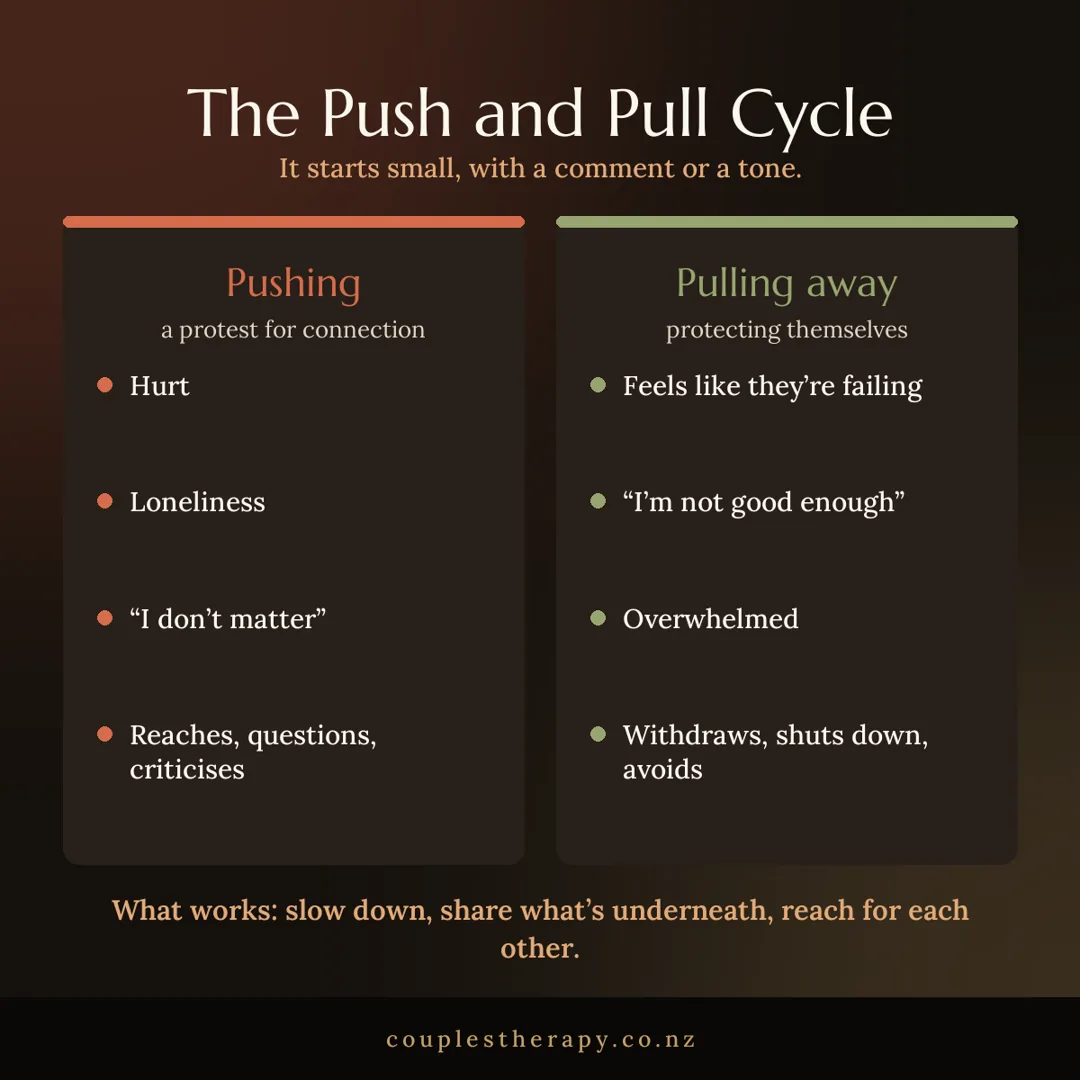
When the answer feels uncertain, some people protest, pursue, or get critical and defensive.
Others shut down, go numb, or retreat into work, parenting, screens, or sex that feels like a chore.
Emotionally Focused Therapy helps couples see the cycle that takes over between them as the enemy, so they can stop treating each other as one.
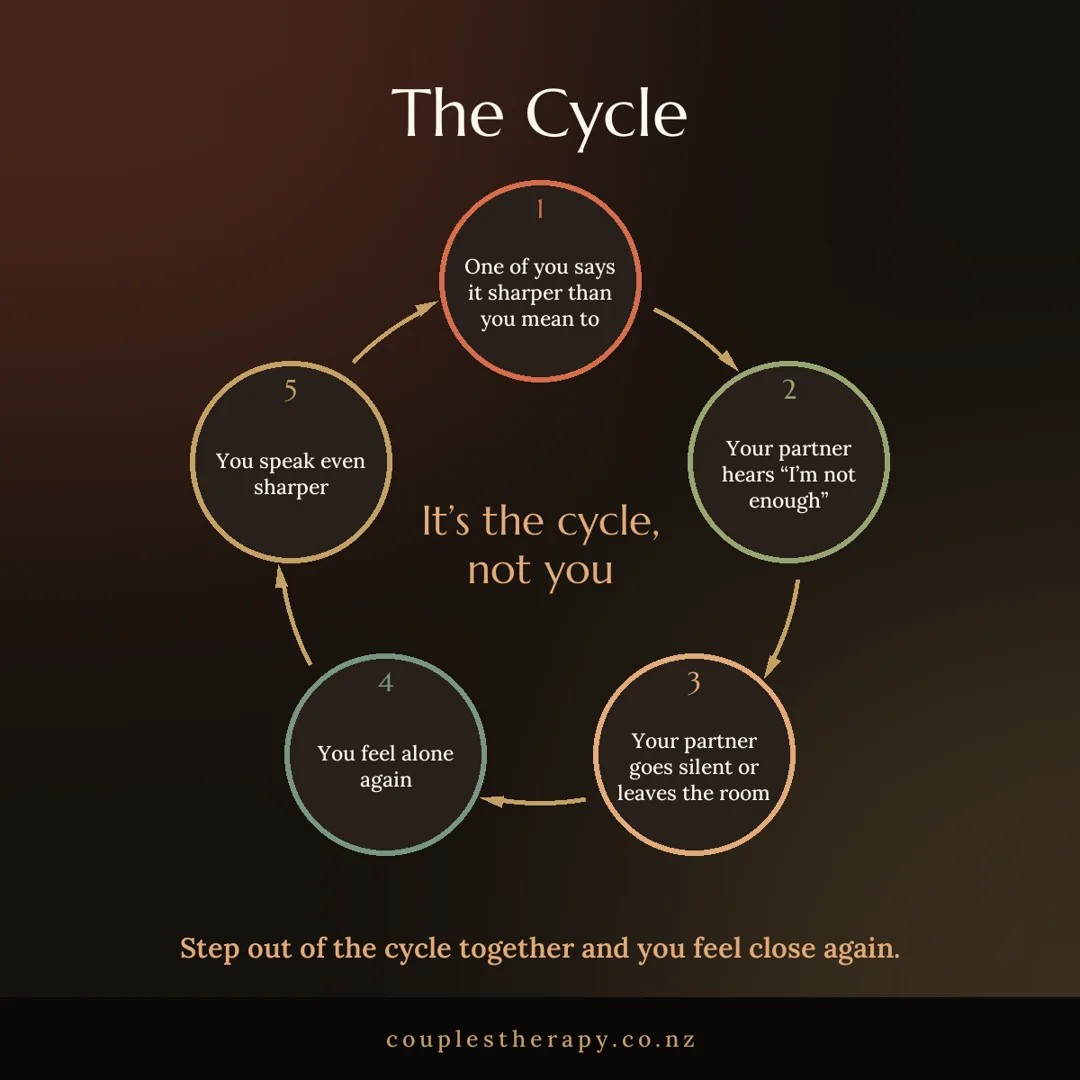
Maybe one of you raises an issue because the distance feels unbearable.
The other hears criticism, feels like a failure and withdraws. The more they withdraw, the harder you push.
Before long you have a familiar dance, where one of you chases, the other disappears, and you both go to sleep feeling lonely.
Does this sound familiar?
The personalities change from couple to couple, but the steps are painfully similar.
An Emotionally Focused therapist slows that dance down.
As well as asking “What happened?”, they help each of you name what’s happening underneath.
It might sound like, “When you turn away, I tell myself I don’t matter to you. I get angry because I’m scared.” That’s a very different conversation from, “You never listen.”
Why the Name Gets Confusing
The phrase “emotion focused therapy” can refer to more than one thing. The capital letters, the context and who’s delivering the therapy all make a difference.
Emotionally Focused Therapy for couples
This is the attachment based approach most often associated with relationship therapy.
Its aim is to create safer emotional bonds through new conversations, and through new experiences of reaching for each other, responding and repairing.
It’s especially useful when:
- You feel locked in recurring conflict or emotional distance
- You’re recovering from a betrayal
- Parenting stress has taken over
- You’ve drifted apart over the years
The work is experiential.
You go beyond analysing why you became distant, and you practise turning towards each other while it still feels risky.
A therapist might help the more guarded partner share, “I pull away because I’m terrified I’ll disappoint you,” and then support the other to respond steadily, without a counterattack.
Emotion Focused Therapy as an individual therapy
Emotion Focused Therapy, often linked with Dr Leslie Greenberg, is a related but distinct modality.
It tends to focus on helping an individual process emotion, change painful patterns and get in touch with deeper needs.
It can be powerful for personal healing, but you can’t assume it’s the same structured couples model that Sue Johnson developed.
The two do overlap.
Both treat our emotions as useful information about what we need.
But if you want targeted relationship work, ask whether the practitioner is trained in Emotionally Focused Therapy for couples and how they use it in sessions.
EFT tapping or Emotional Freedom Techniques
Then there’s EFT tapping, which is short for Emotional Freedom Techniques.
This approach combines paying attention to a distressing feeling with tapping on points on the body. Some people use it as a self regulation tool for anxiety, stress or intense emotion.
EFT tapping is a different thing from Emotionally Focused Therapy.
It might help you settle your system before a hard conversation. On its own, though, it won’t map your attachment cycle as a couple, repair a rupture or rebuild trust after years of disappointment.
What Emotionally Focused Therapy Actually Looks Like
Good Emotionally Focused Therapy is nothing like a weekly postmortem where you both present your evidence and wait for the therapist to declare a winner.
I don’t think anyone needs another referee in the lounge room.
Early sessions often identify the negative cycle with precision.
You learn what sparks it, how each of you protects yourself, and which vulnerable feelings you each hide.
Anger often covers hurt, and indifference often covers fear. Avoiding sex can mean that your body no longer feels emotionally safe enough to be seen.
From there, the therapist helps you have the conversations your usual pattern has made impossible.
The partner who pursues learns to express longing without accusation. The partner who withdraws learns to stay present long enough to share what’s happening inside.
You both get better at receiving each other without immediately trying to fix things or defend yourself.
Over time, the goal is a more secure bond.
You’ll still disagree, but conflict stops feeling like proof that the relationship is doomed.
You learn that you can reach for each other and repair, and that a hard moment doesn’t have to turn into three weeks of frostiness and separate scrolling at opposite ends of the sofa.
Is Emotionally Focused Therapy Enough When Desire Has Gone Missing?
For many long term couples, emotional security and sexual desire are closely linked, but they aren’t the same thing.
Feeling safer with each other makes it easier for desire to come back. When you no longer brace for criticism, rejection or emotional abandonment, your body often has more room to soften, play and respond.
Still, it depends on what has flattened intimacy.
If sex has become pressured, avoidant, painful, resentful or simply absent, couples often need more than attachment repair.
You might need sex therapy, education about desire, body based practices, or honest conversations about erotic preferences. You might need support to meet the changes that come with ageing, health, hormones, stress and parenthood.
There can also be a polarity problem.
You might love each other deeply and still relate only as efficient co-managers who hold the calendar, pay the bills, organise the dog walks and run the logistics.
That’s very admirable, and it isn’t always very hot.
At Couples Therapy & Retreats, Emotionally Focused Therapy can form a powerful foundation.
From there, sex therapy, body based work and shared adventures help couples go from feeling safe with each other to feeling desire again.
The aim is a relationship where you feel both loved and desired, and where you can be honest with each other about what you want.
Questions to Ask Before You Book
If you’re choosing support, don’t be shy about asking direct questions.
You’re trusting someone with the most vulnerable parts of your relationship.
Ask the therapist:
- Whether they use Emotionally Focused Therapy for couples
- Whether they have specific Emotionally Focused Therapy training
- How they work with recurring conflict
If intimacy is part of the struggle, ask how they address sexuality.
Don’t assume it will magically fix itself once communication improves.
And if you’re dealing with betrayal, trauma, compulsive sexual behaviour or significant mental health concerns, ask about their experience with those.
Also pay attention to how you feel in the first conversation.
- Do you both feel respected?
- Does the practitioner hold each of you accountable without turning either of you into the villain?
- Can they make room for pain while still offering a path forward you can believe in?
The right therapy helps you see the love that’s still there under the conflict, and gives you a way back to each other.
Your deepest love may still be ahead of you.
The hard years happened, and you can still choose to be open and vulnerable with each other now.
Want support with this in your own relationship? Find out about couples therapy with Tarisha, a private retreat for two, or our retreats for couples: the Valentine’s Retreat and The Wanaka Adventure. Or start with a free discovery call.