You share a bed and a mortgage but feel ahh so lonely…
You can have a perfectly civil dinner, share a bed, and run a household with military precision.
And you can still feel a gulf between you when the lights go out. If you’re living in that painful gap, the question of sex therapy vs couples counselling is a very practical one.
You want to know where to begin when your relationship works well enough day to day but neither of you feels alive in it.
The short answer is this.
Couples counselling tends to work with the emotional bond between you and the way you handle conflict. Sex therapy focuses more directly on desire, arousal, sexual confidence, pleasure, avoidance and intimacy.
In long term love, though, the two are hard to separate: emotional safety and desire depend on each other.
The best support often works with both.
What couples counselling is designed to change
Couples counselling looks at the pattern you fall into together, especially when you’re stressed, disappointed or feeling vulnerable.
Perhaps one of you pursues a conversation while the other withdraws. Perhaps every disagreement about money, parenting or the dishes blows up into the same old argument.
Or perhaps there are no arguments at all, just two capable adults being unfailingly pleasant while they grow further apart.
A skilled couples therapist helps you see the pattern as the problem, so you can stop treating your partner as the problem.
In Emotionally Focused Therapy (EFT), for example, the work goes beneath criticism, defensiveness and shutdown to the tender feelings underneath: fear of rejection, longing to be chosen, grief, shame and the need to feel emotionally held.
This work can go very deep for couples who’ve lost trust after an affair, become trapped in corrosive conflict, or stopped bringing their true feelings to one another.
You learn to reach for each other where you used to attack, and to respond where you used to retreat.
Hard conversations stop feeling like a fight.
When emotional disconnection affects the bedroom
Many couples arrive in counselling saying, “We need to communicate better.” Often that’s true.
Yet underneath the communication issue there’s often hurt about sex that neither of you has put into words.
One partner has stopped initiating because rejection stings.
The other avoids touch because every cuddle feels like it comes with an expectation of sex. Both miss the ease they once had, and neither knows how to get close again without making things worse.
Couples counselling can create enough emotional safety for those conversations to happen. It helps you name the hurt without handing out blame.
For some couples, that reconnection is enough to bring desire back.
For others, the bedroom still needs its own focused attention.
What sex therapy helps with
Sex therapy is a specialised form of therapy that addresses sexual concerns with care and accuracy, and with far less awkwardness than most people imagine.
No, you won’t be asked to do anything sexual in the therapy room.
You’ll be invited to talk honestly about what happens before, during and after intimacy, and about what your bodies, your beliefs and your relationship history have taught you about sex.
Sex therapy may help with:
- Low desire
- Mismatched desire
- Erectile difficulties
- Painful sex
- Orgasm concerns
- Anxiety about sex
- Compulsive sexual behaviour
- Conflict over pornography
- Menopause related changes
- Body image
- Sexual trauma
- The numbness that can arrive after years of routine
It also supports couples who aren’t facing a clinical problem but know their erotic connection has become predictable, dutiful or absent.
Sex therapy takes the pressure off.
It makes room for pleasure, curiosity, honest consent and your own say in what happens.
A sex therapist can help you understand desire as something that responds to what’s going on around it.
Most of us expect it to appear out of nowhere at 10.14 pm after a day of work, family logistics and scrolling on your mobile.
Desire is more than a communication problem
This is where conventional couples counselling can reach its limit.
You might communicate beautifully about who does school pick up and still feel no erotic pull towards one another.
You may love your partner deeply while resenting the way intimacy has become rushed, goal oriented or loaded with expectation.
Sex therapy lets you see how desire works between you.
It explores the conditions that invite desire and the ones that shut it down.
That could include:
- Exhaustion
- Hormonal changes
- Unresolved anger
- Unequal domestic labour
- Body shame
- Trauma
- Rigid sexual scripts
- The loss of novelty and polarity
It can also explore what each of you actually wants now, which may be quite different from what you wanted at 28 or what you think a good spouse should want.
Sex therapy vs couples counselling: making the choice
You don’t always have to pick one or the other.
It depends on what’s driving the disconnection and what kind of relationship you want to build.
If your main struggle is repeated conflict, betrayal, emotional withdrawal, resentment or a feeling that it isn’t safe to speak your truth, couples counselling may be the right first step.
Without emotional security, sexual exercises can feel hollow, or even like pressure.
If you generally care for one another and can talk reasonably well, but sex has become fraught, infrequent, painful, obligatory or absent, sex therapy may be the more direct route.
It gives your erotic life the dedicated attention it deserves, so you’re not left hoping it will repair itself once you’re “better communicators”.
And if both are true? That’s common.
A couple can be emotionally bonded yet sexually disconnected. They can also have wild chemistry and no reliable way to repair after conflict.
A long term partnership needs both: feeling safe and at home with each other, and still feeling desire for each other.
Why long term couples often need an integrated approach
After 15, 20 or 30 years together, your relationship carries a lot of history.
There are old injuries, changing bodies, seasons of parenting or caregiving, pressure at work, and perhaps years of putting everyone else first.
Passion changing over the years doesn’t mean you’ve failed.
It means desire now needs your attention.
An integrated approach combines emotional repair with sex therapy, embodiment and practical changes in how you relate.
You might work on the pattern that leaves one of you feeling abandoned during conflict, then explore how that same fear shows up when your desire is mismatched.
You might practise speaking a vulnerable sexual truth, notice the protective urge to joke or shut down, and learn to stay present together.
At Couples Therapy & Retreats, I also know that insight alone doesn’t always change a relationship.
Couples can understand their pattern perfectly and still repeat it by Thursday.
Embodied practices, guided experiences and time away from everyday demands can help you feel the connection in your bodies as well as understanding it in your heads.
Questions to ask before choosing support
The therapist’s training and the atmosphere they create are as important as the label on the service.
A couples counsellor may be highly skilled with attachment and conflict but not trained to treat sexual difficulties. A sex therapist may understand desire deeply but be less suited to complex betrayal or entrenched relational trauma.
Ask directly about their experience with the concerns you’re bringing.
Also pay attention to whether both of you feel respected.
Good therapy won’t decide whose libido is correct, push a particular sexual outcome, or treat one partner as the broken one.
It’ll make room for different needs while keeping consent, emotional safety and shared responsibility at the centre.
Finally, be honest about how much support you need.
Weekly sessions can be powerful when you have enough capacity to practise between appointments.
When a relationship is in crisis, when distance has built up for years, or when life keeps getting in the way of your good intentions, an intensive may give you the protected space that deeper work needs.
A relationship that’s more than problem solving
There’s a version of your partnership that’s more than a well run household and an exercise in reducing conflict.
It has laughter, risk, candour and sensuality in it, and the relief of feeling fully met by the person beside you.
You don’t have to be perfect to get there.
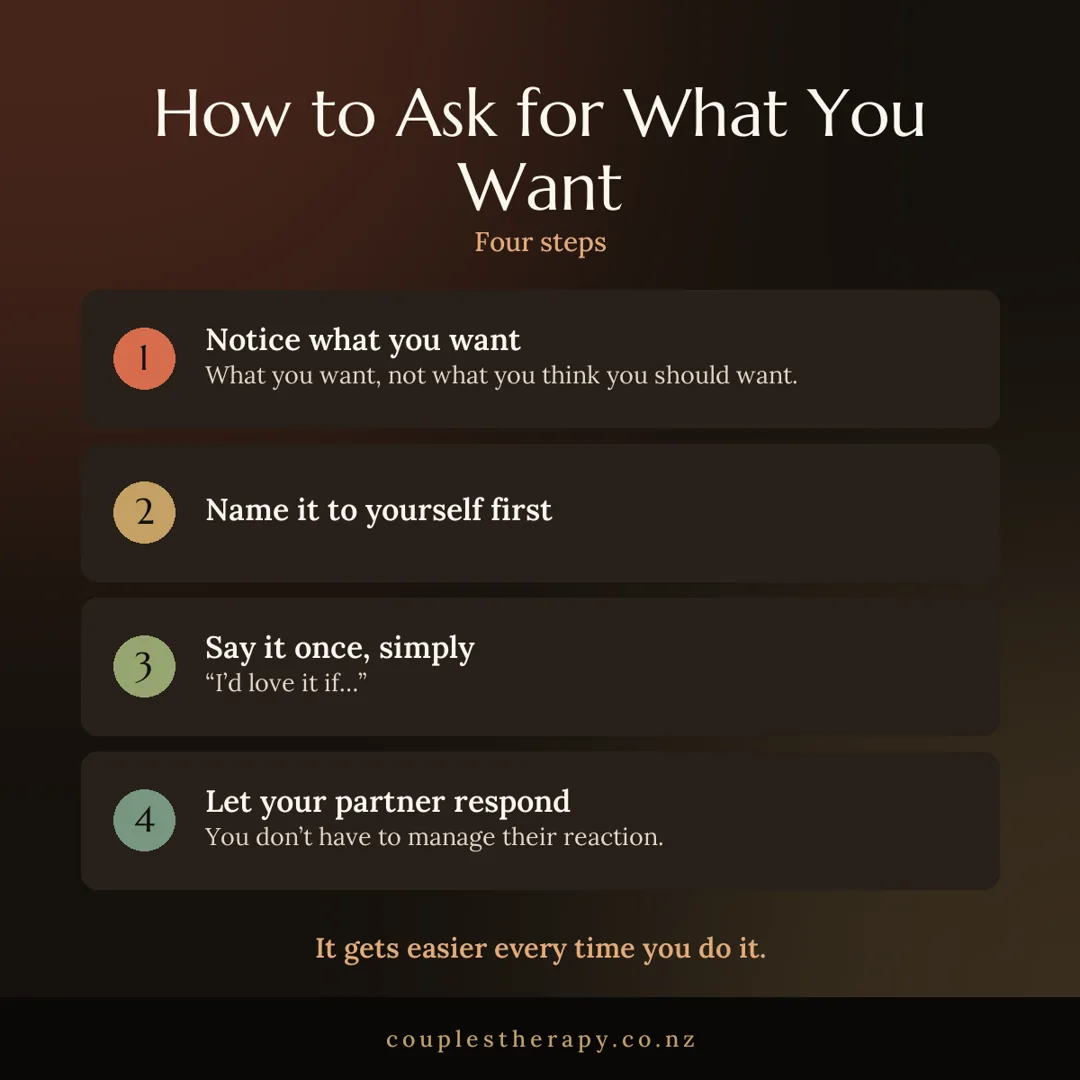
It takes courage to stop settling for distance and ask for more.
Whether you begin with sex therapy, couples counselling or an approach that brings them together, choose support that helps your relationship keep growing.
The deepest love may still be ahead of you.
Want support with this in your own relationship? Find out about couples therapy with Tarisha, a private retreat for two, or our retreats for couples: the Valentine’s Retreat and The Wanaka Adventure. Or start with a free discovery call.