
The argument starts over the dishwasher.
Or it’s a late text, or the way one of you turns away in bed.
Neither of you believes it’s about the dishwasher, though. You can feel the older ache underneath it: Do I matter to you? Can I reach you? Are we still lovers, or just very efficient co-managers of a life?
When couples weigh up intensive therapy vs weekly counselling, they’re deciding more than how to book the calendar.
They’re deciding how much space they’re willing to make for the relationship that has carried them through mortgages, kids, ageing parents, careers, grief and the ordinary exhaustion of being human.
Weekly sessions can bring steady change that lasts. An intensive gives you uninterrupted time to go deeper.
I don’t think either one is automatically better.
The right choice depends on the pattern you’re caught in, how urgent it feels, and whether you can both be honest in the room.
Intensive therapy vs weekly counselling: two different formats
Weekly counselling gives you a regular time to work on your relationship.
You meet with a therapist, slow down a recent fight, work out the cycle you’re in, practise a new conversation, and then go back to the beautiful chaos of everyday life.
The work happens in layers, and for many couples that rhythm is exactly right.
A multiday intensive is more concentrated.
In a weekly session, the first 15 minutes often go on arriving, recapping the week and settling your nervous systems. In an intensive, you have time to stay with what’s happening between you.
- A defensive joke can turn into a tender admission.
- A fight you keep having can show you the fear underneath it.
- A couple who haven’t touched for months can start to understand what made touch feel so loaded in the first place.
I wouldn’t think of it as cramming months of therapy into a weekend.
What changes is the conditions around the work.
There’s time to move past analysing and into experience: emotional repair, awareness of your body, conversations about sex, moments of play, and perhaps tears that have been waiting a very long time to come.
That intensity is powerful, and you still have to go home afterwards.
You’ll unload the dishwasher and choose each other again when the old reflex shows up at 8.30 on a Tuesday morning.
When weekly counselling is the better choice
Weekly work suits couples who need consistency more than speed.
If your foundation is fairly stable, you can talk without things escalating beyond repair, and you want support bringing changes into everyday life, the gradual pace can work very well.
It also lets you watch your relationship in motion.
You try a different response after a difficult call with the kids. You notice what happens when one of you asks directly for reassurance instead of criticising.
Then you come back the following week with something that actually happened to talk about, which is far more useful than theory.
Weekly counselling can be especially valuable when one of you, or both, feels wary of opening up.
Trust with a therapist builds over time.
There’s no prize for forcing yourself to share something before your body believes it’s safe enough.
The limitation is practical.
50 or 60 minutes can feel far too short when your relationship has been struggling for years.
You finally get to what’s hurting, and then it’s time to stop, get back to the car, and collect the children from school.
By the next week the feeling has faded, and it’s tempting to avoid the subject again.
When an intensive can change the direction of your relationship
An intensive is often right when your relationship has reached a crossroads.
Perhaps an affair or another major betrayal has broken trust. Perhaps sex has become absent, dutiful or full of avoidance.
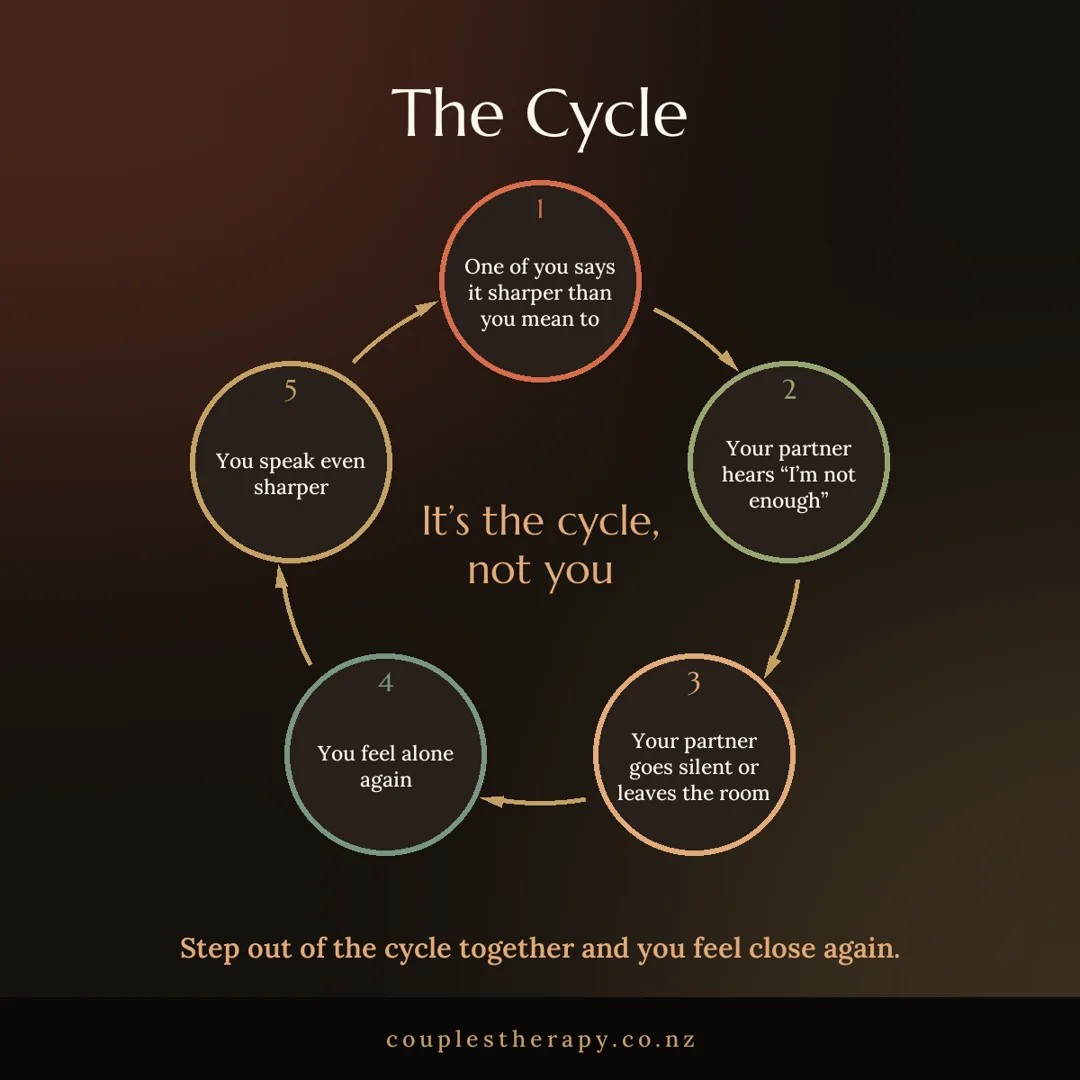
Or perhaps you’re trapped in the same cycle, where one of you protests and the other withdraws, and you can each recite the other’s lines before the argument has properly begun.
Does this sound familiar?
An intensive can also be the right choice when life simply doesn’t leave enough time for your partnership.
Senior roles, blended families, travel, caring for others and packed diaries can turn a weekly appointment into one more thing to cancel.
Setting aside a block of days tells you both that this relationship is part of the life you’re working so hard to build, and that it deserves more than a line on the to do list.
In an intensive, the therapist can follow your attachment pattern as it happens.
One of you presses for contact because distance feels terrifying. The other retreats because criticism or failure feels unbearable.
What I see with couples is that underneath the argument, both people are trying to protect the bond. They’re just doing it in ways that leave the other feeling abandoned.
With enough time, you can slow this dance down until you both see it clearly.
You stop reading it as proof that your partner is cold, needy or impossible, and you start seeing a pattern you’re both caught in.
That’s often when compassion comes back, and compassion helps you far more than winning does.
A relationship intensive should reach beyond talk
For long term couples, understanding alone rarely brings the spark back.
You may already understand your childhood patterns and still find yourselves scrolling beside each other, feeling lonely and being polite about sex.
A well run intensive can work on several sides of intimacy. Emotionally Focused Therapy (EFT) helps you find the vulnerable attachment needs under blame, shutdown and resentment.
Sex therapy gives you language for desire, arousal, shame, your differences, and the sexual scripts you’ve inherited.
Somatic and embodiment practices bring your attention back to the body, which is where we feel attraction, tension, grief and longing.
Polarity work can help you look at what has flattened desire.
Many partners become excellent logistical teammates and lose the charge of being two distinct, curious adults who can still surprise each other.
Adventure and challenge can help here too.
Doing something new together won’t fix a relationship, but it can interrupt the stale roles that keep you stuck.
None of this means putting on a show of sensuality or manufacturing chemistry on command.
Desire needs honesty, and honesty is what this work creates.
You can’t force desire.
What you can do is change the things that are shutting it down.
Choose based on what your relationship needs
You and I both know that booking therapy can become a way of putting off the harder question.
Are we willing to be changed by this?
Choose weekly counselling if you need an ongoing rhythm, your conflict is manageable, or you want time between sessions to practise new ways of relating.
Choose an intensive if your relationship needs protected time, your pattern is entrenched, or you’re facing a major rupture that can’t be dealt with an hour at a time.
For some couples, the strongest approach is both.
An intensive builds momentum and brings the deepest pattern into sharp focus. Follow up sessions then help you live what you discovered.
The apology turns into a new way of handling stress, the vulnerable conversation becomes a habit, and you keep talking honestly about sex once the weekend away is over.
There are situations where couples work shouldn’t be the first step.
If there’s coercion, violence, active intimidation, or fear about what happens after a session, safety and individual specialist support come before joint relationship work.
Couples therapy only works when both people can take part freely.
The work after the breakthrough
The greatest risk of an intensive is treating a big emotional release as the end of the work. A big cry, a passionate reconnection, or a raw truth spoken at last can feel enormous, and it can be enormous.
But a nervous system trained by years of self protection doesn’t change because you had one powerful afternoon.
What you do afterwards is what makes the change last.
That might mean:
- Short daily check ins
- Clearer agreements about how you repair
- Protected time for intimacy
- Individual therapy where it’s needed
- Follow up couples sessions
It also means noticing the old cycle when it starts up, and stopping before it takes over.
I believe the deepest love is still ahead of you.
Your relationship doesn’t need to become perfect for that.
You can both become more honest, more at home in your bodies, and more available to what’s possible between you.
Your partnership deserves attention.
So which kind of support will help you stop having the same painful argument and start building something better together?
Want support with this in your own relationship? Find out about couples therapy with Tarisha, a private retreat for two, or our retreats for couples: the Valentine’s Retreat and The Wanaka Adventure. Or start with a free discovery call.






One Comment
Comments are closed.