
He reaches across the bed.
She pretends to be asleep.
Or she puts on something nice and sits next to him on the couch, and he says he’s tired.
Either way, someone lies awake feeling unwanted.
And someone lies awake feeling guilty.
If you’ve been together a long time, you may know this pattern well. This is what mismatched libido looks like in a long relationship.
I call it the sexual cycle, and it’s one of the most painful and most common things couples over 40 struggle with.
Mismatched libido: two people, two different desires
Almost no couple is perfectly matched in desire.
One of you usually wants sex more often than the other. That’s normal, and it doesn’t mean anything is wrong.
In most couples, the partner who wants more is the man. But not always.
In studies of couples with different levels of desire, it’s the woman in roughly a quarter to a third of them, and those women often feel especially alone, because nearly everything they read assumes it’s the other way round.
So in this post, I’ll talk about the reaching partner and the retreating partner.
You’ll know which one you are.
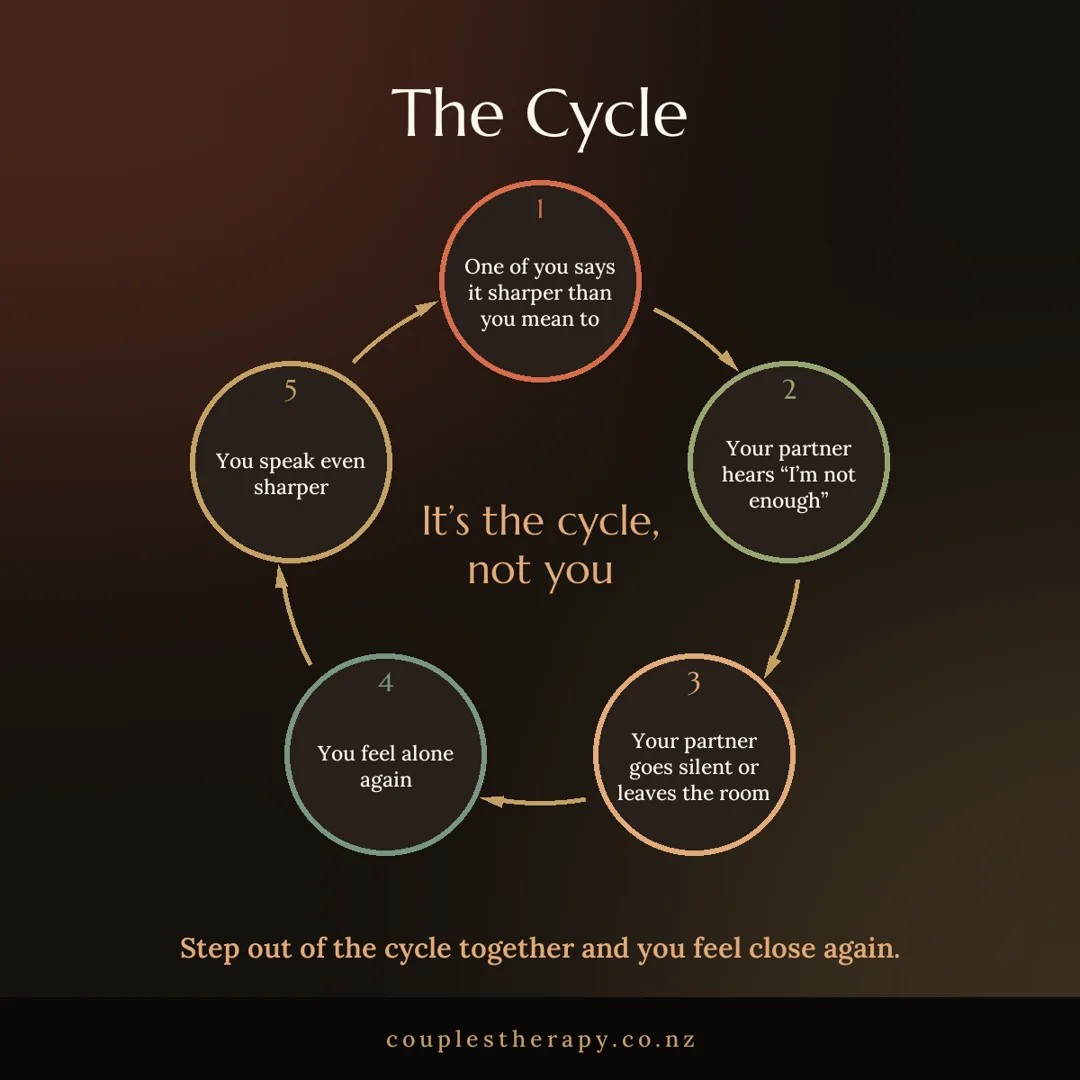
How the cycle starts
It usually starts innocently.
Life gets busy with kids, work, ageing parents and tiredness, and sex happens less often.
The reaching partner notices first.
They miss the closeness, so they initiate. A hand on the hip, a long kiss, an invitation.
The retreating partner is tired, or stressed, or not feeling especially connected. They say not tonight.
Once is fine, but it keeps happening.
What every no feels like
For the reaching partner, each no starts to feel personal.
Not “not tonight” but “not you”.
People describe the same words again and again: unwanted, unattractive, unloved, not enough. Many say it feels like living beside the person they love and being invisible.
Do you know that feeling?
So they reach again, with a bit more urgency.
Or they start keeping score. Or they get hurt and go cold. Some stop initiating altogether, to protect themselves from one more no.
Try this: if you’re the reaching partner, notice what you’re longing for under the sex. Often it’s to feel chosen and close. Try saying that directly: “I miss feeling close to you.”
What every reach feels like
For the retreating partner, each reach starts to feel like pressure.
Many describe learning that touch equals expectation.
A hug isn’t just a hug, it’s a question. A kiss isn’t just a kiss, it’s an opening move.
So, to avoid saying no yet again, they start avoiding touch altogether.
Others describe feeling like they’re only noticed when sex is on the table. Or feeling so stretched by work, kids and the mental load that there’s simply nothing left.
And they feel guilty.
They know their partner is hurting. They don’t want to hurt them. They just don’t know how to want what’s being asked of them.
Why the cycle gets worse
Here’s where it gets stuck.
For many people, especially women and especially after 40, desire is responsive.
It doesn’t appear out of nowhere. It grows from warmth, relaxation and feeling cared for. Touch that feels safe is one of the things that helps it grow.
So when the retreating partner avoids touch to avoid pressure, they also lose the very thing that would help desire come back.
With less touch there’s less desire. One of you reaches more, the other feels pressured, and there’s even less touch.
Have you been there?
Neither of you is doing anything wrong. You’re both responding to the other. That’s what makes it a cycle.

It’s tied to the emotional cycle too
The sexual cycle rarely lives on its own.
Most couples who are caught in it also have an emotional version running in the kitchen: one reaching to talk, the other pulling back.
When you feel emotionally disconnected, sex feels less inviting. And when sex has gone, it’s harder to feel emotionally close.
The two feed each other.
That’s why working on sex alone often doesn’t stick. You have to look at both rooms.
How to change the steps
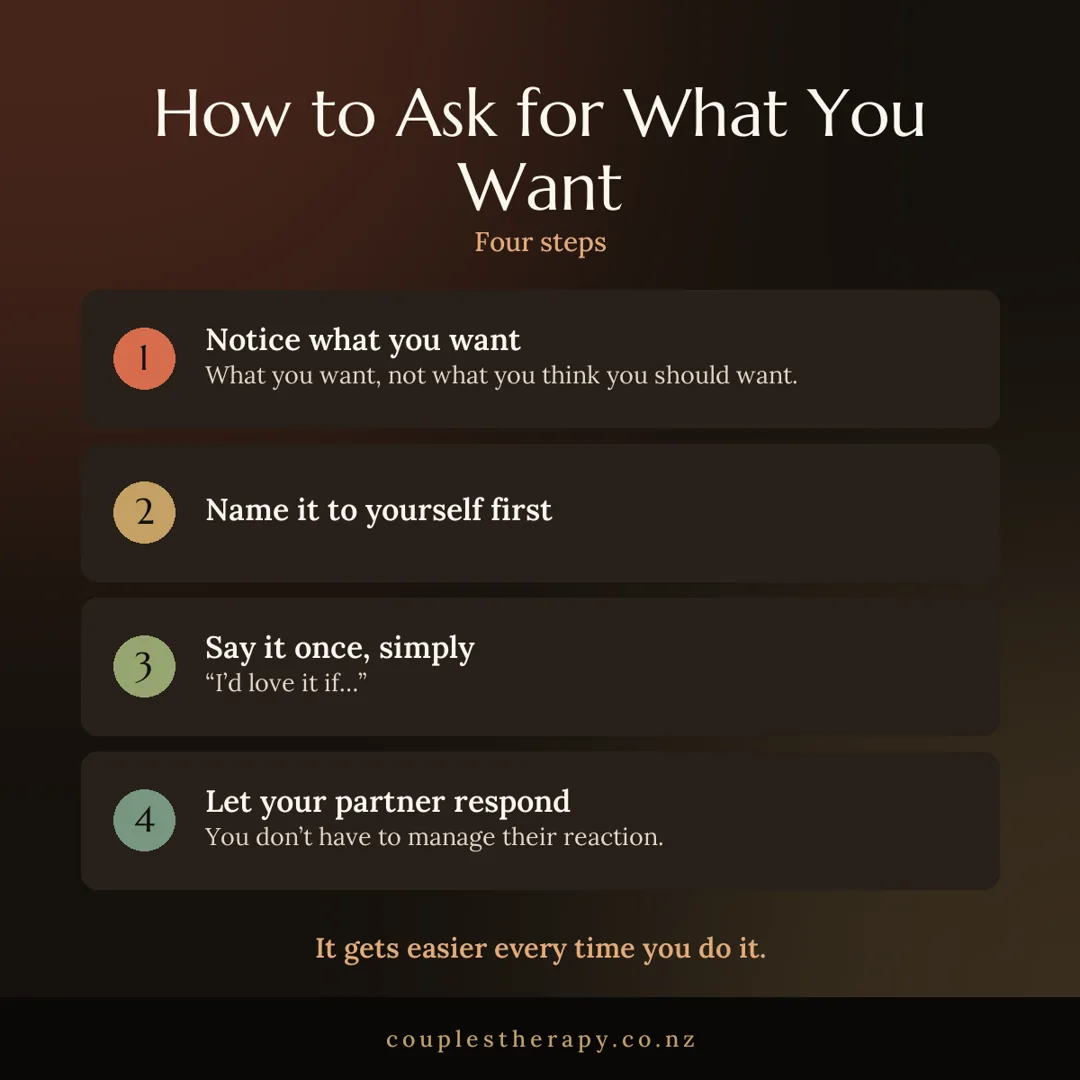
Name the cycle. “I think we’re stuck in a loop where I reach and you pull back, and we both end up hurt.” Naming it takes the blame out.
Separate affection from sex. Agree that, for a while, touch won’t lead to sex. Hugs that end as hugs. Holding hands on a walk. This rebuilds safety, and often desire starts to return on its own.
Talk about it outside the bedroom. Never at 10pm after a no. Choose a calm moment, and each of you share what it’s like on your side. Listen without defending.
Change how you invite and decline.
The reaching partner can invite without pressure: “I’d love to be close to you this weekend, no pressure.”
The retreating partner can decline with warmth and a yes attached: “Not tonight, but I’d love to be held. How about Saturday morning?”
Look at the body.
If sex hurts, or erections have changed, or menopause is in the mix, see your GP. These are common and often very treatable.
I’m not a doctor, and this isn’t medical advice. Please talk to your GP about anything physical.
Get curious about pleasure. Sometimes desire has faded because sex has stopped being enjoyable, or never quite was. Pleasure, presence and connection are more important than frequency or orgasm.
When “no pressure” turns into avoiding it
Don’t let “no pressure” become a way of avoiding the issue.
If intimacy has been missing for months or years, pretending it’ll sort itself out only lets you drift further apart.
Try this: get curious about what has gone missing.
- What kind of touch feels welcome?
- What helps each of you become more available?
- What has become predictable or done on autopilot?
Plan time for intimacy
For some couples, it helps to schedule protected time.
I know scheduling doesn’t sound romantic, but a busy life will otherwise take up all the time you have.
A planned intimacy date doesn’t have to include intercourse.
It might begin with phones out of the room, a shower, music, a slow meal, a walk, a massage, or twenty minutes of touching with one simple rule: either of you can pause or stop without fallout.
What you’re practising is being present. You’re getting to know each other’s bodies again without rushing to the usual ending.
When you get it wrong
You’ll get it wrong sometimes.
One of you will reach out at the wrong moment, a rejection will sting, and one of you will get defensive.
Every couple has these moments.
The couples who grow are the ones who repair quickly, before the hurt turns into a fixed belief about each other.
Repair can sound simple: “I’m sorry I made you feel cornered.”
Or, “I’m sorry I shut you out without telling you what was happening.”
Then ask, “What would help you feel safer with me next time?” and be prepared to hear an answer you can’t solve in one conversation.
You’re on the same side
The sexual cycle can make couples feel like opponents.
One the beggar, one the gatekeeper. That’s not who you are.
You’re two people who both want to feel loved, wanted and safe, caught in a pattern that’s making that harder.
Once you see it together, you can start to change it together.
Want to understand what’s happening between the two of you? Come to Reignite Your Love, a 3 hour workshop in Auckland about the emotional and sexual cycle and how to step out of it. Or start with a free discovery call.