
You look across the kitchen bench.
You see the person you chose, the person who has seen you through children, careers, family drama and years of busy schedules. You love them. You may even like them.
But you may not remember the last time you felt hungry for them, with a pull in your body that went beyond affection or obligation. Learning how to restart desire in midlife doesn’t mean recreating your twenties.
Frankly, thank goodness.
You have more history now, more self knowledge and more capacity for depth.
The work is to stop treating the absence of desire as a personal failure or the end of your relationship.
It’s a sign that something in the bond, in your body, or in the way you’re living together is asking for attention.
Desire rarely disappears for one neat reason.
It gets buried beneath resentment, exhaustion, hormonal shifts, body changes, relentless logistics and the dulling effect of knowing exactly what happens next.
The good news is that desire can return.
You don’t have to get every part of life sorted first. It comes back when you’re braver and more honest with each other.
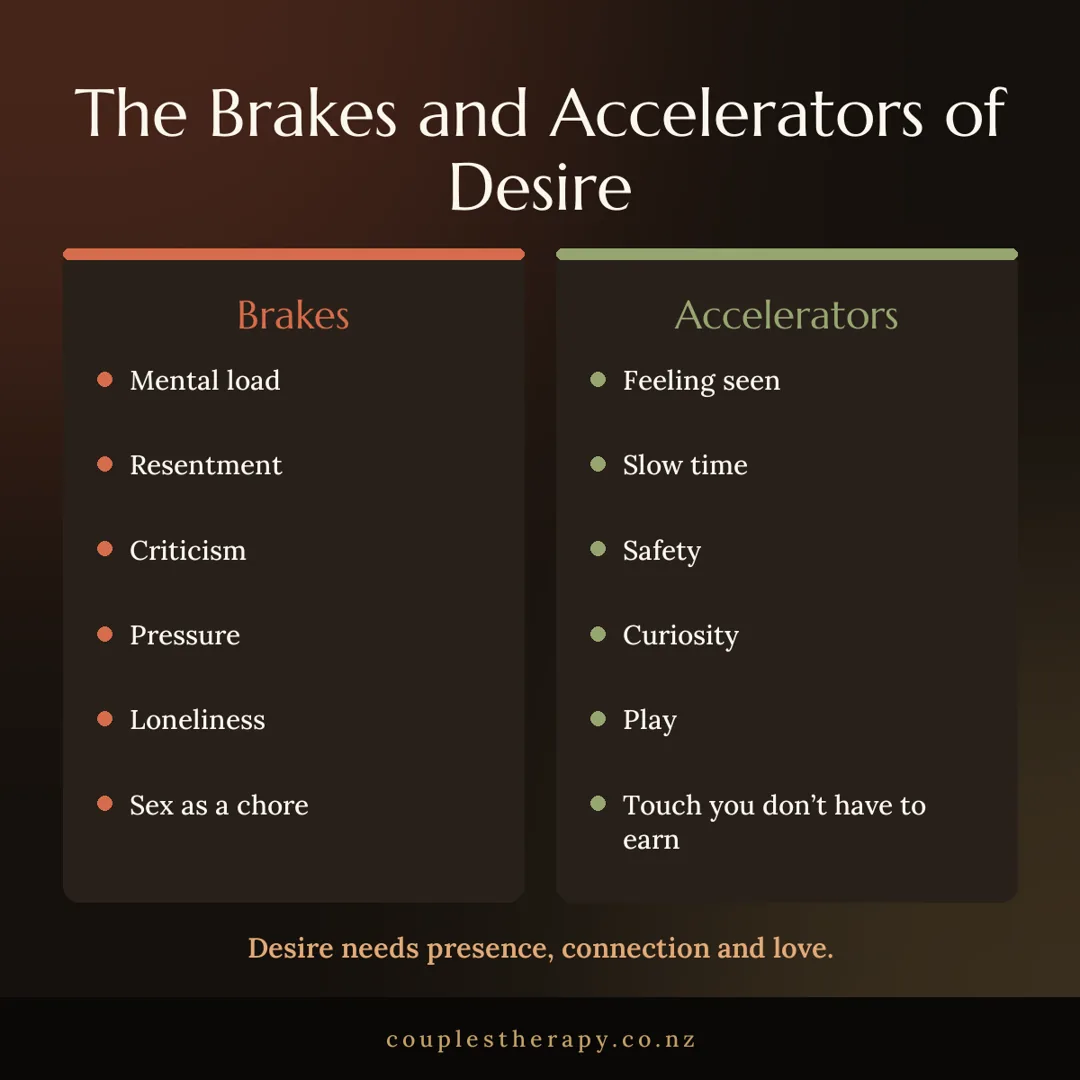
Desire needs more than love
Long term couples often make a painful assumption: if we love each other, sex should flow naturally.
Then life gets bigger.
A parent gets ill, work becomes demanding, and teens need lifts at absurd hours.
One partner carries the invisible load.
The other feels criticised and retreats.
Before long, the bed becomes a place for scrolling, sleeping and negotiating who’s feeding the dog.
Love and desire are related, but they need different things.
Love needs safety, reliability and belonging.
Desire also needs a little space, a sense of otherness, play, novelty and permission to be more than efficient adults in sensible underwear.
You don’t need drama, betrayal or a weekend pretending to be strangers in a hotel lobby.
Your relationship needs room for surprise.
If your partner has become only your co-manager, coparent or emotional support department, there’s very little room for desire.
Start with the relationship beneath the bedroom
When sex has become rare, tense or dutiful, many couples try to solve it with techniques. They schedule date night, buy something lacy, or agree to have more sex.
These gestures can help, but they won’t repair the emotional hurt underneath.
Ask a harder question: what happens between us when one of us reaches?
Perhaps one of you pursues conversation, reassurance or sex, while the other goes blank, defensive or distracted. Perhaps you both avoid raising it because every attempt ends with someone feeling rejected.
This cycle is the problem, and you can work on it together.
In Emotionally Focused Therapy (EFT), I work with the protective pattern that takes over when you don’t feel sure of each other.
The angry comment about never having sex may be carrying a more vulnerable message: “I miss feeling wanted by you.” The shrug and retreat may mean: “I’m terrified I’ll disappoint you.”
Try saying the message underneath the protest.
“When we go weeks without touching, I tell myself you don’t want me. Then I get sharp because it feels safer than admitting I feel lonely.”
That’s a very different conversation from “You never initiate.” It gives your partner something they can respond to with care.
You don’t need endless processing in bed for this.
In fact, keep difficult relationship talks out of the bedroom where you can.
Build safety in ordinary moments: a hand on the shoulder, ten mobile free minutes after dinner, genuine curiosity about what’s going on inside your partner.
Emotional connection is worth having for its own sake, so please don’t treat it as foreplay in disguise. It also helps you trust each other sexually.
How to restart desire in midlife without forcing it
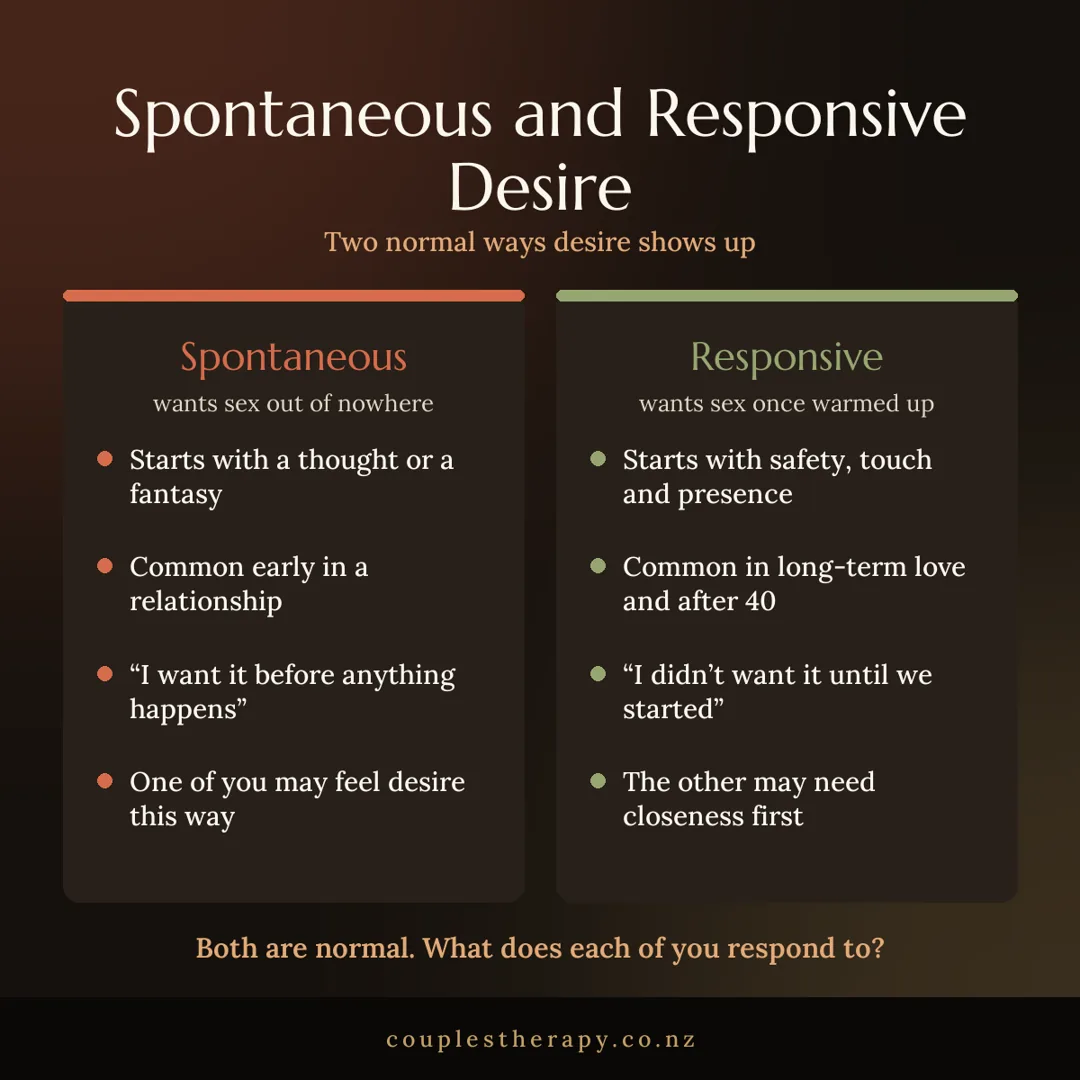
Desire doesn’t always arrive as a lightning bolt.
For many people, particularly after years of stress or hormonal change, it’s responsive. It shows up after warmth, touch, relaxation and the feeling of being met.
If you wait to feel spontaneously ravenous before you connect, you can both be waiting a very long time.
My invitation is to create the conditions for desire without every touch having to lead to sex.
Start with a deliberate practice of touch that has no goal.
Take twenty minutes on the couch or in bed, mobiles out of reach, with one of you receiving touch and the other giving it.
No one is trying to arouse, fix or impress.
You simply notice what feels good, what creates tension, and what you want more or less of.
Use plain language.
“Slower.” “Stay there.” “I like your hand on my waist.” “I want cuddling, not sex tonight.”
Clear boundaries make intimacy feel safer, because neither of you has to guess.
Then talk honestly about what you want sexually.
- What do you miss?
- What have you outgrown?
- Is there a fantasy, a pace, a setting or a kind of touch you’ve never had the courage to name?
You don’t have to act on every fantasy. Sharing it can be an act of intimacy in itself.
Come to these conversations with generosity.
Your partner’s desire may not mirror yours.
One of you may want frequent sex, while the other wants more time, more tenderness or more freedom from pressure.
Nobody’s libido is the correct one.
What you’re building is a shared erotic language that has room for both of you.
Come back to your body
Your midlife body is the body you have now, and it’s capable of sensation, pleasure and a far more honest experience of intimacy.
Physical changes do deserve care.
Perimenopause and menopause can affect lubrication, comfort, sleep and libido. Testosterone changes, erectile difficulties, chronic pain, medication, alcohol, anxiety and depression can alter sexual response for any gender.
A GP, pelvic health physiotherapist or qualified sex therapist can help you find out what’s happening. Asking for support doesn’t mean your relationship is broken. I see it as mature self respect.
At home, trade judging your body for paying attention to it.
Notice where you feel alive:
- Warm water on your back
- Music that gets your hips moving
- The delicious fatigue after a bushwalk
- Your partner’s palm between your shoulder blades
Sensuality is bigger than intercourse. When you feel sensation in your body again and stop judging how it looks, desire can come back.
This is where being in your body helps.
Take a few minutes before intimacy to breathe, stretch, shower, dance badly in the lounge or lie together with your hands over each other’s hearts.
You don’t need to become a blissed out tantric deity before 9 pm.
You only need to stop thinking about the bills and criticising yourself, and pay attention to your body.
Create polarity and shared risk
Familiarity can be deeply comforting.
It can also flatten the charge between you if everything becomes predictable.
Desire is often sparked when we see our partner as separate, capable and vividly alive in their own right.
Polarity is the attraction that builds when each of you is fully yourself: present, decisive and different from the other. It has nothing to do with gender or who does what.
One partner might plan an evening without asking the other to manage it.
The other might practise receiving, and leave the details uncorrected.
You might wear something because it makes you feel powerful, whatever response it does or doesn’t get.
Shared adventure helps too.
Do something that changes your state together: take a coastal hike before sunrise, try a dance class, climb something, or learn a skill that makes you both beginners again.
A mild challenge wakes you up.
You see each other outside the old roles, cheeks flushed, laughing, slightly unsure. That image can travel home with you.
Please don’t turn adventure into another target to hit.
If one of you hates rock climbing, forcing it won’t create a hot marriage.
Choose something that stretches you both and feels exciting, whether that’s a new trail, a long lunch in a different suburb, or an honest conversation you’ve put off for years.
Stop waiting for the perfect season
There’ll always be an excuse to delay intimacy until life calms down:
- The renovation
- The promotion
- The kids leaving home
- The next holiday
- The moment you finally feel confident in your body
You build long term desire by choosing to connect in the middle of ordinary, imperfect life.
Start small and be consistent.
Protect one hour this week for connection, with no agenda beyond being together. Name one thing you miss and one thing you crave.
Let the first attempt be awkward if it needs to be. Awkwardness is often just what it feels like to leave an old pattern.
The deepest love may still be ahead of you.
Time won’t magically restore what drift has taken, but you can be more honest, braver and more present in your body with each other than before.
Want support with this in your own relationship? Find out about couples therapy with Tarisha, a private retreat for two, or our retreats for couples: the Valentine’s Retreat and The Wanaka Adventure. Or start with a free discovery call.