Your life together works well.
The kids are grown, the routines run smoothly, and in bed you feel miles apart.
That’s what many people are feeling when they search for an erotic intimacy retreat couples can trust.
The love is still there.
But your relationship has become about getting things done, and there’s no time or attention left for desire.
Many couples then decide they’ve failed at romance, and I think that’s the wrong way to look at it.
Erotic connection in a long term partnership usually fades for other reasons.
- You’re tense around each other and the same arguments never get resolved.
- You’re both stressed and worn out, and you’ve stopped feeling much in your bodies.
- Sex has become loaded, infrequent or avoided, or you’re going through the motions.
A retreat can help, as long as it works on the whole bond between you and doesn’t stop at the bedroom.
What couples are really seeking in erotic intimacy retreats
Most couples come because they’ve lost something precious and don’t know how to get it back.
They miss the look that used to pass between them across the kitchen.
They miss feeling wanted.
They miss touching without pressure, laughing without getting defensive, and kissing without negotiating whose turn it is to empty the dishwasher.
Underneath the sexual hurt there’s usually an emotional one: you don’t feel safe and close with each other.
One partner feels rejected and the other feels pressured.
One chases and the other shuts down. One talks about the problem and the other goes flat and practical.
Then both start telling themselves a dangerous story: maybe this is just what happens after twenty years.
Does this sound familiar?
I don’t accept that story.
Mature love doesn’t have to become a polite business partnership with occasional holidays and separate inner lives.
Good intentions won’t bring it back either.
You need a place where you can work on your emotional connection and your sex life together.
A retreat should do more than improve sex
Be careful if a retreat promises hotter intimacy without dealing with resentment, shame, grief, old injuries or the ways you’ve been missing each other sexually.
You can’t build lasting desire on top of chronic emotional disconnection.
Your body can tell when you don’t fully trust each other.
It can tell when touch comes with obligation, or when sex is being used as proof that the relationship is fine.
A strong retreat works on several levels at once.
It helps you name the cycle you get trapped in, and it helps your body relax and stop bracing.
It gives structure to the hard conversations that usually blow up at home. And it gives you time and attention for each other, so desire can come back without being forced.
That last point is important.
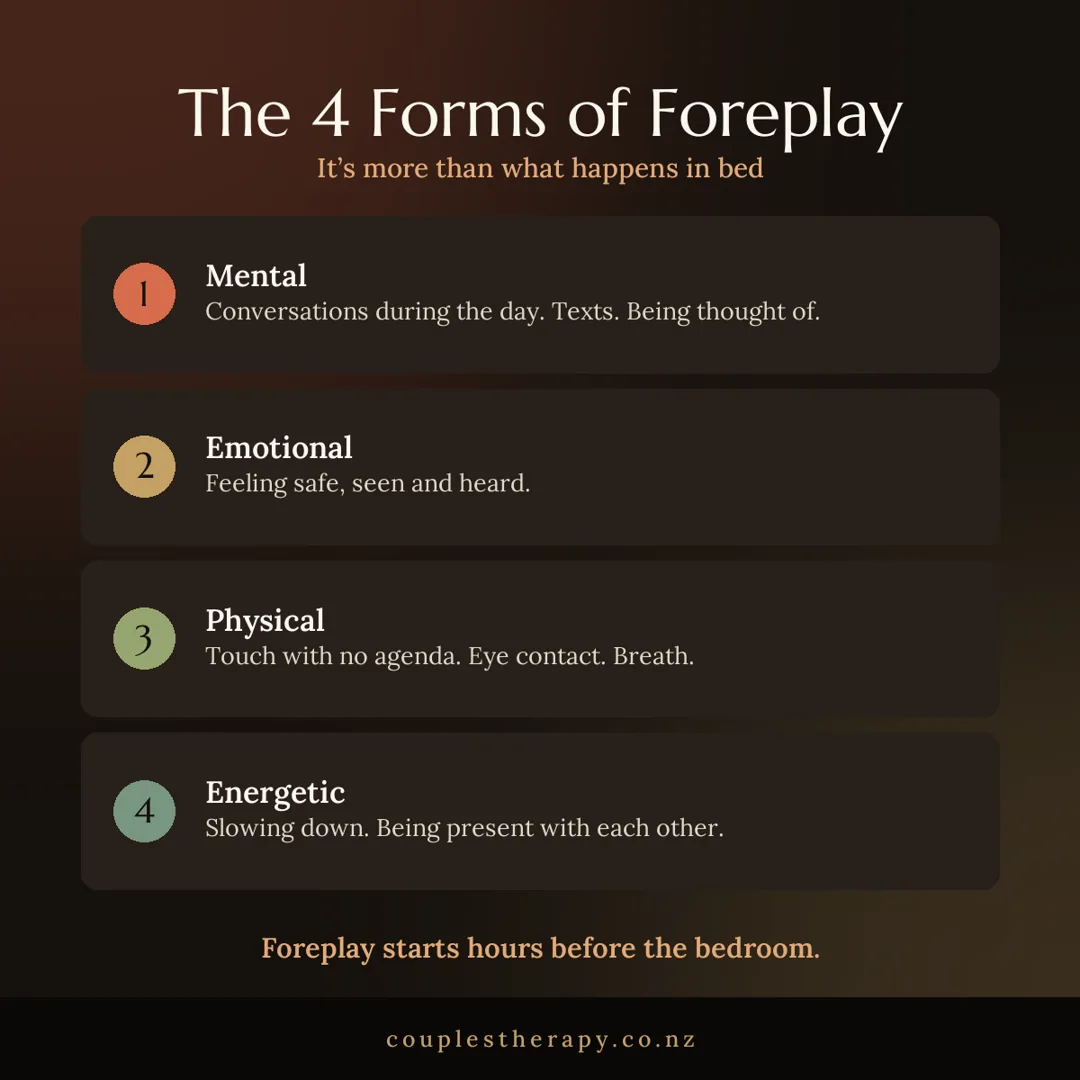
Desire grows when you feel safe, when you’re honest with each other, and when there’s some newness and polarity between you.
It fades when sex feels like a duty.
The difference between a getaway and transformation
A luxury weekend away can be lovely.
Room service, ocean views and a decent bottle of red are all very civilised.
Yet many couples come home and nothing has changed between them. The scenery was different for a few days and the pattern was the same.
An erotic intimacy retreat for couples needs a clear method and skilled facilitators, as well as a nice atmosphere. It means someone in the room knows how to work with shutdown, sexual mismatch, trauma responses, resentment and body shame.
They also know how to work with the flatness that can come into a long relationship when neither of you says what you truly want.
This is where it helps to combine several approaches.
Emotionally focused work helps you see and change the pattern underneath your conflict.
Sex therapy gives you words for desire, arousal and avoidance, and for the habits and expectations you each bring to sex.
Embodiment work helps you get out of your heads and back into sensation. Polarity work can bring back attraction when you’ve started to feel more like siblings or flatmates.
Adventure and novelty are important too, because your body often needs movement, risk and a fresh setting to feel alive again.
Each of these pieces helps create the conditions where the two of you can actually meet each other again.
What makes an erotic intimacy retreat couples can trust
The best retreats don’t try to shock you into chemistry.
They’re designed to help you become more honest and more connected, and to feel more awake in your own skin.
First, the space has to be emotionally safe.
By safe I mean clear boundaries, strong leadership and facilitators who stay steady when emotions run high.
If there’s erotic work involved, consent has to be explicit, checked more than once and respected at every step.
You should never be pushed into exposure in the name of growth.
Second, the retreat should honour what long term love is actually like.
Couples in their 40s, 50s and 60s usually want more than excitement. They want passion with someone they trust, and intimacy that lasts through ordinary life.
A good retreat respects your shared history, your years of parenting and any betrayals you’ve had to work through.
It respects perimenopause, ageing bodies, health changes and all the ways desire evolves over time.
Third, the retreat has to prepare you for going home.
If you leave with no words for what happened, no practices and no way to stop your old pattern, the change won’t last.
Insight is lovely.
What changes a marriage is what you keep doing once you’re home.
Who benefits most from this kind of retreat
Every couple needs something a little different.
If your relationship is actively unsafe, coercive or in acute crisis, a retreat may be the wrong place to start.
If one of you is dead against going and is being dragged there under protest, expect resistance. And if you’re hoping one dramatic weekend will erase years of avoidance, that isn’t realistic.
For couples who still care deeply and feel the loss of what has gone missing, though, a retreat can change a lot in a short time.
It’s especially helpful for partners who understand themselves well and are still stuck.
They’ve tried talking things through and keep ending up in the same place.
These are often successful, capable adults who’ve built a life together and suddenly realise they’ve become excellent co-managers and inconsistent lovers.
Imagine a couple who arrive brittle, sarcastic and exhausted, barely making eye contact over breakfast. Two days later nothing is magically fixed, and yet they’re honest with each other again.
They stop joking to protect themselves, and the tears come.
One of them puts a hand on the other’s thigh and means it.
They can feel desire between them again, and neither of them is doing it out of duty.
Why erotic work without emotional work falls flat
I’ll be blunt about this.
You can’t plan your way into chemistry when your partner feels like your critic, your dependant or your housemate, or when there’s an old hurt between you that hasn’t healed.
Desire needs you to be two different people who are still curious about each other.
It needs some space.
For many long term couples, the erotic shutdown has to do with much more than libido.
It has to do with how your body feels around your partner now.
If every touch reminds you of an argument you haven’t finished, your body won’t relax. If initiating always ends in disappointment, you both start bracing before anything has even happened.
If sex has become the test of whether the relationship is okay, neither of you can relax.
That’s why the strongest retreats work on emotional intimacy and sexual intimacy together.
You repair the trust between you and you start to feel your body again. You tell each other the truth, and you do new things together so you stop seeing each other in the same old way.
What to ask before you book
Before choosing an erotic intimacy retreat, couples should ask:
- How the facilitators are trained.
- What kinds of issues the retreat is designed to address.
- How consent is handled.
- What level of personal sharing is expected.
- Whether the work is educational, therapeutic or experiential. Ideally, it’s a thoughtful blend of all three.
- What support exists after the retreat ends.
Then ask yourselves a harder question: are we willing to let this change us?
Better sex is only part of it.
You’re being invited into a more honest relationship, where you both have the courage to feel again in the places you’ve shut down.
At Couples Therapy & Retreats, that’s what our retreats are for. We help couples find the depth, desire and tenderness that are still there between them.
If your relationship runs well but feels flat, please don’t assume that’s just what a mature relationship is. Your deepest love is still ahead of you when you both decide you want more than a relationship that functions.
Want support with this in your own relationship? Find out about couples therapy with Tarisha, a private retreat for two, or our retreats for couples: the Valentine’s Retreat and The Wanaka Adventure. Or start with a free discovery call.