
You can love your partner deeply.
And you can still feel your body go blank when they reach for you.
There’s nothing wrong with your character, and it doesn’t prove that your best erotic years are behind you.
Erotic embodiment for couples is the work of coming back to how desire feels in your body: the breath in your chest, the warmth in your belly, and the courage to let yourself be seen and touched.
Couples who’ve been together a long time often become extraordinarily capable.
You manage the calendar, make the dinners, handle the school emails, care for ageing parents and remember whose car needs servicing.
Then one night you look at each other across the kitchen bench and realise you’ve become a brilliant operations team. Whether you’re still lovers is less certain.
Does this sound familiar?
A new technique or a better date night rarely fixes this.
Desire shuts down under pressure, and it doesn’t respond to a polite request to “make more effort” either.
It grows when your body feels safe enough to soften and free enough to want, with enough charge between you to feel alive.
What erotic embodiment for couples really means
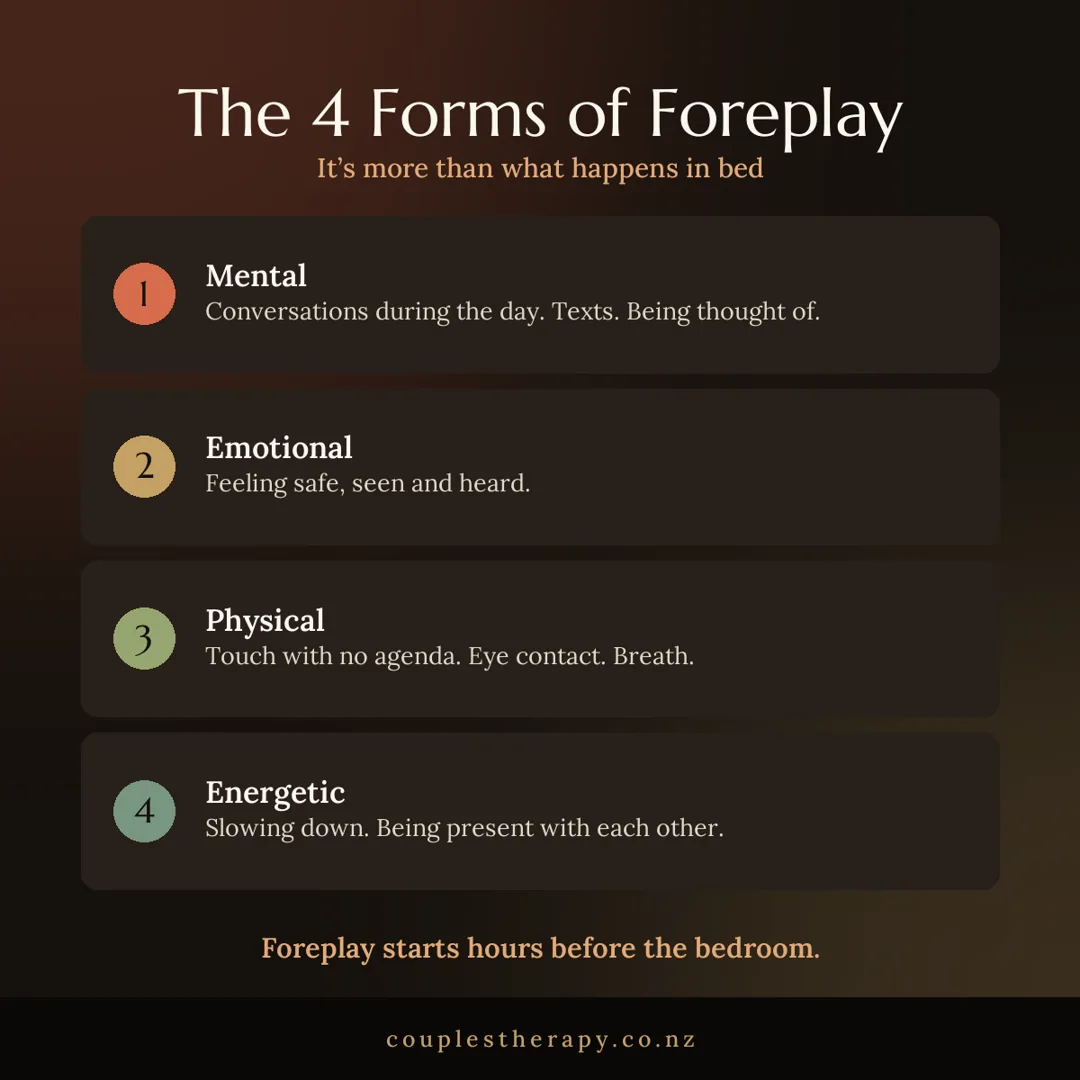
Erotic embodiment means staying in your own body while you’re with another person.
Usually your mind is busy analysing whether sex will happen, whether you look attractive, whether they’re enjoying it, or why things have changed.
Here you learn to notice sensation as it happens.
You notice your breath getting shorter, you feel your shoulders brace, and you catch the flicker of anticipation before your mind talks you out of it.
For couples, this work is about the relationship as much as it’s about sex.
A partner who can say, “I want to slow down, but I don’t want to stop,” is offering something far more intimate than someone who acts enthusiastic.
A partner who can hear that request without taking it as rejection makes it possible for you to trust each other sexually.
This is where emotional attachment and sexuality meet.
If one of you pursues contact while the other withdraws, the bedroom can become the latest place for an old argument, where one of you is asking “Do I matter to you?” and the other is asking “Will I ever be enough?”
Incense, impressive flexibility and tantric jargon won’t get you past that pain.
Erotic embodiment gives you both a way to feel that pain in your bodies and talk about it honestly.
Why desire goes missing in capable, committed couples
Most couples who lose desire still love each other.
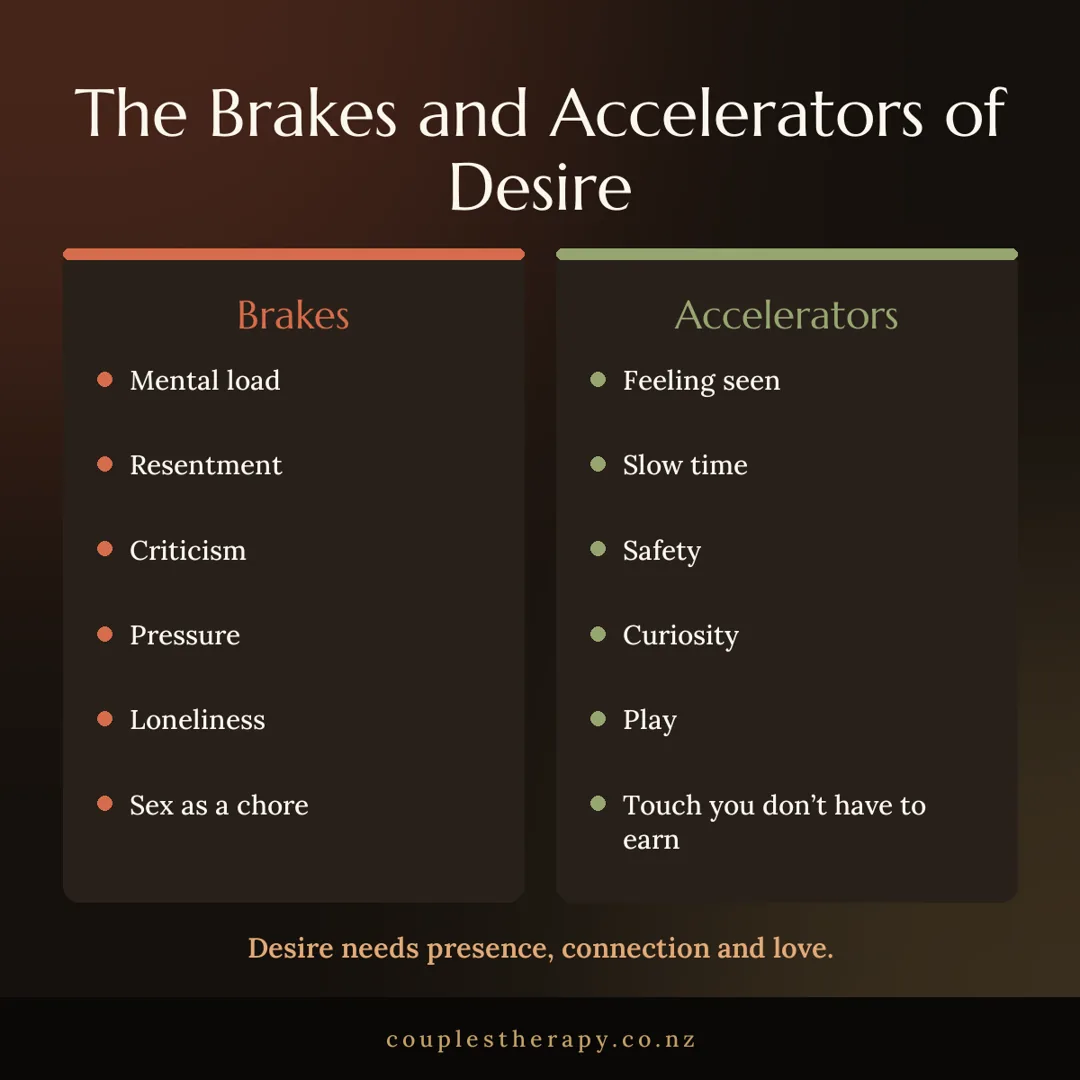
What I see is that they lose access to desire because their bodies are taken up with responsibility, resentment, staying on guard or routine.
A body that has spent all day solving problems doesn’t switch over to pleasure just because the bedroom door closes.
For some people, touch starts to carry a hidden demand.
A cuddle feels like the opening move in a negotiation they aren’t ready to have.
For others, the sexual distance feels like proof: I’m unwanted. Both responses make sense, and neither gives desire the room it needs.
There can also be grief underneath. Bodies change and hormones shift.
Illness, medication, stress, trauma, menopause, erectile changes and the sheer weight of a full life can all alter how arousal arrives.
Pretending none of this is happening doesn’t help. Facing it together can bring you closer.
Embodied intimacy asks you to be more honest than you are on autopilot.
You may need to admit that you miss being chased, that you’re afraid of disappointing your partner, that certain touch no longer works, or that you want more play and less predictability.
That conversation can feel exposing, and it’s also where the charge between you begins.
Start with presence and take the pressure off
The first shift sounds simple.
Take intercourse, orgasm and mutual satisfaction off the table as goals for a moment.
I don’t mean forever, only long enough to remember that connecting with your partner is something you can’t pass or fail.
Try giving yourselves twenty minutes when neither of you needs to be anywhere.
- Put the mobiles away.
- Sit facing each other, fully clothed if that feels safer, and place one hand on your own body.
- Take a few slower breaths.
- Then look at your partner as they are right now, and let go of the person who forgot the shopping or raised that issue again on Sunday.
One of you can say, “Right now, I notice…” and name sensations, leaving the stories out.
It might be: “My jaw is tight. I feel warmth in my chest. I’m nervous you’ll want more than I can give.”
The other person doesn’t need to fix, persuade or defend.
They only need to receive it and say, “Thank you for telling me.”
That might sound almost too basic.
Yet couples who’ve spent years arguing from their heads can find it startlingly intimate.
Being present like this gives your body new evidence: I can tell the truth here. I can have a boundary and still feel loved. I can want more without making my partner wrong.
Build a shared language for turn on and turn off
Desire is built through specific, generous communication, because neither of you can read the other’s mind.
“More intimacy” is too vague to guide anyone. What does it mean in your bodies and in your actual life?
Talk outside the bedroom, when neither of you is trying to initiate.
Ask what helps each of you arrive in your body.
One of you may need laughter, a shower and unhurried affection. The other may need directness, something new, or to feel actively desired.
Neither one is the right way.
Also name what closes you down.
It might be rushing, criticism, obligation, a partner checking whether you’ve finished, or touch that skips the slow build up.
Humour is allowed here. You may discover that discussing school fees straight after kissing isn’t your signature seduction move.
Keep your language inviting.
“Would you be open to…?” lands differently from “You never…” A request gives your partner room to respond.
A complaint often gets their defences up before you’ve even reached the interesting part.
Let polarity and play create some edge
Safety on its own doesn’t create eroticism. A relationship can be tender, stable and emotionally mature, and still have no spark.
Desire also needs aliveness, which means some contrast, some mystery and a little edge.
Polarity work can help you notice the roles you’ve become trapped in.
Perhaps one of you is always the planner, the competent one who manages everybody’s emotions. Perhaps the other has learned to wait, accommodate or disappear.
When you get stuck in those roles, desire often fades.
Experiment with swapping roles, and keep it simple. Let the one who usually organises receive. Let the one who usually hangs back choose the music, initiate a kiss or set the pace.
Take a walk somewhere wild, get your feet on the earth, then come back to each other while you’re still buzzing from it.
Novelty can’t replace repair, but it can remind you both that there’s still more to discover in each other.
You aren’t aiming for dominance for its own sake, or copying someone else’s fantasy.
You’re meeting each other outside your usual roles.
When embodiment needs deeper support
Sometimes sex has become a source of dread.
There may have been betrayal, unresolved trauma, persistent pain or coercion, or a conflict cycle that keeps leaving you both raw.
If that’s you, please don’t force your way through with more touch.
Consent is ongoing and specific.
“No”, “not yet” and “slower” are information your partner needs, and saying them doesn’t mean your relationship is failing.
This is where skilled support can make a big difference.
- Emotionally Focused Therapy (EFT) helps couples work with the attachment injuries underneath the protesting and the withdrawing.
- Sex therapy brings precision to desire, arousal, pain and how you talk about sex.
- Somatic and erotic embodiment practices bring in the body, which talking alone can’t do.
At Couples Therapy & Retreats, I help couples repair emotionally, be honest about sex and feel at home in their bodies again, so that love can become deeper and more alive.
The deepest love may still be ahead of you, and it takes more than good intentions to get there.
Tonight, resist the urge to solve your whole relationship.
Sit close and breathe.
Ask your partner what would help them feel more present with you, then listen carefully to what they tell you.
Want support with this in your own relationship? Find out about couples therapy with Tarisha, a private retreat for two, or our retreats for couples: the Valentine’s Retreat and The Wanaka Adventure. Or start with a free discovery call.