
You’ve been together for 15, 20 or 30 years.
Your relationship feels more like a well run business than a living romance, and the question of tantra vs sex therapy becomes pressing very quickly.
You’re not after another interesting idea to chat about over a flat white. You know the distance between you is hurting you both. You miss the charge and the heat between you.
You miss the softness, and the sense that your partner still wants you.
For long term couples, this is a practical comparison.
You want to know what will actually help if sex has dropped away, initiating feels loaded, resentment is affecting your sex life, or one of you wants more intensity while the other wants to feel safer first.
Tantra and sex therapy can both be powerful, but you can’t swap one for the other.
They work in different ways.
Tantra vs sex therapy: what are you really choosing?
At the simplest level, sex therapy is a clinical approach.
It helps couples understand and shift sexual concerns through psychological insight, communication, repair between you, and changes in behaviour.
Tantra is a body based practice, often with a spiritual side. It uses presence, breath, sensation, ritual and slow, conscious touch to deepen intimacy.
That sounds tidy on paper, and life is messier.
If you and your partner freeze the moment sex comes up, if desire discrepancy hurts you both every week, or if old betrayals still come up between you, sex therapy usually gives you more structure.
It helps you name the pattern, calm things down, and rebuild trust.
If, on the other hand, you still love each other deeply but sex has become mechanical, dutiful, or strangely absent despite plenty of goodwill, tantra may help more.
It can bring you out of your heads and back into your bodies.
You stop trying to impress each other or reach a goal, and you pay attention to each other.
Neither is better in some absolute sense.
A more useful question is: what’s driving the disconnection?
What sex therapy does well
Sex therapy shines when there’s confusion, avoidance, shame, conflict, or a practical sexual problem that needs skilled guidance.
This might include low desire, mismatched desire, pain, erectile difficulties, orgasm concerns, compulsive sexual behaviour, rebuilding after an affair, menopause related shifts, or years of bad sexual communication that you’ve put down to “we’re just busy”.
A strong sex therapist doesn’t simply tell you to schedule intimacy and hope for the best.
They help you understand what’s going on emotionally, and between the two of you, beneath the sexual issue.
- Maybe the partner with lower desire doesn’t feel emotionally safe.
- Maybe the higher desire partner is carrying years of rejection and now initiates with pressure where there used to be invitation.
- Maybe you’ve both become efficient coparents, and being that busy and capable has left no room for desire.
This is where clinical work helps.
Desire rarely fades for one reason. Usually several things are wearing it down.
Sex therapy is also useful if one or both of you need language for what’s happening. Some couples feel enormous relief simply hearing, “Ah, this pattern has a name.”
That relief won’t fix everything, but you stop panicking in private.
You know what you’re dealing with.
The trade off is that sex therapy can stay too much in the head if it doesn’t include the body. You can explain your blocks very well and still feel disconnected from your own body.
I’ve seen couples explain their attachment patterns with textbook precision, then touch each other like distant colleagues at a networking event.
Insight is important, and so is embodiment.
What tantra does well
Tantra brings attention to the body, breath, energy, and the quality of presence between you.
In its healthiest form, it slows everything down enough for you to actually feel, with nothing to prove and nobody to impress.
For couples who’ve fallen into efficient, goal oriented sex, this can be a revelation.
Tantra invites a different tempo. You stop treating sex as something to finish and start enjoying it as it happens.
Eye contact lasts longer. Your breath deepens.
You notice what you feel, and you stop rushing towards an outcome.
This can be especially potent for long term partners, because you know each other so well that you stop really looking at each other.
Tantra breaks that habit.
It asks you to see the person in front of you as they are now, and to let go of who you decided they were five years ago.
It can also help when one or both of you have become disconnected from pleasure itself.
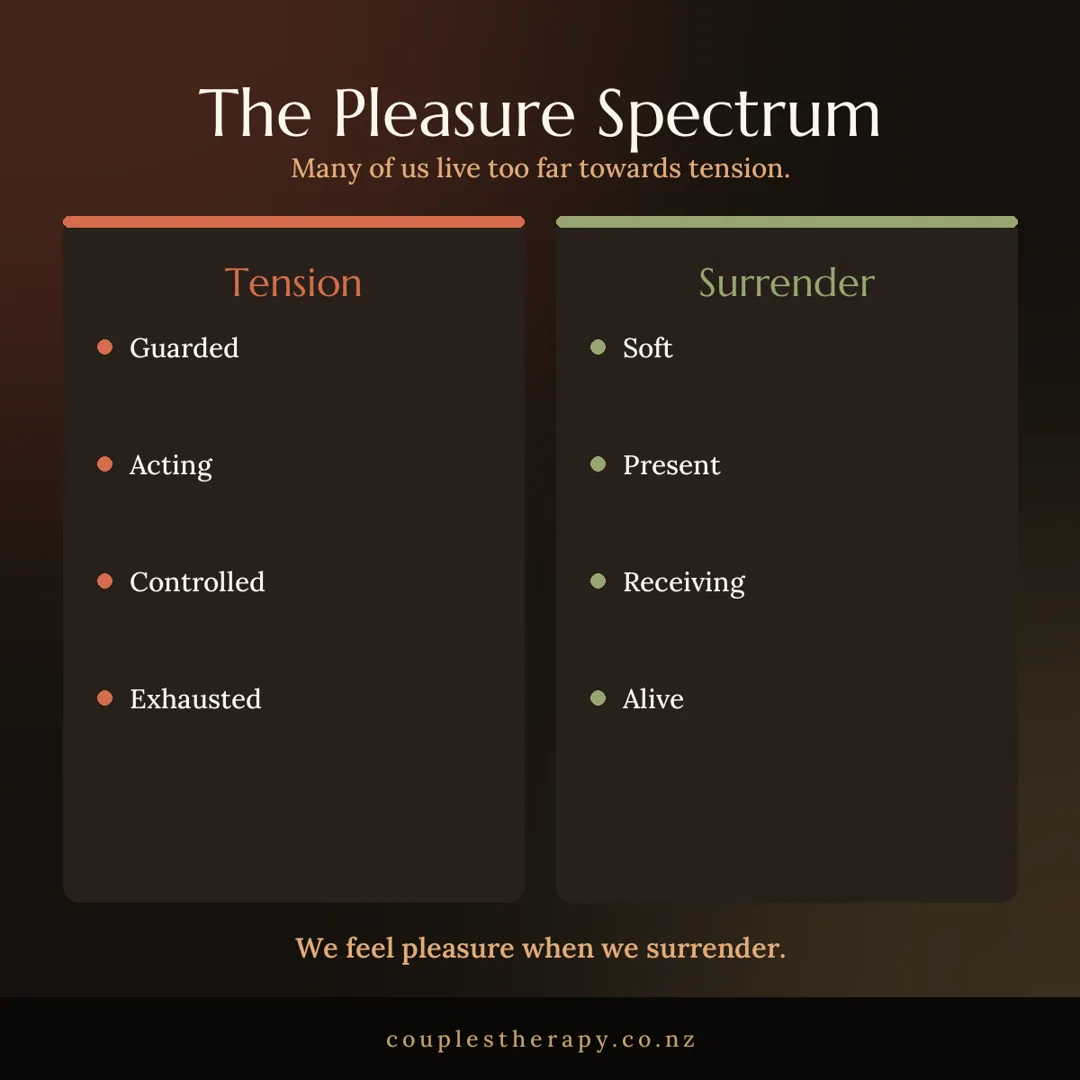
I mean more than sexual technique here. I mean the capacity to receive, soften, surrender, and stay awake in your body.
Plenty of accomplished adults can run a company, renovate a house, and wrangle a family calendar with military precision, yet go completely offline when asked to breathe into their pelvis and feel desire without controlling it.
It’s a bit humbling, really.
The trade off is that tantra can’t stand in for therapy when there’s unprocessed trauma, deep hurt between you, coercion, severe shutdown, or a complete lack of emotional safety.
Breathwork and ritual can open powerful states.
If you don’t feel safe with each other, that opening can feel beautiful one moment and destabilising the next.
Tantra vs sex therapy in long term relationships
This is the simplest way I know to say it.
Sex therapy helps you understand why sex and intimacy have become strained. Tantra helps you experience each other differently.
Sex therapy works through understanding, communication and repair.
Tantra works through sensation, presence and connection in the body.
For many couples, the question is which to do first. You don’t have to choose only one.
If your relationship is full of criticism, unspoken anger, attachment injuries, or sexual pain, start with the clinical work. Build enough safety that you can both relax around each other.
Then body based work can help.
If your bond is fundamentally solid but your sex life has gone flat, tantra may be the better place to start.
You may not need to analyse every pattern. You may need to slow down, feel more, and remember that your body isn’t a machine.
And yes, sometimes the answer is both.
In fact, for long term couples who want to feel more alive together as well as fight less, a mix of the two often works best.
When one approach won’t be enough
A couple can have excellent communication and still have deadened desire. They can also have thrilling chemistry and no ability to repair after a blow up.
That’s why one approach on its own often only gets you so far.
If you only do therapy, you may stop the arguments but never get the desire back. If you only do tantra, you may create beautiful moments without addressing the resentment that keeps spoiling them.
This is where combining the two helps.
Emotional repair on its own can feel dry, and body based work can feel unsafe when the hurt between you hasn’t been repaired.
When couples address both, the relationship feels much more alive.
That’s part of why approaches like Emotionally Focused Therapy (EFT), sex therapy, tantra, and somatic work belong in the same conversation.
Long term love needs more than communication tools.
You need to feel safe in your bodies, free to want each other and honest with each other, and you need time and space for desire.
How to choose wisely as a couple
I wouldn’t choose by which approach sounds more exciting. Ask which one fits where the two of you are right now.
If sex has become something you fight about, start with sex therapy.
If your bodies feel numb and things have gone flat between you, start with tantra.
If one of you wants sacred sexuality and the other is secretly thinking, “Can we first discuss why we haven’t kissed properly in six months?”, that’s useful information.
Start there.
Who guides the work is also important.
Both tantra and sex therapy can be excellent or disappointing, depending on the person leading them.
You want someone who can work with emotional depth, sexual nuance, and what long term partnership is actually like. Generic advice won’t help when you need someone who can lead you through this with confidence.
At Couples Therapy & Retreats, this is exactly why I don’t work with only one approach. Couples need more than a fix for the symptoms.
They need a way back to each other emotionally, physically and sexually.
The deepest love is still ahead of you, but you won’t build it by staying polite, sensible, and mildly disconnected.
Whether you begin with tantra, sex therapy, or a thoughtful mix of both, choose what helps you be honest with your partner, feel your body, and ask for more than a functional relationship.
Want support with this in your own relationship? Find out about couples therapy with Tarisha, a private retreat for two, or our retreats for couples: the Valentine’s Retreat and The Wanaka Adventure. Or start with a free discovery call.