You can feel very lonely inside a long relationship.
You’re sharing a bed, a calendar and a mortgage, maybe adult kids and a dog that sheds on everything, and yet you feel far apart.
If you’re searching for Emotionally Focused Therapy (EFT) in Auckland, chances are you don’t want surface level communication tips. You want to understand why the same fights keep happening and why sex has gone flat.
You want to know how two people who used to be in love can end up feeling like flatmates.
Emotionally Focused Therapy (EFT) can be super useful for exactly this.
It does more than patch things up, and you won’t spend every week recounting who said what on Tuesday night.
EFT looks past the argument about dishes, money, parenting, work stress or desire, and at what each of you is feeling and needing underneath.
What Emotionally Focused Therapy (EFT) in Auckland actually does
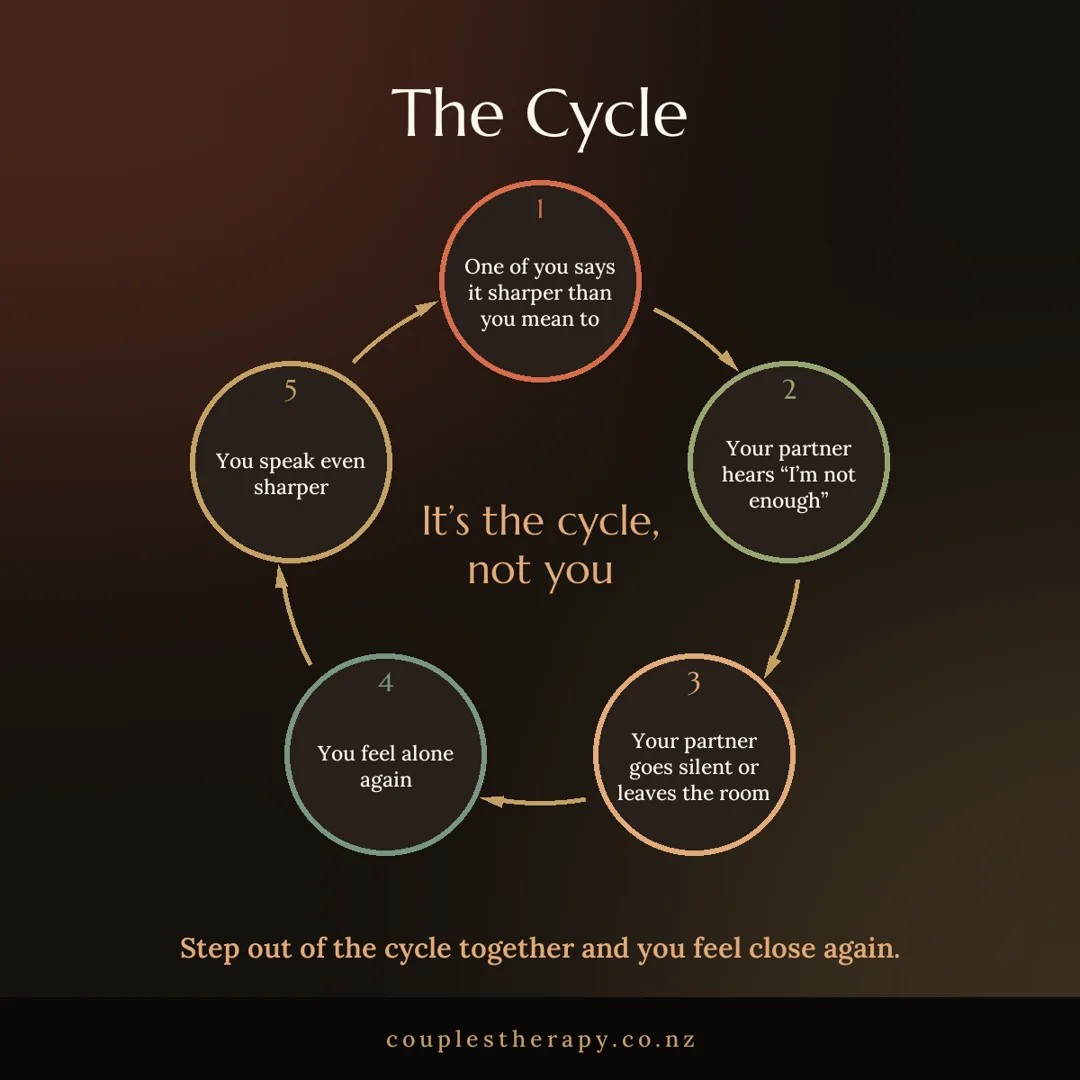
At its core, EFT helps couples identify the negative cycle they get trapped in.
One partner protests, chases, questions, criticises or escalates.
The other shuts down, defends, goes numb or leaves the room emotionally, even if they’re still standing in the kitchen.
Then both of you feel rejected and unsafe. You both start fighting for connection in ways that make connection less likely.
This is what makes relationship distress so painful.
Often the problem is the pattern the two of you have built together under pressure, and your partner is as caught in it as you are.
Emotionally Focused Therapy grew out of attachment science, so it starts from something many of us try to grow out of: we need the person we love to respond to us emotionally.
We want to know:
- Are you here?
- Do I matter?
- Will you turn towards me when I’m hurting, angry, afraid, ashamed or longing for you?
When those questions go unanswered for long enough, we start to protect ourselves.
We stop reaching out, and we stop being tender with each other.
Desire often goes the same way, because it’s hard to want sex with someone you don’t feel emotionally safe with.
Why couples in midlife are drawn to Emotionally Focused Therapy (EFT)
For couples in their 40s, 50s and 60s, the crisis is often less explosive than people expect.
It can look highly functional from the outside. Careers are established, life is full, and you run your life together well.
But inside the relationship, the closeness has gone.
- You may be having the same argument you’ve had for years.
- You may have stopped arguing and started drifting.
- You may love each other deeply and still not feel close.
That’s why Emotionally Focused Therapy (EFT) in Auckland appeals to so many long term couples who are emotionally intelligent and still stuck.
EFT doesn’t treat you like beginners.
It respects your history, your old hurts and your loyalty, and the grief of having become good at running a household together when you used to be lovers.
Plenty of couples don’t need more insight.
They’ve read the books, listened to the podcasts and can explain their childhood patterns over dinner.
Yet when one of them feels criticised, they still snap. When the other feels shut out, they still pursue harder or disappear into silence.
Do you recognise yourselves here?
Insight is useful, but to change the pattern you need to take a risk and show your partner what you actually need.
How EFT moves you from blame to connection
A skilled EFT therapist helps you stop trying to prove your point and say what you feel underneath it.
That sounds simple, and it’s hard to do.
If I say, “You never make time for us,” what I may mean is, “I miss you so much I don’t know how to ask without sounding angry.”
If you reply, “Nothing I do is ever enough,” what you may mean is, “I’m already scared I’m failing you, so I shut down before I feel more shame.”
This is what EFT works with: the vulnerable feelings underneath the defensiveness.
When couples can name the cycle together, something powerful happens. You stop seeing each other as the enemy and start working together against the pattern.
That shift doesn’t solve everything overnight, but it changes the mood between you.
You can be honest in a softer way, and that’s how trust starts to grow back.
What to expect from Emotionally Focused Therapy
A good Emotionally Focused Therapy process usually unfolds in stages.
First, the therapist helps you map the cycle.
- Who tends to pursue?
- Who tends to withdraw?
- What triggers each move?
- What emotions sit beneath the anger, the numbness, the defensiveness or the criticism?
Next comes the deeper work.
This is where each of you starts to speak from the vulnerable place underneath your usual reactions.
The partner who gets loud may find a fear of being abandoned. The partner who disappears may find a terror of not being enough.
These moments can feel exposing, but they’re often the turning point. You stop attacking and start showing each other where it hurts.
From there, the focus shifts to new bonding experiences.
You have different conversations and give different responses. You learn from experience that when one of you reaches out, the other will respond.
The old cycle gets weaker because you feel more secure with each other.
That said, EFT isn’t magic, and it does ask for effort.
If one or both of you are deeply defended, actively deceptive, or only attending therapy to tick a box, progress will be slower.
If there’s trauma, betrayal, neurodivergence, addiction or a major sexual disconnect, the work may need to be broader than classic EFT alone. It depends on the couple, the therapist, and how honest you can safely be with each other.
Emotionally Focused Therapy (EFT) helps the heart, but what about sex?
This is where many couples feel disappointed by conventional therapy.
They start reconnecting emotionally, but the erotic relationship still feels absent, awkward or stale. They can talk more easily, but they still don’t desire each other.
Emotional safety is hugely important for intimacy, and for many couples it’s the missing foundation.
But emotional closeness and erotic charge are two different things.
Closeness creates safety.
Desire also needs polarity, play, curiosity and being in your body, and a willingness to step out of your roles as parents and household managers.
That’s why a more complete relationship approach often integrates Emotionally Focused Therapy with sex therapy, somatic work and a deeper exploration of desire.
At Couples Therapy & Retreats, this is how I work.
I work on the emotional connection and the sexual connection together, so you can repair the hurt and become lovers again.
For some couples, EFT comes first.
It helps you feel safe enough with each other for desire to come back. For others, the emotional work and the erotic work need to happen in parallel.
If you’ve become very polite with each other, safe but with no spark, talking alone may not be enough.
How to choose Emotionally Focused Therapy (EFT) in Auckland
Not every therapist who mentions attachment is practising full EFT with depth and precision. If you’re looking for Emotionally Focused Therapy (EFT) in Auckland, look for more than a nice website.
You want someone who can spot the cycle as it happens and slow a conflict down.
They need to help you both reach your vulnerability without going back to blame.
You also want a good fit.
Some couples need a steady, traditional frame. Others need a therapist who is comfortable with intensity, sexuality and complexity.
Ask how the therapist works with long term loss of desire, betrayal, shutdown, high conflict, or one partner who’s less emotionally expressive.
Ask whether they stay close to Emotionally Focused Therapy or integrate other modalities.
Neither is automatically better.
The right answer depends on whether your relationship needs repair, rekindling, or both.
And yes, practicalities are important.
Weekly sessions can be powerful, but if you’ve been stuck for years, a more immersive format can sometimes get you moving faster.
A concentrated intensive can interrupt entrenched patterns in a way that fifty minute sessions sometimes can’t.
Again, it depends. Choose the format that gives your relationship the best chance.
What changes: you become more honest with each other
One of the myths couples bring into therapy is that success means becoming calmer, more agreeable and less demanding.
Sometimes that does happen on the surface.
The deeper change is that you become more honest and open with each other.
That means saying, “When you turn away, I panic and go hard because I’m terrified I don’t matter to you.”
It means saying, “When you come at me with intensity, I feel like I disappear, and I don’t know how to stay open.”
It means admitting that underneath the resentment there’s longing, and underneath the shutdown there’s an ache. Under the capable adult, there’s a vulnerable person who wants to be chosen.
That kind of truth is messy, and it’s also what brings a relationship back to life.
If your relationship has become all logistics and no connection, don’t assume this is simply what long love turns into.
Mature love can be steadier, yes.
It can also be hotter and deeper than what you had at the beginning, and more emotionally fearless.
The deepest love is still ahead of you.
You won’t get there by avoiding the hard conversations or by spending another year hoping things sort themselves out.
Want support with this in your own relationship? Find out about couples therapy with Tarisha, a private retreat for two, or our retreats for couples: the Valentine’s Retreat and The Wanaka Adventure. Or start with a free discovery call.