
You can feel alone beside your partner.
Do you sometimes sit next to your partner on the couch and feel strangely alone? If you’re wondering how to deepen connection naturally, start here.
Squeezing another date night into an already packed week won’t create deeper love. Love deepens when the two of you stop acting capable all the time and let each other see how you’re really feeling.
For long term couples, disconnection usually happens slowly.
Little by little you become brilliant co-managers of life.
There are the kids, the work, the bills, the ageing parents and the overflowing laundry basket. You communicate efficiently, maybe even kindly, but your relationship starts to feel like a well run business with very little heat.
The good news is that the deepest love can still be ahead of you.
Natural connection still takes some effort.
What you’re doing is creating the conditions where closeness and desire can show up, without forcing a fake version of romance.
Why connection fades in capable couples
Most couples I work with still care about each other.
What they lose under pressure is the ability to reach each other.
When one partner reaches out with criticism, the other may defend, shut down or disappear into a mobile screen. Soon you’re both protecting yourselves from the very person you most want comfort from.
This is the pattern underneath many familiar arguments.
The fight about sex may really be about the pain of feeling rejected.
The fight about spending may really be about a fear that you’re no longer a team.
And the fight about a partner arriving home late may sound, underneath the anger, like: “Do I still count to you?”
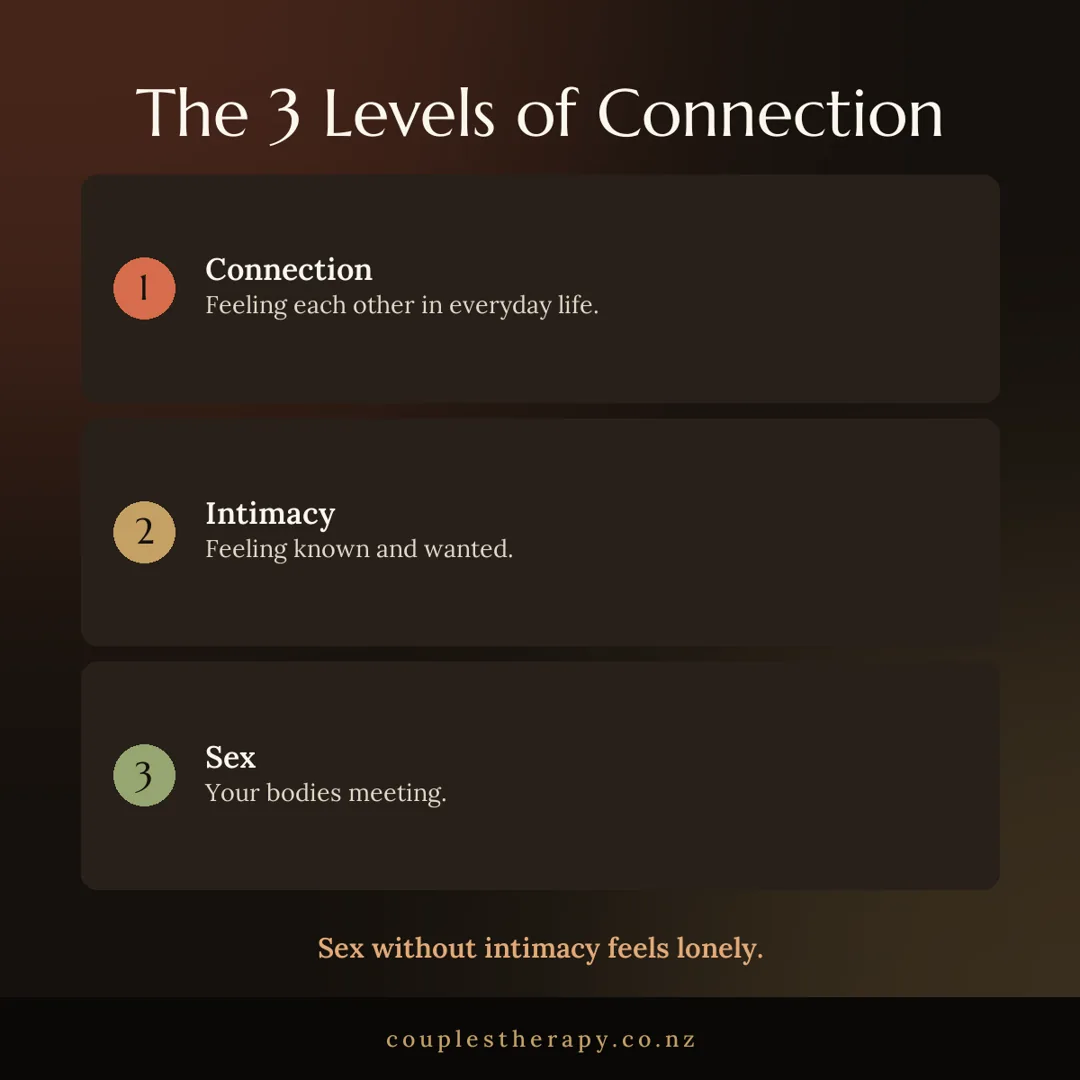
Emotional distance affects your erotic life too.
Desire rarely grows when one of you feels judged for wanting sex less and the other feels rejected for wanting it more.
Sex becomes loaded, or scheduled, or avoided, or painfully polite.
Who wants to be another item on the to do list, particularly after folding the fifth load of washing?
Connection returns when you learn to see what your partner is longing for underneath the criticism or the withdrawal.
That takes courage, and it takes a different kind of conversation.
How to deepen connection naturally: start with emotional safety
Natural closeness begins with safety, and your communication doesn’t have to be perfect.
Safety is knowing that I can bring you something tender, messy or inconvenient, and you’ll turn towards me and won’t use it against me.
Try changing the opening line of a difficult conversation.
Where you might say, “You never make time for me,” pause and say, “I’ve been missing you, and I don’t know how to reach you without getting sharp.”
Where you might say, “All you care about is work,” try, “When work takes over, I tell myself I’m not a priority. Can you reassure me?”
You don’t have to make every feeling sound lovely.
Sometimes you’ll be furious, and sometimes your partner will get it wrong. What changes is that you say the vulnerable thing first, before you get defensive.
Stay with the feeling before fixing it
When your partner shares something vulnerable, hold back from correcting the facts, offering solutions or explaining what you meant in the first ten seconds.
Those instincts make sense, especially if you’ve spent decades solving problems.
But your partner needs to feel heard before anything gets solved.
Instead, offer a reflection: “I can see why that hurt.” Or, “You felt alone in that moment, didn’t you?”
Then ask what they need.
It might be comfort, clarity, an apology, or simply your presence.
You don’t have to agree with every interpretation to honour how it felt for them.
I think being able to stay present when you see things differently is one of the sexiest forms of maturity there is.
Let your body join the conversation
Connection is built through more than words.
Your bodies are already communicating before either of you has said a word.
Folded arms, a clenched jaw, a glance at the clock or a hand resting on a thigh all say something.
Before a meaningful conversation, take two minutes to arrive. Put your mobiles in another room and sit facing each other.
Feel your feet on the floor.
Take a slower breath than usual and notice whether your body is bracing for a fight.
Then add simple, consensual touch. Hold hands.
Place one palm over your own heart and one over your partner’s, or sit back to back on the lounge.
All you’re doing is helping your bodies register that you’re on the same side. It doesn’t need to be a spiritual experience in the living room.
For some couples, touch will feel welcome straight away.
For others, especially after betrayal, conflict or a long sexual drought, it may feel exposing.
Go at the pace of the partner who needs more time, and don’t let the more impatient one set the speed, because pressure doesn’t create safety.
Bring curiosity back to desire
Desire doesn’t automatically come back once you’re communicating well.
It’s shaped by stress, health, hormones, body image, resentment, fantasy, novelty and the roles you’ve fallen into at home.
A common trap is treating low desire as one person’s problem. That story creates shame, and it turns the other person into an anxious pursuer.
A better question is: what has happened between us that makes desire hard to reach right now?
Talk about intimacy outside the bedroom, and not five minutes after one of you has made a move. Ask each other what helps you feel open, playful and wanted, and be specific.
Maybe one of you needs unhurried affection with no expectation of sex. Maybe the other needs to feel actively chosen and not just tolerated.
Maybe you both need permission to be beginners again.
Desire also responds to polarity.
That’s the attraction you feel when you meet as two distinct people, and not only as the team that runs the household.
You can love an equal partnership and still leave room for surprise, boldness and being pursued.
- Wear something that makes you feel like yourself.
- Send a message with some heat in it.
- Let your partner see a side of you that isn’t coordinating dinner.
There’s humour here too.
If your first attempt at flirting feels like two accountants trying to order oysters, laugh together.
Awkwardness is often how you find your way back to feeling alive with each other, so it doesn’t mean you’ve failed.
Try something new together
Connection deepens when you meet each other in new conditions.
You don’t need to book a luxury retreat or leap from a plane, although a little adventure can be electric.
It can be a sunrise walk before the household wakes, learning to dance badly, taking a hard hike, cooking something ambitious, or having the conversation you’ve both been putting off.
A shared challenge interrupts old roles. The planner may need help, and the calm one may show fear.
The partner who normally carries everyone may finally be cared for. In those moments you see your partner as a person again, outside their usual role.
The key is to choose something that excites you both and doesn’t feel like punishment.
If one of you hates crowds, a packed festival is unlikely to create intimacy. If money is tight, don’t make connection something you have to spend a lot on.
Whatever you choose has to fit the life you actually have, while asking you to step out of autopilot together.
A simple weekly practice for deeper connection
Set aside twenty minutes once a week, with no screens, no logistics and no scorekeeping.
Think of it as looking after your connection before you’ve lost it.
- Begin by naming one moment from the week when you felt close to your partner.
- Then name one moment when you felt distant, using “I felt” and leaving out “you always”.
- Ask one question you don’t already know the answer to.
- Finally, make one clear request for the coming week.
It could be a long hug at the door, an evening walk, help carrying a burden, or time to be lovers and not just colleagues.
Keep it small enough that you’ll actually do it.
Big promises feel powerful in the moment, but intimacy is usually rebuilt through small things repeated many times: one of you reaches out, the other responds, and you repair after a fight.
When natural connection needs skilled support
Some patterns are too entrenched to shift through goodwill alone.
Maybe conversations spiral into contempt, or one of you freezes. Maybe sex has become a source of dread, or old betrayals keep coming up.
If that’s you, getting support doesn’t mean the relationship has failed.
It means you’ve decided to do something about the pain.
At Couples Therapy & Retreats, I work with couples on the old hurts underneath their conflict, on how their bodies respond to closeness, and on the sexual relationship they want to create now.
Therapy, intensive work and shared experiences can give you the focused space that ordinary life rarely does.
You can love each other more deeply as the people you already are.
It takes more honesty, more attention, and more willingness to turn towards the person beside you when it would be easier to pull away.
Want support with this in your own relationship? Find out about couples therapy with Tarisha, a private retreat for two, or our retreats for couples: the Valentine’s Retreat and The Wanaka Adventure. Or start with a free discovery call.