You and your partner keep having the same fight.
It happens over and over with a different topic each time.
You’re probably not arguing about the dishes, the sex, the in laws, or who forgot to reply to the text. You’re fighting about something much more vulnerable. What is the primary goal of Emotionally Focused Therapy (EFT)?
At its core, EFT aims to help couples create a secure emotional bond. That’s the kind of connection where you both feel safe and wanted, and you can reach for each other without getting hurt.
That sounds simple, and it’s hard to do, especially when you’ve spent years becoming brilliant co-managers of life while losing each other as lovers.
What is the primary goal of Emotionally Focused Therapy (EFT)?
The primary goal of Emotionally Focused Therapy (EFT) is to strengthen secure attachment between partners.
In plain language, that means helping you move out of protecting yourselves and disconnecting, and into emotional safety where you respond to each other.
EFT is built on something deeply human.
When we don’t feel emotionally safe with the person we love, we protest, pursue, shut down, lash out, go numb, or hide behind being competent.
One partner might demand more closeness. The other might pull away to avoid failing yet again.
Then you both end up feeling alone.
Emotionally Focused Therapy doesn’t read that pattern as proof your relationship is broken.
It treats the cycle as the enemy, so neither of you has to be.
The work is to slow the dance down, bring out the raw emotions underneath it, and help each of you respond in a new way.
The aim is for you to feel that your partner is emotionally there for you when it counts, which is far more important than getting better at debating each other.
Why secure attachment changes everything
Long term couples often think their main problem is communication.
Sometimes that’s true, but usually it’s only part of the picture.
Plenty of couples communicate very clearly and still feel miles apart. They can state their needs, use all the right therapy words, and still go to bed cold.
Attachment sits underneath communication.
If the bond feels shaky, every conversation becomes loaded.
A neutral comment lands like criticism. A request for comfort feels like pressure. An invitation to have sex feels like judgement or obligation.
When attachment becomes more secure, something powerful happens.
Conflict softens and you get less defensive, and desire has room to come back.
You won’t suddenly agree on everything or turn into a pair of floating enlightened beings. What changes is that your bodies stop treating each other as a threat.
That’s why EFT can be so powerful for couples who still love each other but can’t seem to find each other.
Emotionally Focused Therapy (EFT) isn’t just about stopping fights
This is the part many couples underestimate.
They come in wanting fewer arguments, which is fair enough. But EFT aims deeper than managing conflict. It aims for emotional reconnection.
A couple can fight less simply by going numb, avoiding hot topics, or living parallel lives. Plenty of relationships look stable from the outside when there’s no warmth left inside.
Emotionally Focused Therapy asks for something braver than keeping the peace.
It helps you risk being honest with each other again.
That honesty sounds like this: When you turn away, I get annoyed, and underneath that I feel abandoned. When you come at me hard, I shut down, because I feel like I can’t ever get it right with you.
Saying this out loud changes the conversation, because your partner can finally see the hurt underneath your defences.
And once you can both see that hurt, you can start to repair.
The cycle hides what you really feel
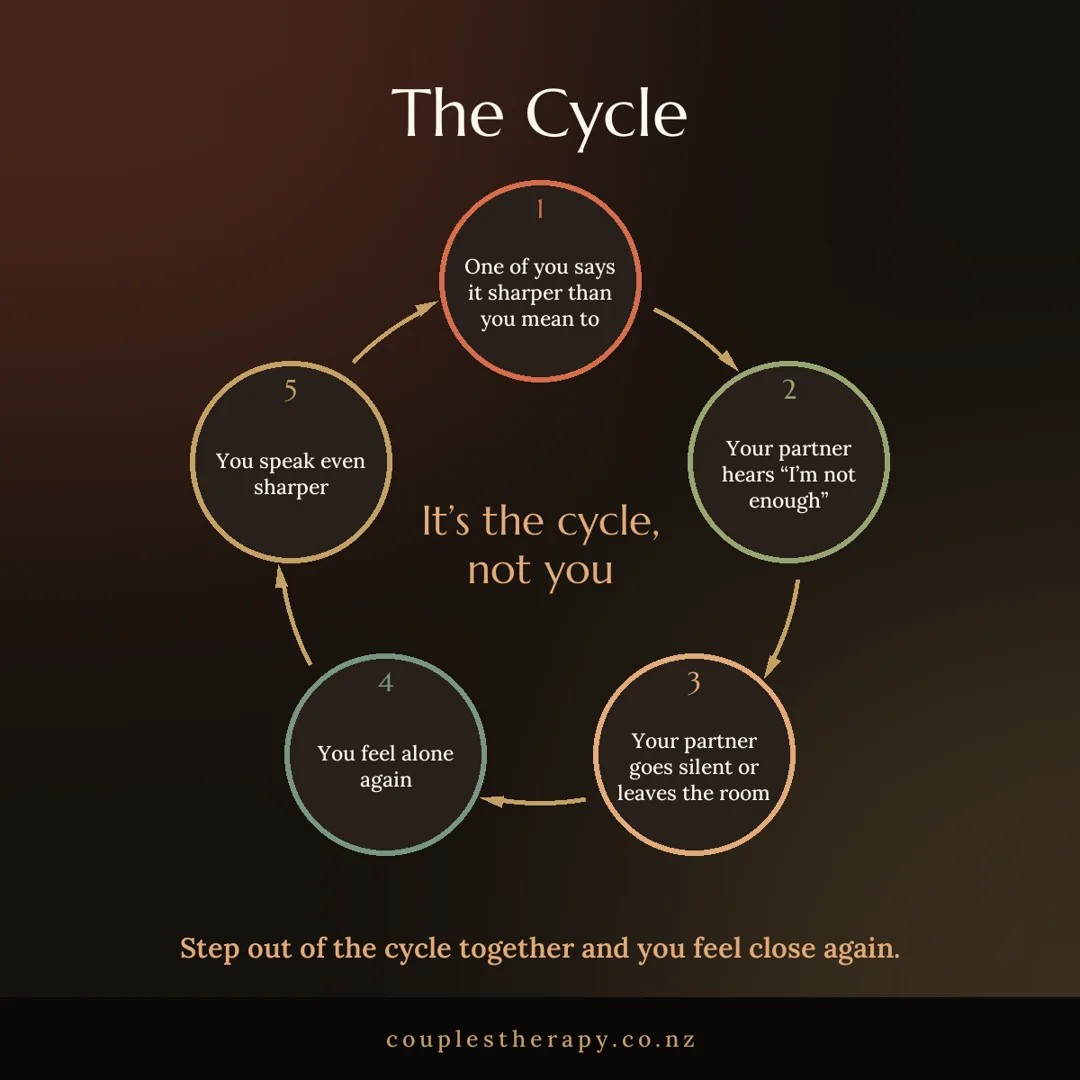
Most distressed couples are trapped in a predictable loop.
One of you protests and pursues, pushing for contact. The other defends and withdraws, disappearing into work, screens, logic, or silence.
The topic changes, but the steps you each take stay the same.
EFT helps you name those steps and understand what drives them.
When you can see the cycle clearly, you stop treating your partner as the whole problem. The fight feels less personal and you can work with it.
There’s relief in that, and I mean relief you can feel in your body.
What happens in Emotionally Focused Therapy (EFT) sessions?
EFT sessions guide couples underneath the surface argument to the attachment emotions that are driving it. A skilled therapist will track what happens between you step by step and identify the pattern.
Then they’ll help each of you say what’s actually happening inside you, so you’re no longer only accusing each other.
That means the session won’t stay at the level of, You never listen, or, You’re always angry.
It will move towards what’s deeper:
- I don’t know how to reach you anymore.
- I’m scared I don’t matter.
- I miss you.
- I’m furious because I’m hurting.
Nobody needs to put on a dramatic show. What I’m looking for is that you name the feeling exactly.
Over time, Emotionally Focused Therapy helps partners have what are often called corrective emotional experiences.
One of you risks showing something vulnerable. The other stays present and doesn’t go into protection. That moment lands differently in your body.
Trust starts to rebuild because you’ve experienced it, which goes much further than agreeing with it as an idea.
What is the primary goal of Emotionally Focused Therapy (EFT) in a long term relationship?
In a long term relationship, the primary goal of Emotionally Focused Therapy (EFT) is to bring back a connection you can feel, where emotional drift has taken hold.
That drift can look perfectly respectable.
You run the household, you parent well and you discuss logistics. You know each other’s coffee order and bank details.
Yet the warmth has thinned out.
Touch becomes functional. Sex becomes occasional, tense, or absent. Tenderness starts to feel like a memory.
Does this sound familiar?
EFT works with the emotional break underneath that drift.
It helps you answer the questions that sit below every repeated hurt:
- Are you there for me?
- Do I matter to you?
- Can I reach you when I’m scared, sad, ashamed, or in need?
- Will you meet me, or will I hit a wall again?
When those questions get answered consistently, intimacy deepens. Emotional intimacy usually comes first, and it often lays the ground for erotic intimacy too.
Lasting desire rarely grows where there’s resentment, emotional loneliness and a need to stay on guard.
What Emotionally Focused Therapy (EFT) does well, and where it has limits
EFT is powerful, but it won’t magically dissolve decades of pain. It works best when you’re both willing to engage honestly and stay emotionally present, even when it’s uncomfortable.
It can be transformative for couples caught in painful pursue withdraw cycles, chronic defensiveness, or disconnecting again and again after conflict. It’s especially useful when you both still care deeply but have lost access to each other.
At the same time, Emotionally Focused Therapy isn’t the full answer for every couple or every problem.
The work may need extra structure and support if there’s:
- Active addiction
- Ongoing betrayal
- Coercive control
- Untreated trauma that’s seriously affecting safety
And if you want renewed erotic charge as well as emotional repair, you may need more than attachment work alone.
That’s why some approaches, including the work I do at Couples Therapy & Retreats, bring EFT together with sex therapy, embodiment, polarity, and experiential practices.
Secure attachment is the foundation.
But mature love also asks for aliveness and desire, and the courage to meet each other with more than good communication.
What changes for couples
EFT won’t stop you triggering each other altogether.
You’re human. You’ll still miss each other, misread each other, and occasionally act like absolute idiots under stress.
The biggest change is that a fight no longer feels like proof that love is dying.
It becomes something you know how to repair.
You learn to hear the fear beneath the criticism, and to show the longing beneath your anger.
You learn that when vulnerability is met well, it strengthens the relationship and builds trust between you.
For many long term couples, that changes far more than conflict.
It changes how the whole partnership feels.
Home feels softer. You hold eye contact for longer and your body unclenches. Touch stops feeling loaded, and desire has room to breathe again.
If your relationship has become efficient but emotionally distant, Emotionally Focused Therapy is a strong place to start. It helps you find each other where it actually counts, which does far more than teaching you to behave better.
The deepest love is still ahead of you when you stop managing the distance and start repairing the bond.
Want support with this in your own relationship? Find out about couples therapy with Tarisha, a private retreat for two, or our retreats for couples: the Valentine’s Retreat and The Wanaka Adventure. Or start with a free discovery call.