You don’t have to be in crisis.
You can book a couples adventure therapy retreat without one.
More often the life you’ve built together works well, but you no longer feel close or attracted to each other.
You share a home, a history, maybe grown kids, calendars and responsibilities, and the same tired arguments on repeat. You’ve become very good at running a life together, but you rarely feel like lovers.
This is when a retreat like this becomes powerful.
It’s much more than a nice holiday. It’s time set aside to change the habits that keep your relationship flat.
A well designed retreat takes you away from your daily routine.
You’re outdoors, you’re moving, you’re being challenged, and you see parts of yourselves that don’t come out in another conversation at the kitchen bench.
What a couples adventure therapy retreat actually does
On the best retreats, the adventure is part of the therapy.
The hike, the paddle, the climb, the cold water plunge or the guided challenge does far more than fill the time between sessions.
Why? Because long term couples get stuck in how their bodies react to each other, as well as in what they think.
One of you pursues and the other shuts down.
One pushes for clarity and the other avoids, because it all feels too loaded.
Then you each tell yourselves a familiar story about who the other person is. After enough years, that story can feel like fact.
Adventure can change that.
When you’re navigating a trail together, managing fear, relying on each other physically, or trying something that asks for courage, your usual roles often wobble.
- The highly competent one may soften.
- The avoidant one may suddenly become present and protective.
- The partner who has felt numb may feel alive again.
You get to experience trust, dependence, desire and responsiveness in your body, as well as talk about them.
Insight is important.
But on its own it won’t necessarily help your body relax, or bring back the attraction between two people who’ve become efficient companions.
Why long term couples need more than talk therapy
Traditional weekly therapy can be deeply useful, especially when conflict has become corrosive or communication is breaking down.
But if your relationship feels emotionally stale, sexually dutiful, or deadened by years of logistics, one hour a week may not be enough to change how it feels between you.
A retreat gives you time.
You can stay with the most important issue, where normally you’d touch on it and rush back to work, errands, emails and school pick up.
Once you’ve repaired some of the hurt, you can start to feel close in your bodies again.
You can uncover the grief under the irritation, the longing under the criticism, and the erotic spark buried beneath resentment.
That’s important for couples in midlife and beyond.
By this stage you have history. Some of that history is beautiful and some of it still hurts.
You also have established habits in the bedroom, around affection, and in how you handle closeness.
If you feel more like co-managers than lovers, a pep talk won’t do much. You need an experience strong enough to bring you close again.
What goes into an effective retreat
A strong couples adventure therapy retreat usually combines several approaches.
Emotionally Focused Therapy (EFT) helps you see the negative pattern you both get caught in.
It looks past the surface argument and shows what each of you really needs, which might be safety, reassurance, responsiveness, choice or desire.
Sex therapy helps you talk about desire and your sex life, and it covers much more than technique.
Mature intimacy has nothing to do with acting young.
You’re learning how desire works now, in these bodies, with this history, after stress, disappointment, parenting, illness, success and ageing. That takes skill, and frankly, most couples need more than a date night to do it.
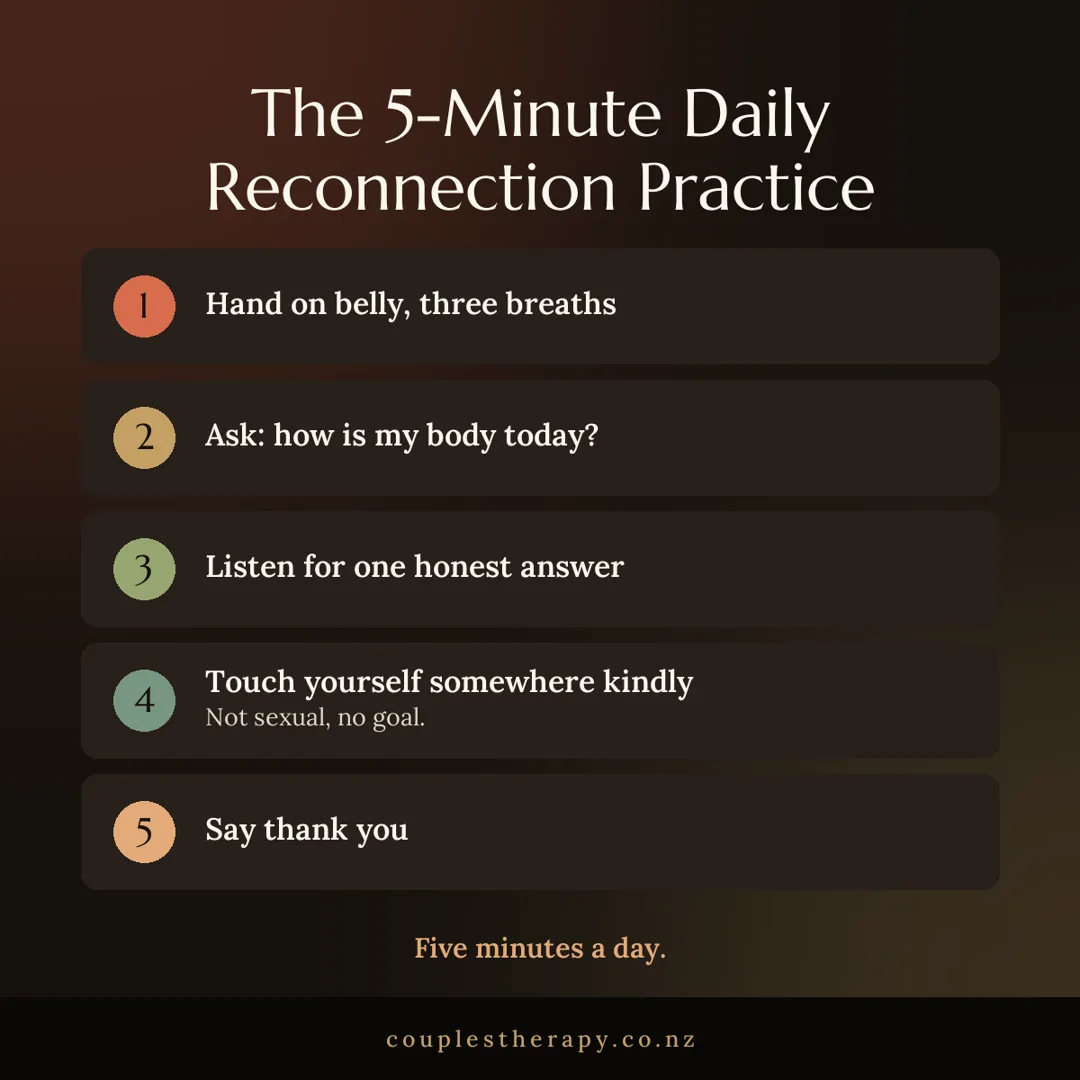
Embodiment and somatic practices are important because many couples are living from the neck up.
They can explain their relationship beautifully and still feel almost nothing when they touch.
Breathing, movement, calming your nervous system, eye contact and guided touch help you feel the connection in your body, where before it was only an idea.
Adventure adds what many couples are missing, which is feeling alive together.
A relationship needs movement, some risk, play and new experiences. You don’t need chaos or forced vulnerability for that.
What happens on a couples adventure therapy retreat
No two retreats are identical, and that’s a good thing.
Some couples arrive in active crisis.
Others are functioning well enough but know they’re drifting. Some want to repair a betrayal, and others want to find each other again after years of parenting or intense work.
A good retreat starts from where each couple is, and doesn’t put everyone through the same programme. Usually there’s a blend of guided therapeutic sessions, structured relational exercises, and outdoor experiences chosen for what they bring up.
You might move from a session on your conflict cycle into a challenge that shows you exactly how that cycle plays out under pressure.
You might explore trust in conversation, then feel it in your body while you rely on each other in a physically demanding setting.
There may also be work around attraction, desire discrepancy, affection, touch and sexual communication.
For many long term couples, this is where things get tender.
One of you has felt rejected. One of you has felt pressure. You’ve both stopped saying what’s true for you because it seems easier than getting hurt.
On a retreat you can talk about all of this with far more depth and care than in a rushed conversation after dinner.
And yes, there can be humour in it.
Picture a couple who could barely make eye contact on day one becoming ridiculously alive while they learn something simple but revealing outdoors.
You see who grabs control, who freezes, who flirts and who finally laughs.
That laughter counts for a lot, because it’s often the first time the tension has eased in a long while.
Is this right for every couple?
No, and I’d rather be honest with you about that.
- If there’s active abuse, coercion or a serious lack of safety, an adventure based retreat may not be the right starting point.
- If one partner is utterly unwilling and has been dragged there as a final threat, the retreat can go badly.
- If there are major mental health concerns or trauma responses that need stabilising first, the retreat should be shaped with proper clinical care.
It also depends on what you mean by adventure.
For some couples, adventure means a physically demanding experience in wild country. For others, it means being honest about feelings and sex after years of staying numb.
The best providers know that more intense doesn’t mean more effective, and they choose the level of challenge carefully.
That’s why it’s important to choose carefully.
A pretty retreat in a beautiful location can still be shallow.
You want a trained therapist leading it, and a charismatic host with a few exercises and a nice playlist won’t give you that.
How to choose a couples adventure therapy retreat
Look first at the therapy training behind it.
If the retreat promises transformation, there should be a clear therapy method behind the mood and the look of the place.
You want practitioners who understand attachment, conflict patterns, trauma, sexuality and how relationships work.
Then look at whether the retreat works with both your emotional connection and your sex life. Plenty of couples retreats help you communicate better but leave the sexual relationship untouched.
Pay attention to the role of adventure.
Is it part of the therapy, or only an activity?
On the most effective retreats, the challenge helps you repair, be brave with each other and build trust.
And finally, consider fit.
Some couples want to work privately, with a retreat designed just for them.
Others are comfortable in a small group setting.
At Couples Therapy & Retreats, for example, our retreats combine therapy, body based practices, work on sexuality and outdoor challenge, which is quite different from a standard couples getaway.
That’s why couples can go so much deeper.
What couples often discover
Couples often discover that communication was only ever part of the problem.
The disconnection was also in their bodies, in how safe they felt with each other, and in their sex life.
They discover that resentment often covers grief, and that shutdown can hide tenderness. They discover that desire doesn’t come back because you try harder to be nice.
They also discover that their relationship isn’t finished simply because it has gone flat.
Some of the most striking transformations can happen after twenty or thirty years together, when two people stop asking, “How do we keep this going?” and start asking, “What wants to come alive between us now?”
I find that a far more hopeful question, and it doesn’t pretend everything is easy.
If your relationship has become competent but not compelling, a couples adventure therapy retreat may be less of an indulgence than a reckoning.
Sometimes what love needs is a strong enough experience to bring both of you back into the room, back into your bodies, and back into the living pulse of your partnership, and more analysis won’t do that.
The deepest love is still ahead of you, but it won’t arrive by accident.
Want support with this in your own relationship? Find out about couples therapy with Tarisha, a private retreat for two, or our retreats for couples: the Valentine’s Retreat and The Wanaka Adventure. Or start with a free discovery call.