
Affair recovery is hard work.
The first session after an affair can feel like walking into a room after a storm.
One of you is desperate for answers and keeps replaying every detail. The other may be flooded with shame or fear, or may just want it all to stop.
The couples therapy after affair examples below show what repair asks of two people once trust has been broken.
None of them wraps up neatly.
An affair doesn’t automatically mean your relationship is over. It also doesn’t mean it can be saved at any cost.
Sometimes separating is the cleanest, healthiest choice.
But when you both want to explore repair, therapy gives you a place to tell the truth, to grieve and to take responsibility.
It can be fierce and surprisingly intimate, and a different kind of love can grow from there.
You won’t be going back to the old relationship.
It had problems in it, even if neither of you could name them at the time.
What you’re building now is more honest, and in time it feels more alive.
What couples therapy after an affair looks like
Good affair recovery work takes its time.
It doesn’t rush you towards forgiveness or push you back into sex, and it never treats the betrayed partner’s pain as an inconvenience.
It begins by creating emotional safety.
That usually means the affair has ended and contact with the third person has stopped.
It also means the partner who had the affair is willing to be transparent, without that openness being used to punish them.
In the early phase, therapy helps each of you steady yourself while everything feels out of control. The betrayed partner often needs room for anger and shock, and for the questions that keep coming.
The partner who strayed needs to learn how to stay present with that pain without collapsing into shame, explaining it away, or complaining that nothing they do is enough.
Later, the work goes deeper.
How did secrecy become possible? What was going on in the background?
It might be attachment wounds, resentments that were never spoken, a sex life that had shut down, a big life change or a personal crisis.
Understanding the context is never the same as excusing the betrayal.
I hold both with couples: the affair was a choice, and the relationship deserves an honest look.
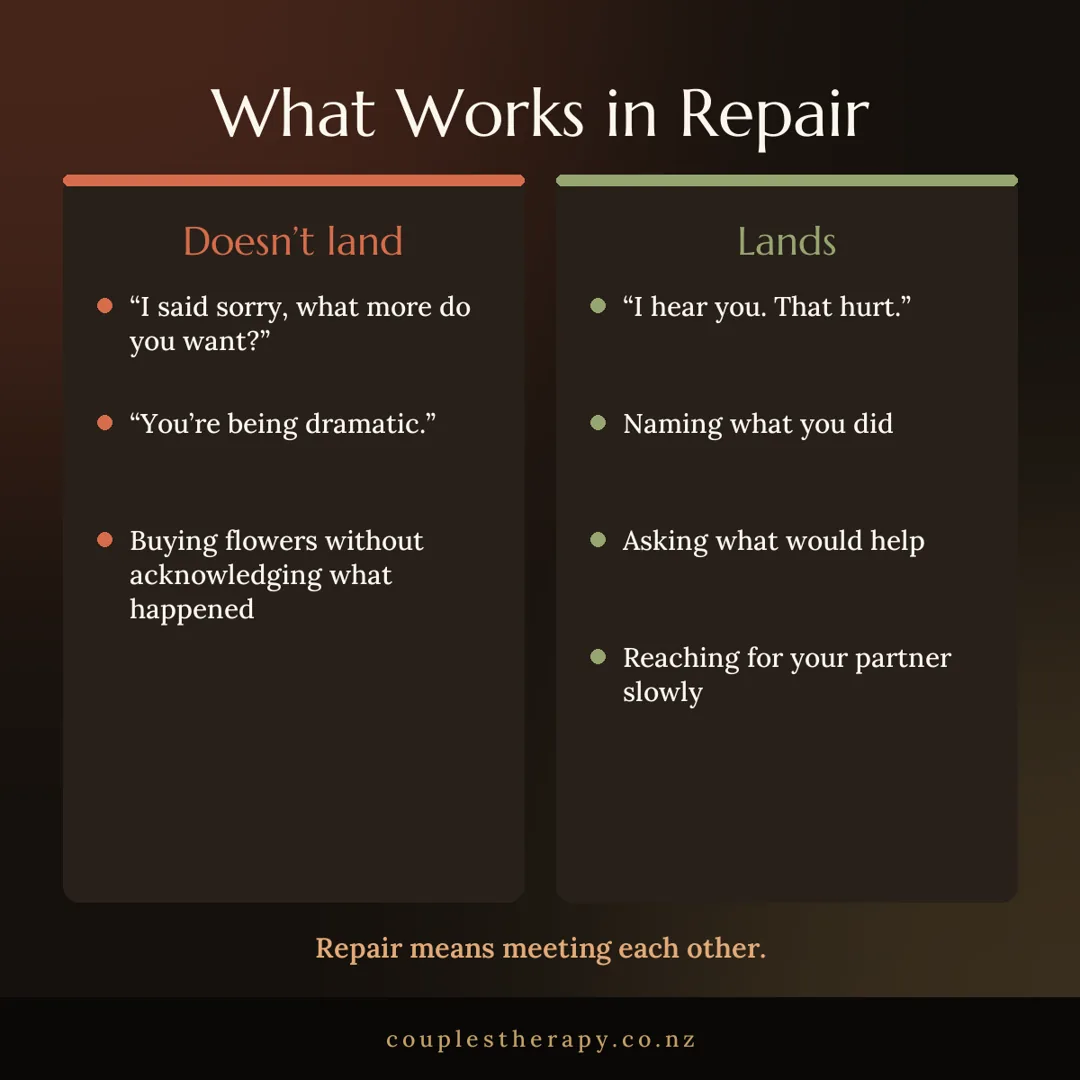
Couples therapy after affair examples from repair work
These are composite examples that protect privacy, so none of them is one particular couple.
You may still recognise the emotional patterns.
The affair that became a courtroom
Maya found messages on Joel’s mobile after a work trip. For six months, every conversation turned into a cross examination.
- What did you say?
- Where did you go?
- Did you love her more?
Joel answered with bits of the truth, then left things out, then told her more when Maya found another inconsistency.
Each new revelation hit her like a second affair.
In therapy, the first task was to stop the drip feed of disclosure. Exploring childhood and reviving their sex life could wait.
With therapeutic guidance, Joel put together a full, honest timeline and answered the questions they’d agreed on directly.
He accepted that Maya’s nervous system had no reason to trust him yet.
He learned to say, “I can see why you don’t believe me. I lied to you and I broke your trust,” instead of, “How many times do I have to apologise?”
Maya’s rage made sense, and it was never treated as a character flaw.
It was a protest against being abandoned and lied to.
Once she no longer had to fight to have her pain believed, she could start to name the terror underneath it: “I feel replaceable. I feel foolish for loving you.”
That was the first moment Joel stopped defending himself and really listened to her.
Repair began there, with Joel staying honest under pressure.
It didn’t take a grand romantic gesture.
The long marriage where sex had stopped
After 24 years together, Priya and Daniel had become brilliant co-managers.
They raised teenagers, paid the mortgage, cared for ageing parents and planned efficient weekends.
Their sex life had faded years earlier.
Daniel’s affair with someone he met through cycling was devastating. It also exposed how painfully flat the marriage had become.
It would have been easy to make the whole story about Daniel’s sexual frustration. Therapy didn’t take that shortcut.
His affair was his responsibility.
At the same time, both of them were invited to face how completely they’d let go of their emotional and erotic connection.
Priya eventually said, “I thought wanting more from us was selfish.”
Daniel admitted he’d felt rejected for years. He’d hidden behind being competent, and behind his resentment, because that felt easier than risking a vulnerable conversation.
Neither statement justified the betrayal, but each one gave them somewhere to start talking.
Their work included Emotionally Focused Therapy (EFT) to interrupt their pursue withdraw cycle, alongside sex therapy and embodied exercises that rebuilt safety around touch.
At first, their homework had nothing to do with sex.
It was ten minutes of clothed touch with no goal, several nights a week, with each of them saying what felt good, awkward or too much.
Desire came back slowly, and then with more honesty than they’d known in decades.
They’d stopped trying to recreate their twenties. They were creating an adult erotic connection with clear consent, and with room for nervousness and play.
The emotional affair neither of them wanted to call an affair
Leah insisted she’d never been unfaithful because she hadn’t slept with her colleague.
Her husband, Tom, had seen months of intimate messages.
There were private jokes, confessions about their marriage, photos Leah had never sent him, and plans to meet after work that had been deleted from her calendar.
The stalemate was brutal.
Leah felt accused of something she hadn’t technically done. Tom felt gaslit by the person he trusted most.
Therapy helped them move past a narrow definition of infidelity. The key question became: what did this connection take away from the marriage?
Leah recognised that she’d poured her longing to feel desired and understood into a secret relationship.
Tom recognised that he’d often met her bids for connection with sarcasm, or with a distracted grunt from behind his laptop.
Again, the context didn’t erase responsibility. Leah chose secrecy.
She stopped contact and shared access by agreement, and she grieved the emotional high of feeling so intensely seen by someone new.
Tom learned to express his hurt without checking up on everything she did.
Their repair meant rebuilding emotional intimacy on purpose, because living in the same house wasn’t going to do it for them.
When the betrayed partner had an affair years earlier
Sometimes an affair blows open old injuries that were never resolved.
When Marcus had a brief affair, he told his wife, Anna, that she had no right to be so hurt, because she had cheated early in their relationship, before they had children.
They’d never properly dealt with it.
Marcus had said he forgave her, but part of him had stayed hurt and closed off.
Their sessions showed a grim pattern.
Both of them had used contempt and sexual distance to avoid the original wound.
Marcus’s affair wasn’t payback in any simple sense, but it happened in a relationship already hurt by a betrayal they’d never worked through.
They had to grieve two affairs, 15 years apart, and they couldn’t use one to cancel out the other.
This is hard work.
Each of you has to take responsibility for your own choices without keeping score.
For some couples, this is where the relationship becomes more truthful than it’s ever been.
What makes repair more likely
With healing after an affair, I look for whether you can both create a new pattern when you’re under stress. How quickly the betrayed partner stops crying, or how soon sex resumes, tells you much less.
- The partner who had the affair needs to stay accountable and patient, and be willing to understand their own choices.
- The betrayed partner needs room to have boundaries, ask hard questions and decide whether repair is what they want.
- You both need help to identify the pattern that was there before the affair.
It might have been criticism, avoidance, loneliness, a parent child dynamic, conflict avoidance or erotic neglect, and it left the relationship vulnerable.
There are trade offs.
Full access to each other’s devices may reassure you in the short term, but it can’t become the permanent foundation of trust.
Detailed disclosure can settle the mind for some people and create intrusive images for others. A skilled therapist helps you decide what information supports healing and what would only feed the trauma.
If there’s been coercion, ongoing deception, abuse, or repeated boundary violations, safety comes before reconciliation.
Therapy should never pressure anyone to stay in a relationship that’s harming them.
From surviving the affair to wanting each other again
Affair recovery asks you to face the parts of your relationship that went numb, the needs you hid, the truth you avoided and the longing you took somewhere else.
That can be excruciating.
It can also be the beginning of a more courageous partnership.
At Couples Therapy & Retreats, I work with the emotional hurt and with what the affair has done to your sex life.
I help couples move from interrogation and withdrawal towards feeling secure with each other, being present in your bodies, and a sex life that belongs to who you both are now.
The deepest love may still be ahead of you, and you’ll both need to work for it.
You don’t have to decide the whole future in one conversation. Start by asking whether you can both show up for the next honest one.
Want support with this in your own relationship? Find out about couples therapy with Tarisha, a private retreat for two, or our retreats for couples: the Valentine’s Retreat and The Wanaka Adventure. Or start with a free discovery call.