
You can love each other and feel alone.
Many couples love each other, get on well, and still feel startlingly alone with each other.
If you’re wondering how to increase intimacy in marriage, another date night squeezed between Saturday sport and the grocery run won’t do it.
It starts when you stop accepting disconnection as the price of a long relationship and decide to do something about it.
Long term love was never meant to stay frozen in its early, breathless form.
It’s meant to deepen and become more honest as you both change.
I believe the deepest love is still ahead of you, but it asks both of you to bring more than logistics to the table.
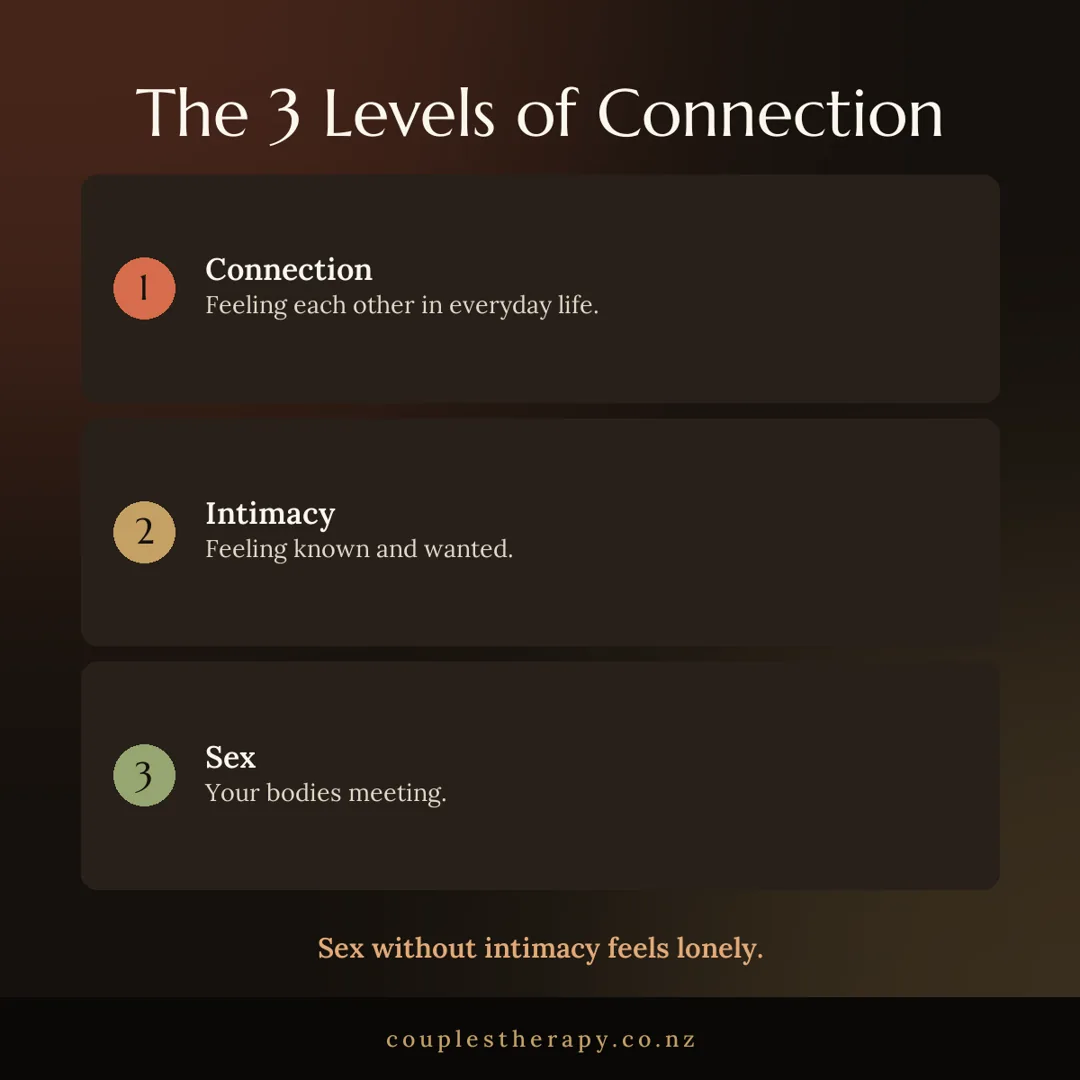
Intimacy is more than affection or sex
Many couples say intimacy when they mean sex. Others mean being able to talk without arguing.
Both belong, but intimacy is bigger than either.
It’s the experience of feeling seen and received by your partner, including in the places you usually protect.
Emotional intimacy says, “I can tell you what hurts without fearing you’ll dismiss me.” Erotic intimacy says, “I can let you see what I want, what I fear and what turns me on.”
Physical intimacy is being able to stay present with sensation, eye contact and touch, and with the vulnerability that comes up when you can’t hide behind being competent.
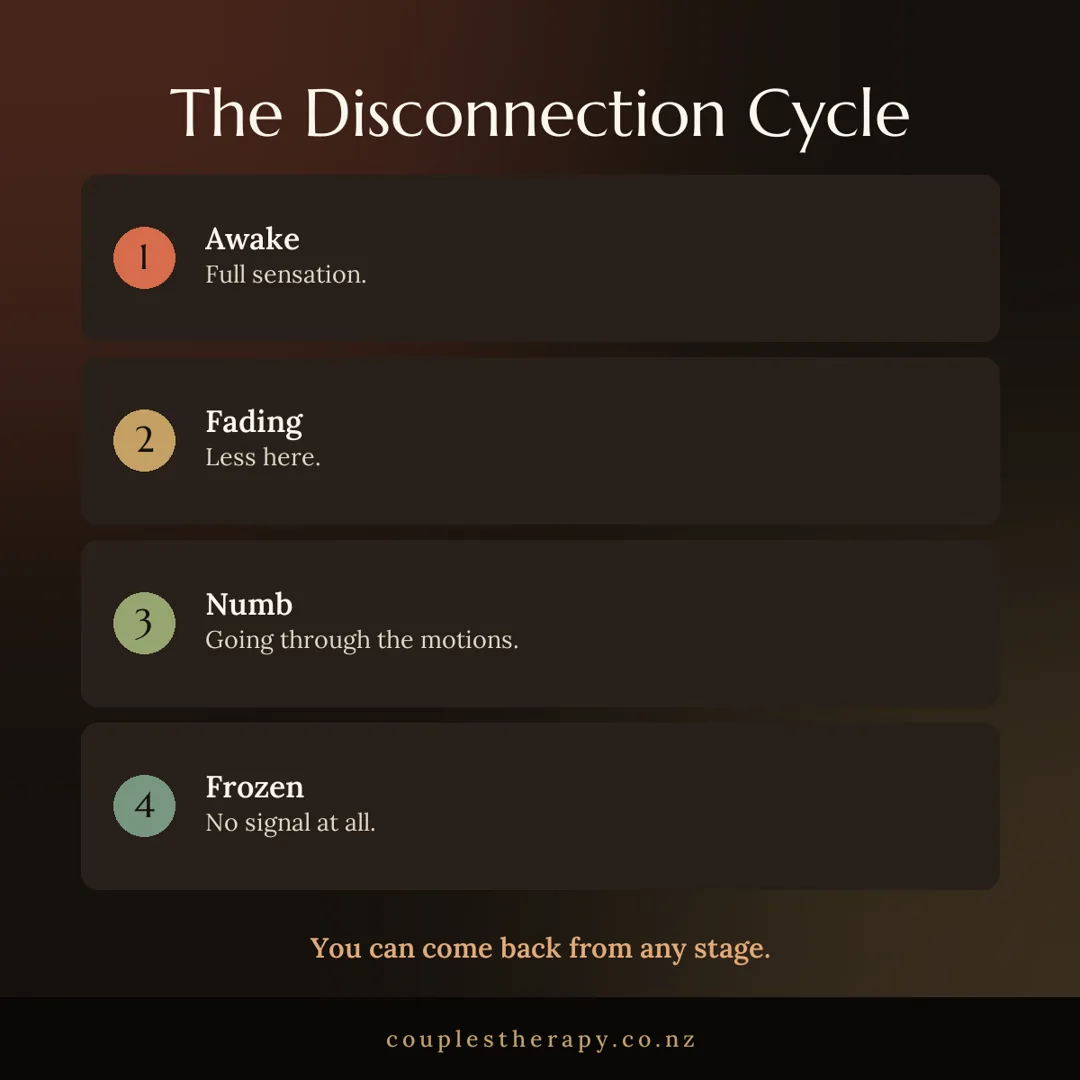
When these dry up, couples often become extraordinarily efficient co-managers.
The household runs, the kids are cared for and the bills get paid. Yet the relationship feels like a well organised office with a shared duvet.
Romance can last for decades.
It fades when the relationship becomes a place where neither of you asks for anything new or risks revealing anything.
How to increase intimacy in marriage by creating emotional safety
You can’t shame, pressure or negotiate someone into closeness. Intimacy grows where you both feel emotionally safe enough to be yourselves.
Conversations can still be uncomfortable in a safe relationship.
What’s important is that neither of you routinely meets the other’s vulnerability with contempt, criticism, defensiveness or withdrawal.
The familiar cycle often looks like this.
One partner reaches out with frustration and says, “You never want to talk,” while the other retreats, goes blank or gets busy.
Under the criticism there may be something much softer: “I miss you. I don’t know how to get close without being rejected.” Under the withdrawal there may be, “I feel like I fail you, so I shut down before you can prove it.”
Does this sound familiar?
Try naming the dance together, so you stop blaming each other for it.
You might say, “We’re doing that thing again where I pursue harder and you disappear. I don’t want to fight you. I want to find you.”
It can feel awkward at first, and that’s fine.
Awkward usually means you’re doing something new.
Talk about what’s underneath the argument
Choose a moment when neither of you is hungry, exhausted or halfway out the door.
Then speak from your inner experience, and leave out the case for why your partner is wrong.
So “You don’t care about me” becomes “When we go days without connecting, I start telling myself I’m not important to you. I miss feeling close.”
The partner who’s listening has a demanding job too. Don’t rush to defend, solve or come back with a complaint of your own.
Reflect what you heard first: “You’ve been feeling unimportant and lonely. I can see why that would hurt.”
Feeling understood doesn’t resolve every issue, but it changes the mood between you.
When you feel heard, your body can relax, and a relaxed body is much more open to connection, play and desire.
Bring curiosity back to the person you think you know
Familiarity creates a strange illusion.
You assume you know your partner because you know their coffee order, their work stories and the exact face they make when the WiFi drops out.
But people change, and so does desire.
Grief, ageing, parenthood, career pressure, health and confidence all reshape what’s going on inside a person.
Ask questions that can’t be answered with “fine” or “nothing”.
Ask what’s been taking up emotional space lately, and what they miss about themselves. Ask when they feel most alive, most desired or most at ease in their body.
Then listen without judging their answer or taking it personally.
You may discover that your partner is carrying a private shame about their changing body, resentment about invisible labour, grief they haven’t named, or a desire they’re afraid will be judged.
None of these are minor details, because this is what your marriage is made of right now.
Curiosity also means letting your partner surprise you.
The person across from you may not be who they were at 32, and thank goodness for that. A relationship goes stale when you insist on relating to an old version of each other.
Make room for erotic honesty without sexual pressure
A gap in desire is one of the most painful sources of distance for long term couples, and one of the most misunderstood.
The partner with higher desire can feel rejected again and again.
The partner with lower desire can feel watched or obligated, and emotionally unsafe whenever affection seems to come with an expectation of sex.
Pressure kills erotic charge, and so does avoidance.
What helps is an honest conversation where nobody is expected to follow it up with sex straight away.
Set aside time to talk about sex when you’re not trying to initiate it. Speak plainly about what helps you feel open to intimacy and what shuts you down.
For one of you, the brakes might be stress, an unequal load at home or unresolved anger. For the other, going without touch may create a deep ache.
Neither experience is wrong, and both need room.
Then widen your definition of sexual connection. These can all rebuild trust around sex:
- Slow kissing
- A shower together
- A massage
- Lying skin to skin
- Sharing a fantasy
- Ten minutes of undistracted touch
There’s no particular outcome to aim for.
You’re letting your bodies learn that closeness can be pleasurable and mutual, with no demand attached.
If sex is painful, if trauma is being activated, or if resentment has set in deeply, don’t try to force your way through it with a weekend away and a bottle of wine.
Skilled sex therapy can give you the structure and care that a couple often can’t create alone.
Change the conditions that flatten desire
Desire rarely thrives in a relationship that runs on repetition and resentment, with responsibility that never lets up. You don’t need to abandon your life to reconnect, but you do need to interrupt the conditions that make you feel like colleagues.
Start with the unsexy, practical part, which is unfairness.
If one of you carries the mental load of family life while the other waits to be told what to do, attraction can sour fast.
A shared plan for meals, children, money and the house isn’t romantic in itself.
It does create the breathing room in which romance has a chance.
Then create novelty on purpose.
You don’t have to book a luxury escape every month. Take a different track on your morning walk, or learn something physical together.
Go camping, climb, dance or swim at dawn.
Leave the phones in the car and have a slightly ridiculous afternoon. A shared challenge can wake up parts of you that domestic routine puts to sleep.
Adventure works because you get to see each other in motion.
You remember that your partner is more than the person who loads the dishwasher incorrectly. They’re a living, changing human being with courage, humour and an edge.
Practise small moments of physical connection
You and I can talk about communication for hours, but words alone don’t build intimacy.
We feel it in our bodies.
A distracted peck while you check your phone sends a different message from a thirty second embrace where you’re both fully there.
Create simple rituals that are realistic enough to keep.
- Greet each other with a full hug at the end of the day.
- Sit facing one another for five minutes without devices, or hold hands on a walk.
- Before sleep, ask one question: “What do you need from me tomorrow?”
These practices can sound almost too simple, until you notice how rarely you give each other your undivided attention.
Being present doesn’t take a grand gesture.
You do it over and over in small ways, saying with your attention and your body, “I’m here. I choose you. I’m still interested.”
Let support become part of the adventure
Some couples can shift their patterns through consistent effort at home.
Others need a guided space, because every meaningful conversation turns into the same fight by minute seven.
If that’s you, you haven’t failed.
It simply tells you what kind of help you need.
Therapy that combines Emotionally Focused Therapy (EFT) with sex therapy, body based work and shared adventure can help in ways that talking alone can’t.
You don’t need to settle for a marriage that’s polite, functional and starved of touch.
In sessions I work towards what’s possible: the honest conversation, the repair after a fight, the return of laughter, the first kiss that feels like a kiss again.
I see your relationship as an adventure that keeps evolving.
It can become richer and wilder than the love you had at the beginning, and more deeply secure.
Want support with this in your own relationship? Find out about couples therapy with Tarisha, a private retreat for two, or our retreats for couples: the Valentine’s Retreat and The Wanaka Adventure. Or start with a free discovery call.