It hurts to feel unwanted.
You can share a home, a history, even a bed.
You can still feel invisible in the place where you most want to be wanted.
If you’re wondering how to feel desired again, what you’re feeling is usually grief. You’re grieving the version of your relationship that once had passion and mischief in it, and the part of you that felt chosen and pulled close on purpose.
And no, the answer isn’t to fake confidence, buy better lingerie, or wait for your partner to suddenly notice you over the grocery list and the school calendar.
You haven’t failed. Desire in long term love fades when the relationship becomes efficient and you both stop living in your bodies.
Two good people can become brilliant co-managers and forget how to be lovers.
Why desire disappears in good relationships
Most couples assume lost desire is a sexual problem. Often the problem is in the relationship itself.
Desire needs certain conditions.
It wants emotional safety, yes, but safety alone can become dull.
Desire also needs some mystery and excitement, and the sense that you’re still two separate people who are drawn to each other.
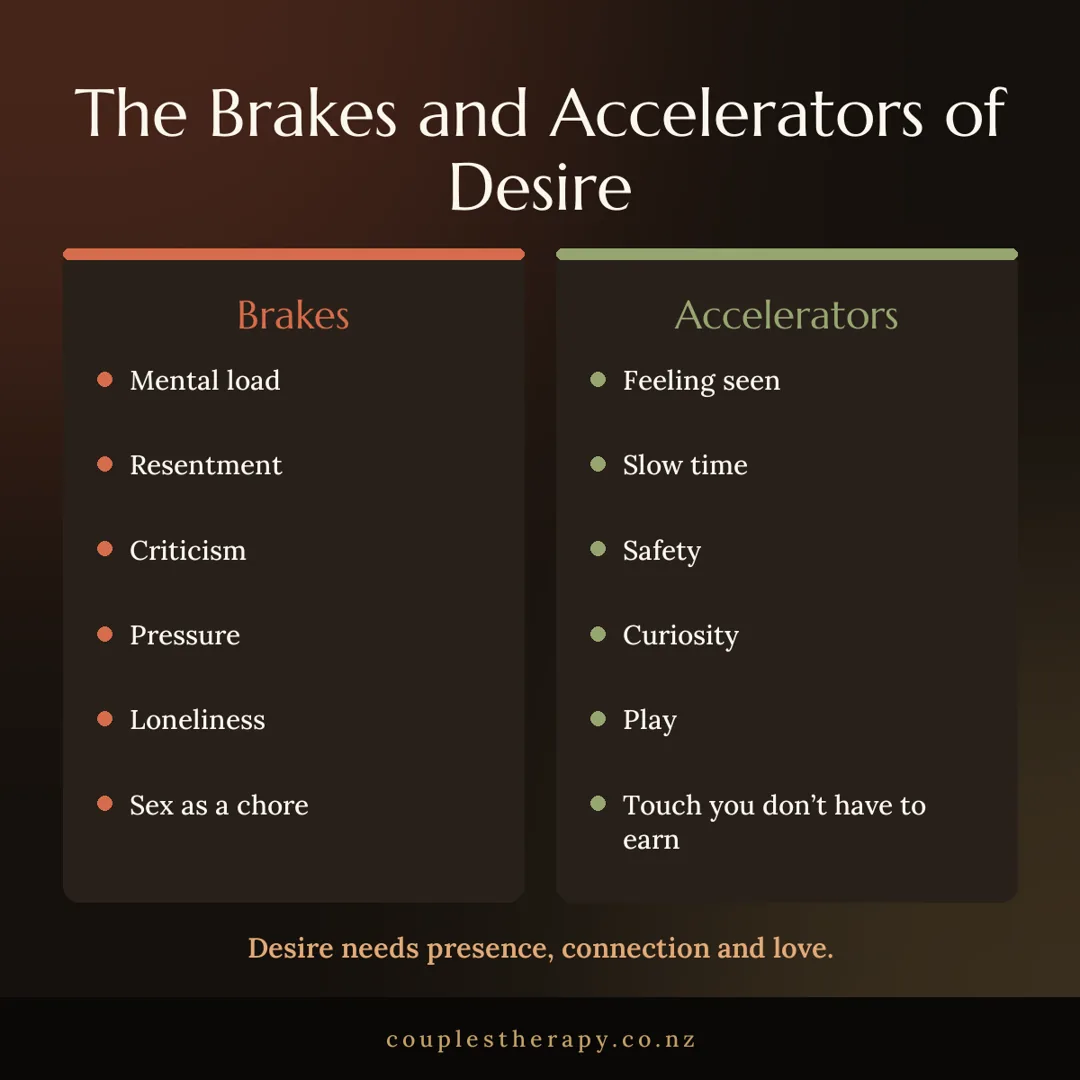
Resentment kills desire. So does routine, and so does a lack of safety.
Yes, we need both variety and safety.
When every touch feels like pressure for sex, your body tenses up. When one of you feels criticised and the other feels rejected, your bodies learn to protect themselves and stop opening.
Then there’s familiarity.
Familiarity is beautiful for attachment.
It’s less helpful for eroticism when it turns into overexposure and predictability, with no space left for anticipation.
You stop seeing each other as lovers.
You start seeing the project manager, the dishwasher, the problem solver, or a difficult flatmate with shared assets.
Your relationship can still be sound when this happens. It needs more than looking after the household, though.
It needs passion and play again.
How to feel desired again starts with feeling your own body
Many people don’t expect this part.
If you want to feel desired again, begin by asking whether you can feel yourself.
I mean you, underneath your role and your competence and the polished adult who gets things done.
Many people in long term relationships become so functional that they go numb from the neck down. They’re tired, overextended, touched out, hormonally shifted and stressed, and they’re carrying years of hurt from the relationship.
Then they ask their body to leap into desire on cue.
That’s a bit like asking a campfire to roar after you’ve poured water on it for five years.
Feeling desired is partly about how your partner sees you.
It’s also about whether you’re living in your own body. Can you feel pleasure in your skin? Can you receive a compliment without batting it away?
Can you let yourself be seen without instantly correcting, apologising or putting on an act?
What helps is feeling more alive in your own body, and that has nothing to do with looking more conventionally attractive. Desire comes more easily when you’re present in your body, and it’s hard to feel when you’ve stopped paying attention to yourself.
How emotional disconnection kills desire
If you feel hurt and distant from each other, no amount of technique in bed will fix it.
Many couples have the same fight over and over, about different things.
One partner reaches and the other withdraws. One protests or gets louder, and the other shuts down or goes cold.
Over time, you both feel unwanted, and you’re both usually protecting a more vulnerable truth: I miss you. I don’t know how to get back to you without getting hurt.
That pattern is very hard on your sex life.
Your nervous system won’t relax into desire when it expects criticism, defensiveness or emotional loneliness.
This takes courage.
Date night won’t be enough, and neither will trying harder in bed. You need to repair the hurt between you.
That means naming the hurt underneath the pattern and owning the ways you’ve both contributed to the distance.
It means learning how to reach for each other openly, without protecting yourselves.
Desire grows in relationships where you each feel chosen and wanted. It struggles when you feel managed, evaluated or merely tolerated.
How to feel desired again when your partner still loves you but the spark is gone
Love and desire aren’t the same thing.
Your partner can adore you and still have no idea how to express erotic energy anymore.
They can feel devotion and still be trapped in stress, shutdown, shame, anxiety about ageing, body image struggles, or old sexual scripts that don’t fit the relationship you have now.
Long term attraction needs to evolve. What worked at 32 may do absolutely nothing at 52. Bodies change, turn ons change, and the pace changes.
Sometimes what used to turn you both on stops working, and couples mistake that for incompatibility.
Usually it means you need to find out what works for you both now.
That might involve slower touch, clearer communication, more polarity and more play. It might mean less focus on a goal and more honesty about what you actually want.
It might also involve grieving the fantasy that desire should stay effortless if the relationship is right.
Honestly, I think that fantasy has done more damage than most affairs.
The strongest couples create the conditions where chemistry can come back, and they don’t sit waiting for it to return by magic.
Three shifts that bring desire back to life
1. Stop asking for reassurance and start creating excitement
When you feel undesired, it’s natural to fish for proof.
- Do I still look good to you?
- Are you attracted to me?
- Why don’t you initiate?
The problem is that reassurance can soothe you for a moment without bringing back the desire between you.
Excitement comes from giving each other your full attention.
It comes from:
- Eye contact that lingers
- Honest expression
- Playful tension and novelty
It comes from a sense that your partner is with you, and isn’t half reading emails while saying, “Sorry, what was that?”
If every interaction is logistical, don’t be surprised when the relationship feels like running a household together and nothing more.
2. Tell the truth about what hurts
Polite distance kills desire faster than almost anything.
If you feel rejected, say so without attacking. If you feel pressure around sex, say that too.
If you miss being pursued, wanted, ravished or adored, use those actual words.
Mature intimacy can handle adult language.
Your tone is important. Speak from your own experience, without blaming.
“I miss feeling wanted by you” lands very differently from “You never make me feel attractive anymore.” The first brings your partner closer. The second makes them defend themselves.
3. Bring your erotic self back into the relationship
Your erotic self is a different thing from how well you do in bed.
It’s the part of you that can feel, want, play, receive, tease, soften and choose.
For some people, it’s been buried under responsibility. For others, it’s been flattened by stress and self doubt. For many, there has simply been no room for it.
Reconnection can begin in small ways.
- Wear something because it makes you feel alive, and stop choosing clothes because they hide you.
- Put music on while you’re cooking and let your hips remember they exist.
- Kiss for longer than the standard peck.
- Touch without making it a negotiation.
- Create moments that belong to you as lovers as well as life partners.
No, this won’t solve deeper wounds on its own. But it does signal that the erotic relationship is still worth courting.
When feeling undesired is really about old pain
Sometimes feeling undesired now brings up a much older hurt.
Maybe you felt overlooked as a child, or you were replaced in a past relationship. Maybe you were desired for what you did and never for who you were.
Then your partner forgets to reach for you, and suddenly the pain is much larger than the moment.
Your feelings are still valid. They may be stronger because of what happened to you before.
If that’s true for you, be kind and honest with yourself.
Your partner can help soothe the disconnection you feel now, but they can’t single handedly heal every old injury.
That’s where deeper relational work can be life changing.
Needing this doesn’t mean you’re broken.
Our bodies remember what has happened to us, and we feel desire in our bodies.
This is also why quick fixes often fall flat. A weekend away helps, until the same pattern returns on Tuesday night near the dishwasher.
Make your relationship a place where desire can grow
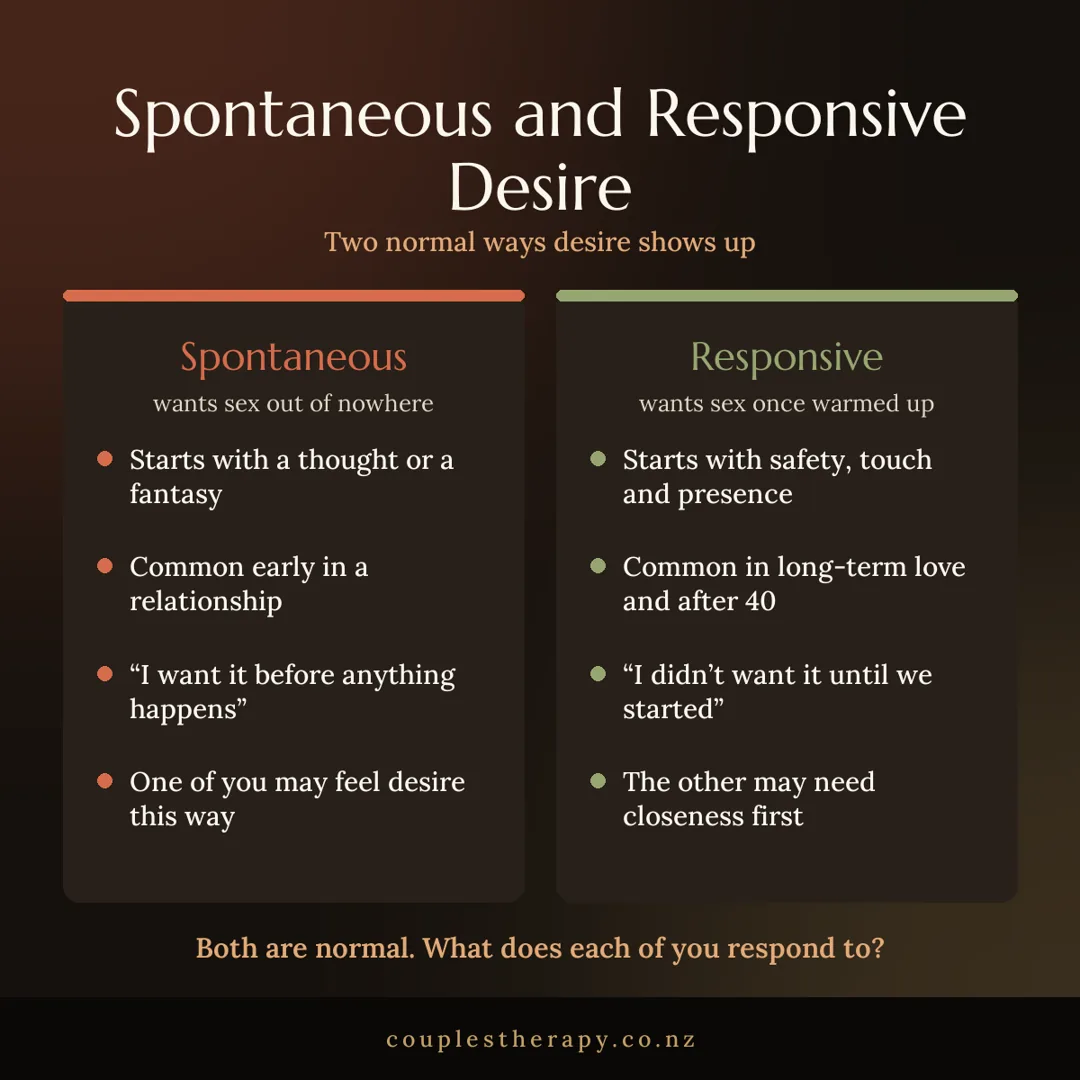
You can’t demand desire.
It comes as a response.
It responds to feeling safe and still excited by each other.
It responds to tenderness and playfulness, and to feeling seen as a whole person who is emotional, sexual, messy and changing.
For some couples, that means rebuilding trust after years of small disconnections.
For others, it means learning a new erotic language entirely.
For many, it means dropping the stale script that says sex should just happen if you love each other enough.
At Couples Therapy & Retreats, this is what I work on with couples.
I help them move from flat companionship back into emotionally secure, erotically alive partnership.
I do that by helping you both feel safe and close enough for desire to come back. It can’t be forced.
If you want to know how to feel desired again, don’t start by trying to be more appealing.
Ask what has gone unsaid between you, and where touch and play have stopped.
Start by telling the truth and coming back into your body.
Treat desire as something you build together.
The deepest love is still ahead of you, and you build it by paying attention to each other now.
Want support with this in your own relationship? Find out about couples therapy with Tarisha, a private retreat for two, or our retreats for couples: the Valentine’s Retreat and The Wanaka Adventure. Or start with a free discovery call.