
Loving couples can still feel far apart.
Why do two people who love each other end up feeling miles apart, in bed and in their hearts?
That’s exactly why Emotionally Focused Therapy (EFT) by Sue Johnson is so important for long term couples. It treats relationship pain as an attachment wound, and it goes much deeper than fixing a communication glitch.
It happens between two people who still want each other and can’t seem to reach each other.
For couples in midlife there are layers of pain.
By this stage, you probably know perfectly well how to use “I feel” statements.
What hurts is that one of you reaches and gets nothing back, or the other feels criticised and shuts down, and before long you’re in the same stale loop.
You stop being lovers and become managers of logistics. The relationship still functions, and it no longer feels alive.
What Sue Johnson’s Emotionally Focused Therapy (EFT) is
Sue Johnson developed Emotionally Focused Therapy (EFT) as a structured, evidence based model for couples.
The core idea is simple: the bond between adult partners is an attachment bond, like the one between a child and a parent.
When that bond feels threatened, we protest, pursue, withdraw, numb out, attack, defend, or disappear behind being competent.
EFT helps you understand those reactions without shaming them.
Beneath the sharp words, the cold distance or the exhausted silence, there’s usually something more vulnerable.
- Are you here for me?
- Do I matter to you?
- Can I trust you when it counts?
That’s what makes Johnson’s work so useful.
She took attachment theory out of the universities and applied it to how couples treat each other every day.
With EFT you stop arguing about who started it, and you learn to see the cycle as the enemy.
Your partner stops being the enemy, and so do you.
For many couples, that shift alone changes the mood in the room.
The fight about sex, money, in laws or whose turn it was to empty the dishwasher turns out to be about more than its content.
It was a moment where the bond felt shaky, and you both reacted in ways that made the disconnection worse.
Does this sound familiar?
Why Sue Johnson’s Emotionally Focused Therapy (EFT) changed couples therapy
Before Emotionally Focused Therapy became widely respected, a lot of couples work leaned heavily on negotiation, behaviour management or surface communication skills. Those approaches can help.
They often don’t go deep enough when trust has frayed or desire has gone flat.
Johnson’s contribution was to say, very clearly, that emotional responsiveness is the foundation, and couples can’t treat it as a luxury.
Couples heal when each partner risks showing the softer feeling underneath their defences and gets a different response. Better debating skills don’t get you there.
That may sound sentimental.
In the room it’s clinical and practical, and it’s often confronting.
If one partner has spent fifteen years looking angry, EFT may uncover grief, fear, rejection or longing underneath. If the other has looked detached, EFT may uncover shame, helplessness or the terror of failing yet again.
Once those deeper emotions are named and met, the whole dance can change.
And yes, it can feel exposing, as good therapy often does.
I still think it’s far more useful than spending another decade having the same argument about different topics.
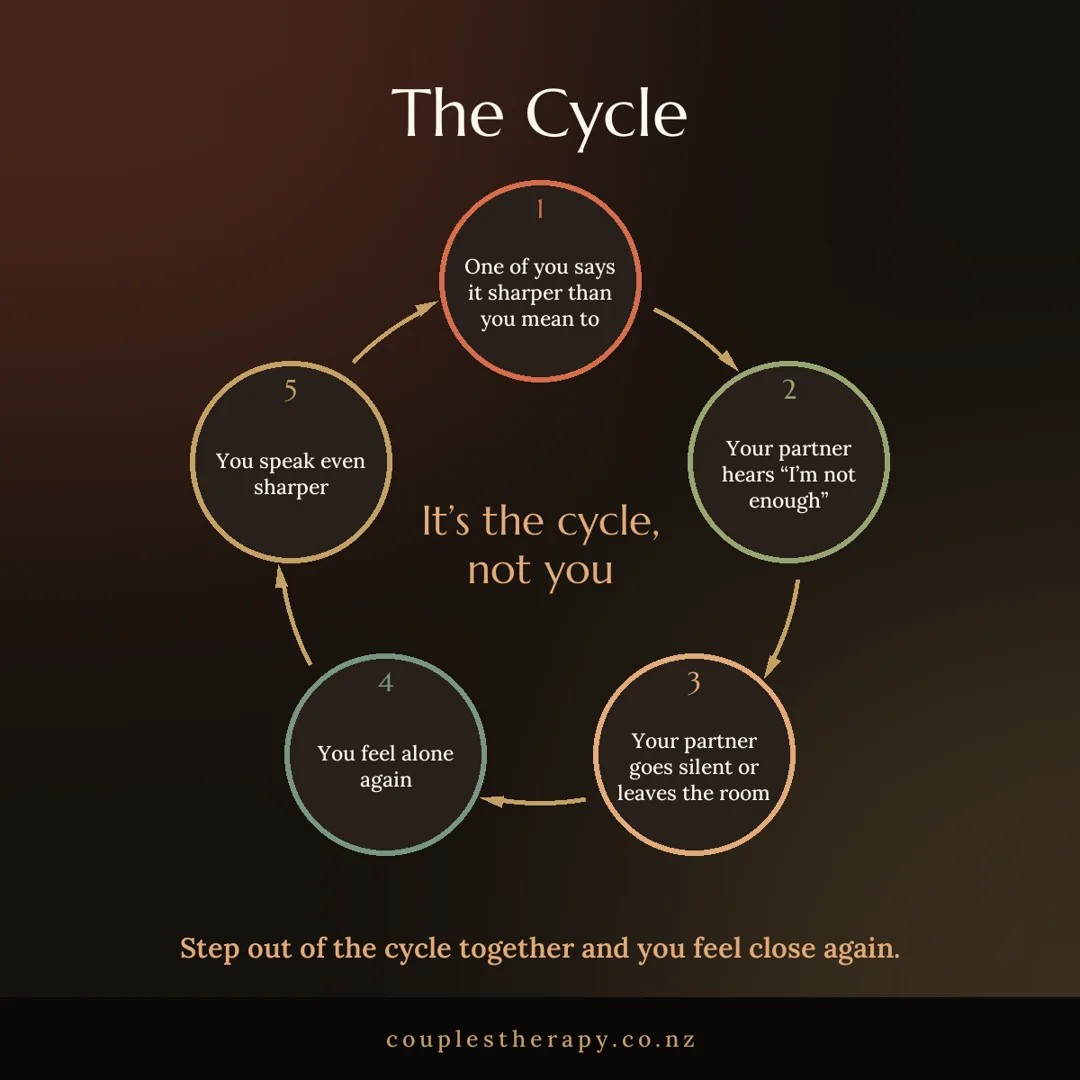
The Emotionally Focused Therapy (EFT) cycle most couples get trapped in
Long term couples usually recognise themselves quickly when Emotionally Focused Therapy is explained well.
One partner reaches, protests, nags, pushes, interrogates or escalates. The other retreats, goes blank, gets defensive, intellectualises or leaves the room.
You’ll hear it described as pursue and withdraw, criticise and defend, or demand and disappear.
Neither position feels good.
The pursuer feels abandoned and more and more desperate. The withdrawer feels hunted and more and more inadequate.
Both feel alone.
This is where Emotionally Focused Therapy (EFT) by Sue Johnson is so powerful.
It treats these moves as protective strategies, so neither of you has to carry them as a character defect.
The one who protests is often saying, in a very unsexy way, “Please don’t leave me emotionally.” The one who withdraws is often saying, “I don’t know how to survive this without shutting down.”
Once you can see the pattern clearly and with compassion, you stop wasting energy on trying to win.
You give up on proving who’s right, and you put your effort into making it safe enough for a new conversation to happen.
What happens in an Emotionally Focused Therapy (EFT) session
A skilled EFT therapist tracks emotion moment by moment.
They slow the fight down, identify the cycle, and help each of you get in touch with what’s happening underneath your reaction.
Then comes the harder and more beautiful work, which is sharing that softer feeling in a way your partner can actually hear.
In place of “You never care about us,” that might sound like, “When you turn away from me, I go into protest because I feel unimportant and scared I’ve already lost you.”
In place of stony silence, it might sound like, “When you come at me hard, I shut down because I already feel like I’m failing and I can’t bear more proof.”
You can still swear in the kitchen, and you don’t need to become soft spoken angels.
You’re learning to be emotionally honest with each other, and that changes your bond.
The most healing moments in EFT are often surprisingly direct, even raw. One partner says what they’ve hidden for years, and the other finally responds without defending.
Can Emotionally Focused Therapy (EFT) help with sex and desire?
Yes, although it doesn’t always happen in the simple way people hope.
EFT is exceptional at rebuilding emotional safety, trust and secure connection. For many couples, that changes the erotic feeling between them straight away.
When resentment softens and closeness returns, there’s more room for desire.
Bodies that were tense start to relax, and touch stops feeling loaded or obligatory.
Emotional repair and erotic renewal are still two different things. It depends on the couple, the history, and what else is affecting your sex life.
Some couples need Emotionally Focused Therapy plus direct sex therapy, embodiment work, or a deeper exploration of polarity and desire.
If sex has become overly polite, duty driven or shut down by years of hurt, attachment repair is essential.
Sometimes it isn’t enough on its own.
That’s when it helps to combine approaches.
I want more for a couple than an end to the fighting. I want you to feel each other again, and to find your way back to affection, play, hunger and tenderness.
What Emotionally Focused Therapy (EFT) does well, and where it has limits
No therapy model is magic, and I’d be wary of anyone who says theirs is.
EFT does extremely well with conflict cycles, emotional disconnection and, in many cases, betrayal recovery. It helps couples build a more secure bond, and it offers a map when everything has felt chaotic.
For couples who still care but can’t stop hurting each other, that map can be life changing.
Its limits show up when there’s more going on than attachment distress.
There might be active addiction, coercive control, ongoing deception, or untreated trauma that takes over the sessions. One partner might have already checked out and won’t engage.
In those situations, EFT may need support from other modalities, or a different structure altogether.
The same is true if the relationship has become emotionally safer but is still erotically flat.
You can become terrific housemates with improved communication and still not want to rip each other’s clothes off. When that happens, Emotionally Focused Therapy has done its part and the work has further to go.
For many established couples, the transformation comes from combining secure attachment with embodied intimacy work.
Emotional safety is the foundation.
Feeling desire for each other again asks for more from you.
It asks you to be present and honest, to take risks and play, and to be willing to meet each other beyond routine.
Is Sue Johnson’s Emotionally Focused Therapy (EFT) right for your relationship?
EFT is worth serious attention if the two of you keep having the same painful argument, or if one of you feels too much and the other feels too little.
It’s also worth it if affection has become cautious, or if sex feels heavy or absent.
It’s especially useful when the love is still alive but buried under defence.
That’s a very different situation from indifference.
Couples often arrive convinced they have a communication problem, when what they actually have is an attachment injury that keeps reopening.
I’d set aside the question, “Are we broken?”
A more useful one is, “What happens between us when we most need each other, and can that be changed?”
In many cases, yes.
Sue Johnson’s work endures because it honours something adults often forget once the years pile on.
We may become more accomplished, more self contained and more successful on the outside. In love, we still ache for closeness and reassurance, and for connection we can feel.
We still want to know that our partner will be there when we need them.
If that has gone missing, don’t settle for a relationship that merely runs well.
Your deepest love is still ahead of you when you’re willing to face the cycle, tell the truth underneath it, and build a bond that has room for both tenderness and passion.
Want support with this in your own relationship? Find out about couples therapy with Tarisha, a private retreat for two, or our retreats for couples: the Valentine’s Retreat and The Wanaka Adventure. Or start with a free discovery call.