
The dishwasher is still full.
Someone has asked a perfectly reasonable question about dinner.
Then, without warning, your chest tightens, your jaw locks, and you can hardly bear the sound of your partner’s voice. Relationship flooding triggers can make an ordinary moment feel like an attack.
If this happens to you, you’re not too sensitive or too dramatic, and you’re perfectly capable of an adult conversation.
Flooding is a nervous system response.
Your body has decided, often before your rational mind catches up, that connection is under threat.
You might attack or defend. You might shut down, go blank, become relentlessly logical, or suddenly need to leave the room.
For long term couples, flooding can be especially confusing. You love this person.
You’ve built a life together, raised children, paid the bills and survived hard seasons, and maybe you still share a bed.
So why can one sigh or one badly timed comment make you feel as if the whole relationship is on fire?
Why relationship flooding triggers run so deep
Flooding is rarely about the surface topic.
The argument might begin with money, sex, the in laws, drinking, parenting, or who’s meant to be organising the weekend.
Underneath the anger there’s usually a more basic question: Am I safe with you? Do I matter to you? Will you come towards me, or leave me alone with this?
Hurts build up over a long relationship.
When your partner is late, it might touch a decade of feeling like you come second.
A request for more sex might collide with years of pressure, rejection or shame, or with the fear that you’re only desired when you put on a show.
Your own history plays a part too.
If criticism once meant humiliation, your partner’s frustrated tone can feel enormous. If love was unpredictable, distance can set off an internal alarm.
Your partner can still have a part in it, and plenty of your reactions belong to the present day.
Your body is responding to a blend of old learning and what’s happening right now.
When a couple tells me about a fight, I ask what happened in each person’s body, because that tells me more than who had the better argument.
A couple can’t feel close while one of them is expecting to be attacked and the other is overwhelmed.
Signs you’re flooded, not simply frustrated
When you’re frustrated, you can still be curious. When you’re flooded, the curiosity goes.
You can’t take in nuance or hear affection, and the person across from you starts to look like an opponent when they’re actually your partner.
You might notice:
- A pounding heart
- Heat in your face
- Shallow breathing
- Nausea or trembling
- Tunnel vision
- Tears that appear out of nowhere
- A powerful urge to escape
Some people become loud and sharp. Others go cold, silent and unreachable.
Both are forms of protection.
There’s often a mental shift as well.
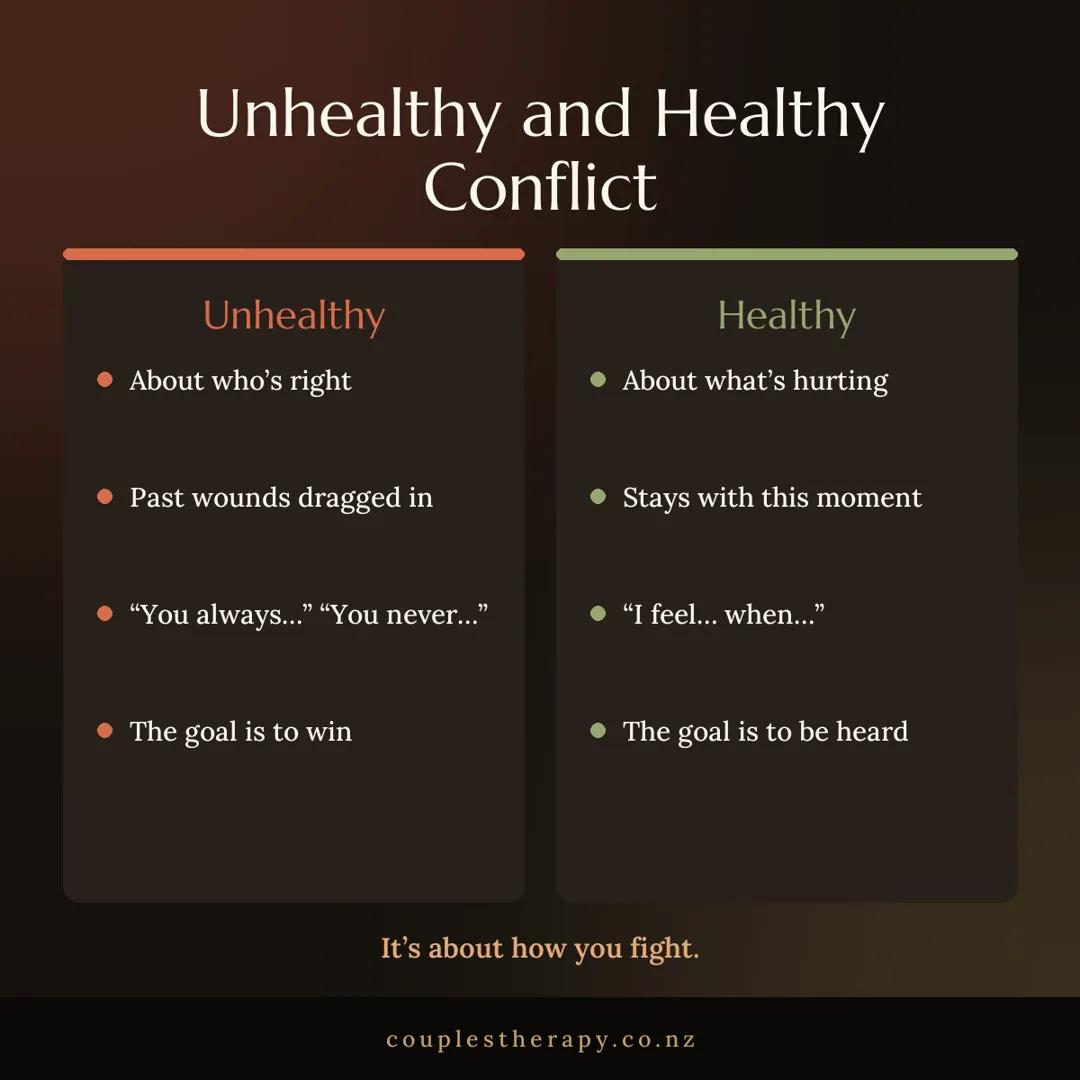
You start thinking in absolutes: You always do this. You never care. What’s the point? You start building a case against your partner and stop looking for connection.
Humour disappears and touch feels unbearable. Even a kind gesture can seem manipulative, or too little, too late.
Try not to shame the response.
What helps is noticing it early.
The sooner you can name flooding, the less likely you’ll be to say something that hurts your partner and that you can’t take back.
Common relationship flooding triggers
Feeling criticised, corrected, or judged
A complaint can sound like a judgement of your whole character very fast. “Can you put your mobile away?” might land as “You’re selfish and absent.”
This hits hardest for partners who already carry shame or feel they can never get it right.
You still need to raise issues.
What changes things is leading with how it affects you, the vulnerable part, before any attack comes out. “I miss you when we’re together but not really connected” feels very different from “You’re always on that bloody mobile.”
Feeling dismissed or emotionally abandoned
For many people, a shrug, a distracted answer, a partner walking away or hearing “You’re overreacting” creates an instant surge of panic or rage.
Do you recognise that one?
The reaction is often a protest against disconnection.
Beneath the fury there’s a plea: Please don’t leave me alone in this.
Pursue withdraw cycles
One partner presses for a conversation because distance feels unbearable. The other retreats because intensity feels unbearable. The more one pursues, the more the other withdraws.
Soon you’re both flooded and neither of you feels understood.
I don’t see either role as the villain.
The pursuer is often trying to restore closeness, and the withdrawer is often trying to stop things escalating. The problem is the cycle the two of you get caught in.
Sexual rejection, pressure, or disconnection
Sex can set off some of the most tender flooding triggers in a long term partnership.
When you initiate and your partner says no, it can feel like personal rejection.
When your partner asks for intimacy, it can feel like pressure or obligation, or like another test you’re destined to fail.
Desire doesn’t thrive under threat.
It needs emotional safety, choice and playfulness, and room for each of you to say an honest yes or no.
You still need to have sexual conversations.
Have them when you’re both calm and feeling warm towards each other, and leave them for later when you’re both tense and ready to fight.
Feeling controlled or powerless
Being interrupted, monitored, lectured, cornered or told what you should feel can set off a strong urge to protect yourself.
Sometimes the trigger is about present behaviour that genuinely needs to change. Sometimes it’s amplified by older experiences of having very little say. Usually it’s some combination of both.
What to do when the flood arrives
In the first few minutes, your only goal is to stop causing further harm.
Solving the issue can wait.
Start by naming what’s happening without making your partner the enemy.
Try: “I want to stay in this with you, but I’m flooded. I need 30 minutes to settle, and I’ll come back at 7:30.”
A pause without a return time can feel like abandonment.
When you give a clear time to come back, your partner knows you still care.
Then regulate your body.
- Take a brisk walk.
- Splash cold water on your face.
- Breathe with a longer exhale.
- Stretch.
- Sit somewhere without rehearsing your next devastating point.
Don’t use the break to plan your next argument, text a friend to get them on your side, or scroll on your mobile until you feel worse.
Your job is to come back more available to your partner than when you left.
If you’re the less flooded partner, resist chasing.
Say something simple: “Okay. I’m here, and I expect us to come back to this.”
That sentence helps, because it tells your partner you’re steady and that you both need to come back to the conversation.
If either of you feels frightened, threatened, or unable to prevent escalation, prioritise physical safety and seek professional support. A relationship should never require you to endure intimidation, violence or coercion in the name of working things out.
Return to the conversation you need to have
Once you’ve both settled, talk about what’s underneath the complaint.
In Emotionally Focused Therapy (EFT), I look for the more vulnerable feeling under the defensive reaction. Anger might be protecting grief. Withdrawal might be protecting shame.
Criticism might be protecting a desperate longing to feel chosen.
Try this sequence: name the moment, name the feeling, name the meaning, then make a clear request.
“When you left the room while I was talking, I felt panicked and unimportant. I told myself you didn’t care. Next time, can you tell me you need a break and when you’ll be back?”
The listening partner doesn’t need to agree with every interpretation.
They do need to show they understand the emotional impact.
“I can see why it felt like I was leaving you. I was overwhelmed, and I wasn’t trying to punish you.”
That’s how repair begins.
There’s no magic phrase for repair.
Repair happens each time you find your way back to each other, especially after you’ve made a mess.
Over time, repeated repair teaches your nervous system that conflict doesn’t automatically mean disconnection.
Build a relationship that can handle conflict
You can’t eliminate every trigger, and I wouldn’t want you to aim for a conflict free partnership where neither of you says what you want.
The deeper goal is being able to stay connected when you differ, when you’re disappointed, and when desire and life keep changing.
Create regular moments where you speak before resentment builds up.
Let each of you share what has felt good, what has felt hard, and what you’re longing for emotionally and erotically.
Keep these conversations out of the bedroom when you can. Who wants a work appraisal while they’re trying to get naked?
Bring the body back into your relationship as well.
Holding hands during a difficult conversation, a slower breath, eye contact, movement, affectionate touch, or doing something physically challenging together can all shift the mood between you.
Adventure can’t replace repair, but doing something that makes you both feel alive can remind you that you’re more than co-managers of a household.
The deepest love is still ahead of you when you both learn that the conversation can carry on after the flood. When you get flooded, it’s a chance to find the vulnerable feeling underneath and share it with your partner.
Want support with this in your own relationship? Find out about couples therapy with Tarisha, a private retreat for two, or our retreats for couples: the Valentine’s Retreat and The Wanaka Adventure. Or start with a free discovery call.







One Comment
Comments are closed.