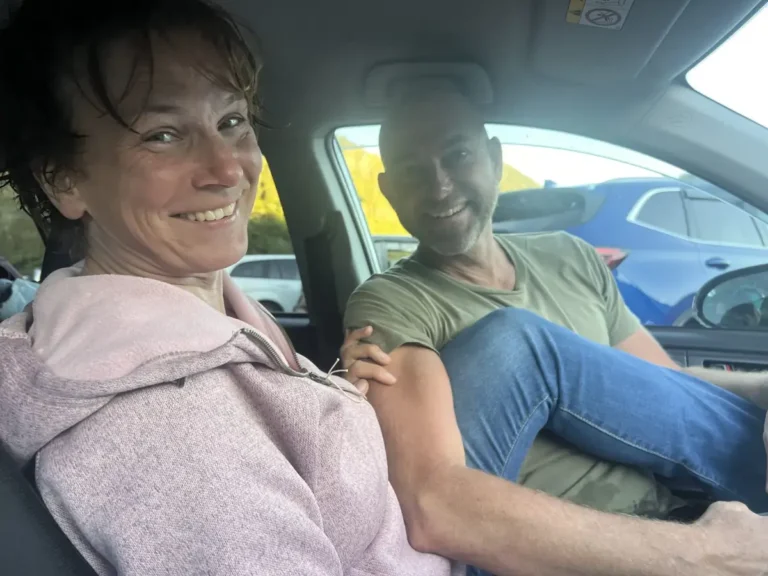
You’re lying beside the person you chose.
Your body feels a kilometre away. Perhaps one of you reaches for reassurance and the other goes blank.
Perhaps a small disagreement about money, the kids, or who should book the plumber turns into a familiar, ugly spiral. This guide to healing attachment wounds is for couples who are tired of treating these moments as proof that love has failed.
Attachment wounds are rarely created by one bad conversation.
They’re the tender places shaped by early experiences of closeness that came and went, of being left, criticised or betrayed, or of feeling emotionally alone.
When something in your adult relationship touches them, you feel the old pain again.
Your partner is late home, less affectionate, distracted during sex, or frustrated with you.
Your nervous system hears something much bigger: I don’t matter. I will be left. I’m too much. I can’t rely on anyone.
The good news is that attachment patterns can change.
Healing them does ask more of you than promising to communicate better over a glass of wine after the kids are in bed.
It asks you to understand the dance you’re caught in, to feel safer in your bodies, and to have new experiences of your partner being there when you need them.
What attachment wounds look like in long term love
In established relationships, attachment wounds often hide beneath very competent adult lives.
You may run a business, raise capable children and manage a mortgage, and still feel panicked when your partner needs space.
Or you may be calm and rational at work, then go ice cold when your partner wants to talk about feelings.
Usually, couples land in a pattern you’ll recognise.
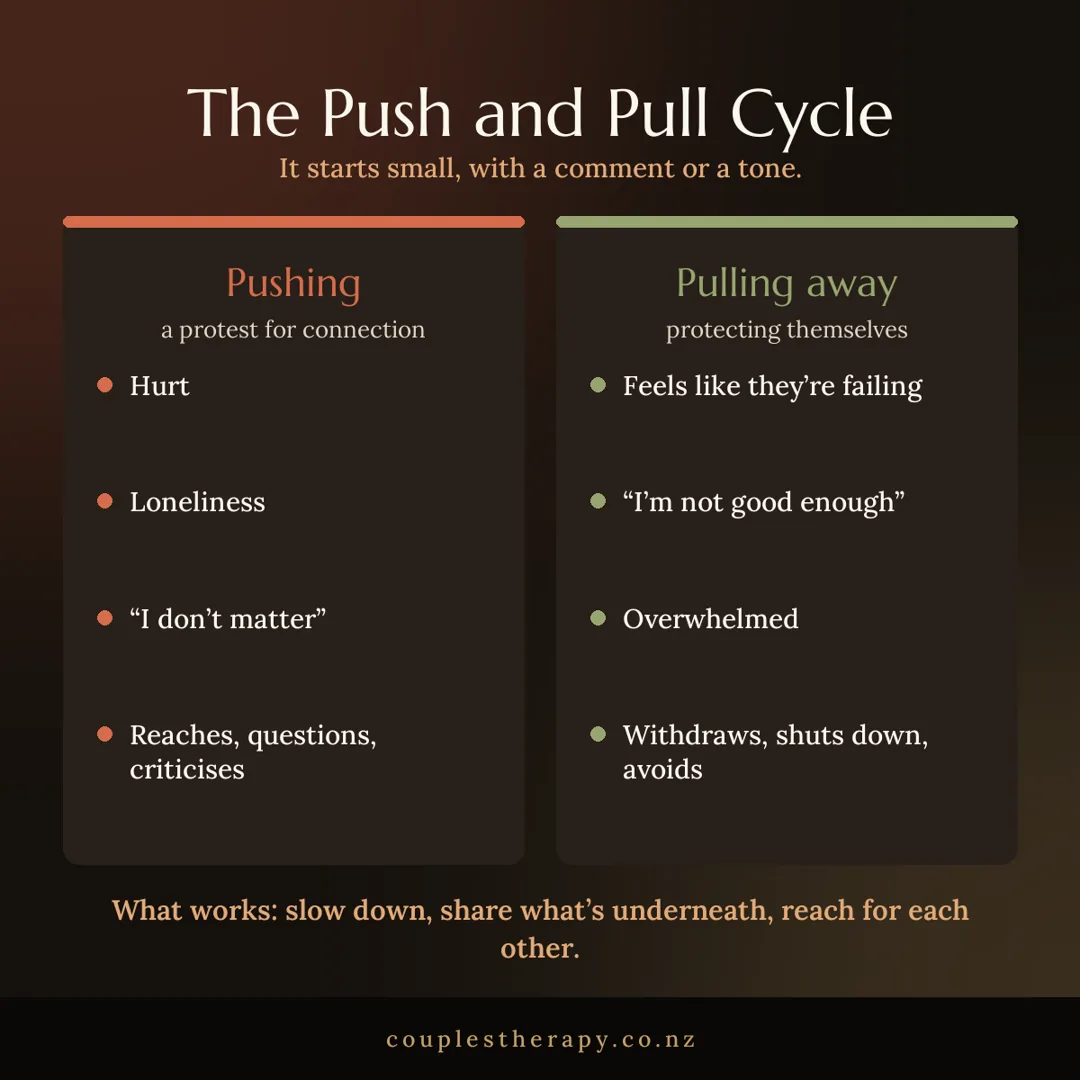
One partner pursues contact through questions, complaints, repeated requests, or anger. The other protects themselves by withdrawing, defending, getting practical, or shutting down.
Neither person is the villain.
Both are trying to feel less under threat, and both end up making it worse.
The pursuer may think, “If I don’t push, we’ll drift apart.” The withdrawer may think, “If I engage, I’ll fail, be blamed, or lose myself.”
Then it gets worse.
The more one of you reaches, the more the other retreats, and the more one retreats, the harder the other pushes. Your relationship starts to feel like a constant negotiation.
Does this sound familiar?
Attachment wounds can show up in your erotic life too.
To feel desire, we need to feel safe enough to relax and free enough to play.
If touch has become loaded with pressure, rejection, resentment, or worry about getting it right, sex can feel like one more area where somebody is failing.
Couples may stop initiating altogether, settle for dutiful intimacy, or have sex that works technically but doesn’t leave you feeling any closer.
A guide to healing attachment wounds begins with the pattern
The first task is to stop arguing about which of you is the problem.
Then look at the pattern you’re both caught in.
I’m not excusing harmful behaviour when I say that. Cruelty, coercion, chronic contempt, and breaches of trust need direct accountability.
Yet many couples spend years arguing about the surface issue while the deeper cycle carries on.
You fight about the text message, when what you’re struggling with is whether you can reach for each other without shame and without defending yourselves.
Start by naming your sequence as exactly as you can.
- What happens first?
- What does each of you do next?
- What are you feeling when you do that?
A typical cycle might sound like this: “When I sense you pulling away, I criticise because I feel unwanted. When you hear criticism, you shut down because you feel like a disappointment. Your shutdown makes me feel abandoned, so I come in harder.”
Talking this way changes the mood between you, because you’re describing what happens and nobody is being accused. You can be on the same side and look at the cycle together.
Make room for the feeling beneath the reaction
Healing attachment wounds means learning to show your vulnerable feelings before you start protecting yourself. You don’t have to agree with everything.
Anger often protects a more vulnerable feeling.
Numbness can do the same, and sarcasm often covers fear. When you can name the feeling underneath, you give your partner something they can respond to.
Instead of, “You never care what I need,” try: “When plans change and I don’t hear from you, I feel unimportant. I know I get sharp, but underneath I’m scared I’m not a priority to you.”
Instead of, “Stop nagging me,” try: “When I hear that you’re unhappy, I feel like I can’t get anything right. I want to stay with you, but my body wants to disappear.”
These sentences won’t work like magic.
If the two of you get very reactive with each other, they may feel awkward at first, or even dangerous.
That’s normal.
You’re asking your body to stay close when it’s used to protecting itself. Go slowly enough that neither of you gets flooded.
Regulate before you repair
A good conversation can’t happen when you’re both in survival mode. If voices rise, hearts pound, or one of you has gone blank, take a structured pause.
A pause is different from storming off, punishing, or leaving the other person to stew. It’s an agreement: “I’m overwhelmed. I’ll come back at 7:30, and I want to finish this with you.”
During that break, don’t build a better court case.
- Move your body
- Breathe low into your belly
- Walk around the block
- Splash cool water on your face
- Put a hand over your chest
You don’t have to decide you were wrong for having feelings.
The aim of the pause is to settle enough that you can stay connected while you have them.
Create new experiences together, as well as insight
Understanding your childhood is valuable.
It can also become a way to avoid changing what happens between you at home on a Tuesday night.
Healing happens through repeated moments in which your old prediction doesn’t come true.
If you learned that expressing a need leads to being dismissed, the new experience you need is asking clearly and getting a warm, reliable response.
If you learned that conflict means abandonment, it’s coming back after a rupture and finding your partner still there.
If you learned that closeness costs you your autonomy, it’s saying no without being punished or frozen out.
Being consistent does more here than grand declarations.
A heartfelt weekend away can give you hope.
But secure attachment is built in small everyday moments: a mobile put down when your partner begins to speak, a repair after a harsh tone, a hand on the thigh in the car, a genuine “tell me more”.
These moments teach your body that closeness can feel safe.
For couples rebuilding after betrayal, the pace is often slower.
The injured partner needs transparency, empathy, and room to grieve. The partner who broke trust needs to tolerate the discomfort of accountability without demanding quick forgiveness.
Both of you deserve skilled support, because this is complicated. Neither forgiveness nor safety can be rushed, so give yourselves time.
Bring attachment healing into the bedroom
Emotional safety and erotic charge are two different things.
A relationship can feel safe but overly familiar, with no spark. It can also feel intensely sexual but emotionally shaky.
We need both: to feel secure with each other and to feel alive with each other.
Begin by removing the unspoken pass or fail test around sex. Touch doesn’t always need to lead to intercourse. Desire doesn’t respond well to obligation, resentment, or being judged.
Make time for sensual contact where the agreement is to stay curious, with no outcome in mind.
You might spend twenty minutes touching, kissing, or simply holding one another while noticing what your body wants. Say what’s true for you right now: “Softer there.” “Stay close.” “I feel shy.” “I want more pressure.”
Being this honest about what your body wants can feel very intimate when you’ve spent years talking about logistics and never about desire.
Polarity deserves attention too.
Long term partners often become an efficient team at running a household, which is admirable and not very erotic.
Desire can return when each of you has space to feel alive, playful and strong in your own way.
There’s no one right gendered script.
What I’d ask is whether you still meet each other as living, surprising humans, or whether you’ve each settled into a fixed role.
When to get support
Some attachment wounds are too raw to heal through good intentions alone.
Look for skilled couples support if:
- Conflict escalates quickly
- One or both of you shut down for days
- Intimacy has disappeared
- A betrayal is still unresolved
- You’ve been having the same fight for years about different topics
Good therapy helps you slow the cycle down as it’s happening. Emotionally Focused Therapy (EFT) helps you understand the bond between you and make it more secure.
Sex therapy and body based work can help with desire, inhibition, shame, and touch.
Doing new things together, including challenge and adventure, can take you out of your familiar roles and remind you why you chose each other.
You won’t become a couple who never set each other off.
You’re human, and old fears will still come up now and then.
What you can learn is to recognise the fear when it comes, turn towards each other sooner, and stay close even when one of you is afraid.
The deepest love may still be ahead of you.
The past did hurt, and you can learn to heal it together.
Want support with this in your own relationship? Find out about couples therapy with Tarisha, a private retreat for two, or our retreats for couples: the Valentine’s Retreat and The Wanaka Adventure. Or start with a free discovery call.